Free practice test
Try 30 questions free
Work through 30 questions, then see your score, results by topic and an explanation for every answer. No account or email needed.
These are 30 of the 150 questions in the full PDF. You can also read the questions and answers below.
The full 150-question PDF
Includes the 30 free questions plus 120 additional questions, explanations and references. One payment, no subscription.
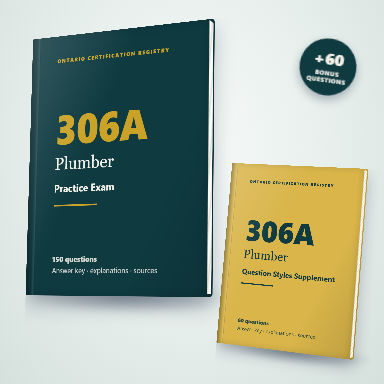
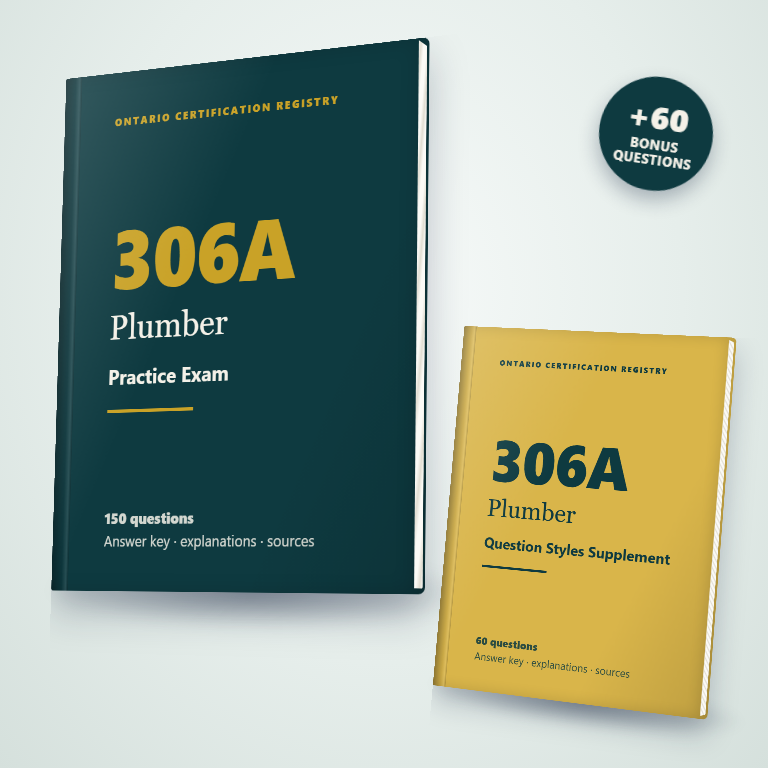
Also included at no extra cost: a second PDF, the Plumber (306A) Question Styles Supplement. It has 60 more original questions with answers and explanations, written in the same forms as Red Seal's own published sample questions for this trade. They are not real exam questions, and none repeats a question in the main PDF.
| Questions | 150, all original |
|---|---|
| Answer key | Correct answer, the reasoning, and a cited source for each question |
| Distinct references | 84 distinct citations across the bank |
| Free samples here | 30, with answers, below |
| Bonus supplement | 60 more original questions with answers, in a second PDF |
| Format | PDF, emailed on purchase, plus a download link valid 30 days |
| Price | $67.49 CAD, one payment, no subscription |
Payment is handled by Stripe. This is study material, not an official exam, and it is not affiliated with Skilled Trades Ontario, TSSA or the Red Seal program.
Look inside the PDF
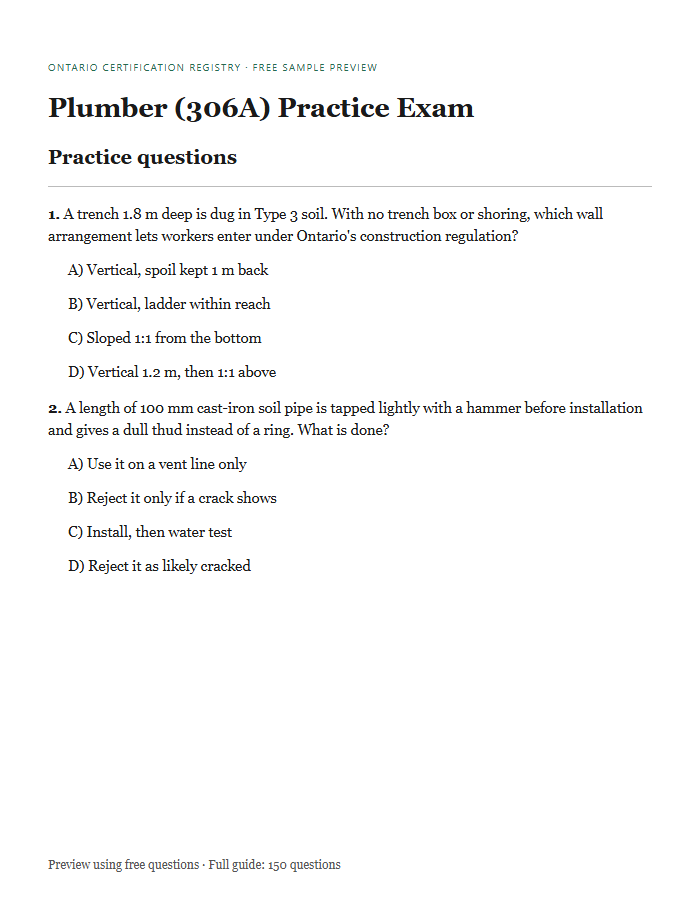
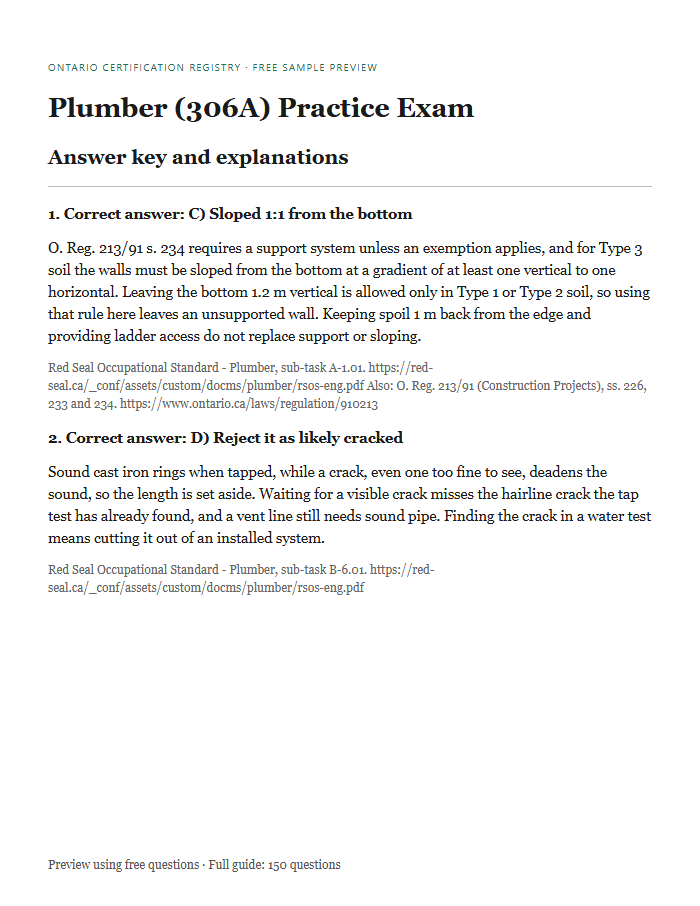
A preview of the question and answer-key layout, using questions from the free sample. The full guide contains all 150 questions.
What this guide covers
Published Red Seal exam question counts scaled to 150 with whole-question rounding. The table shows the actual counts and shares in this guide.
| Major work activity | Questions here | Share of this guide |
|---|---|---|
| A. Common occupational skills | 17 | 11.3% |
| B. Tube, tubing and pipe preparation and joining | 16 | 10.7% |
| C. Sewers, sewage treatment and DWV | 38 | 25.3% |
| D. Water service and distribution | 29 | 19.3% |
| E. Fixtures, appliances and water treatment | 20 | 13.3% |
| F. Hydronic piping and equipment | 19 | 12.7% |
| G. Specialized systems | 11 | 7.3% |
The published official exam has 125 questions. This guide contains 150 original study questions, with topic counts rounded to fit that length.
Coverage source: Published Red Seal exam breakdown
The mix of question types
The table compares this guide's mix with the published Red Seal ranges for this trade.
| Type | Questions here | Share | Published range |
|---|---|---|---|
| Knowledge and recall | 30 | 20% | 15 to 25% |
| Procedural and application | 98 | 65.3% | 60 to 70% |
| Critical thinking | 22 | 14.7% | 10 to 20% |
30 free sample questions from the Plumber bank
This fixed selection comes straight from the bank and covers every major work activity, with the answers and sources shown. Read them before you decide whether the rest is worth $67.49 to you.
Question 1: A trench 1.8 m deep is dug in Type 3 soil. With no trench box or shoring, which wall arrangement lets workers enter under Ontario's construction regulation?
Sample 1 · Activity A
A trench 1.8 m deep is dug in Type 3 soil. With no trench box or shoring, which wall arrangement lets workers enter under Ontario's construction regulation?
- Vertical, spoil kept 1 m back
- Vertical, ladder within reach
- Sloped 1:1 from the bottom (correct)
- Vertical 1.2 m, then 1:1 above
O. Reg. 213/91 s. 234 requires a support system unless an exemption applies, and for Type 3 soil the walls must be sloped from the bottom at a gradient of at least one vertical to one horizontal. Leaving the bottom 1.2 m vertical is allowed only in Type 1 or Type 2 soil, so using that rule here leaves an unsupported wall. Keeping spoil 1 m back from the edge and providing ladder access do not replace support or sloping.
Red Seal Occupational Standard - Plumber, sub-task A-1.01. https://red-seal.ca/_conf/assets/custom/docms/plumber/rsos-eng.pdf Also: O. Reg. 213/91 (Construction Projects), ss. 226, 233 and 234. https://www.ontario.ca/laws/regulation/910213
Question 2: Two 50 mm copper elbows are 1200 mm centre to centre. Each elbow is 57 mm centre to end, with a 23 mm socket depth. What is the tube cut length?
Sample 2 · Activity A
Two 50 mm copper elbows are 1200 mm centre to centre. Each elbow is 57 mm centre to end, with a 23 mm socket depth. What is the tube cut length?
- 1109 mm
- 1040 mm
- 1086 mm
- 1132 mm (correct)
Each fitting allowance is centre-to-end minus socket depth, 57 - 23 = 34 mm, so the cut is 1200 - 34 - 34 = 1132 mm because the tube runs into both sockets. 1086 mm subtracts the full centre-to-end twice and leaves the tube 46 mm short, 1109 mm adds back only one socket, and 1040 mm subtracts the sockets instead of adding them. These fitting dimensions are supplied for this question; take real ones from the fitting maker's data.
Red Seal Occupational Standard - Plumber, sub-task A-4.02. https://red-seal.ca/_conf/assets/custom/docms/plumber/rsos-eng.pdf
Question 3: What does a double-block-and-bleed isolation of a pressurized pipe consist of?
Sample 3 · Activity A
What does a double-block-and-bleed isolation of a pressurized pipe consist of?
- Blind flange behind one valve
- Two shut valves, vent between (correct)
- One shut valve, drain beyond it
- Two shut valves, drain beyond
Two isolating valves are closed and the bleed valve between them is opened, so any leakage past the first valve escapes to drain or atmosphere instead of building pressure against the second valve and the work. A drain beyond both valves only empties the work side and gives no relief or warning if the upstream valve passes. Blinding is a separate positive-isolation method, and one valve with a drain is a single barrier.
Red Seal Occupational Standard - Plumber, sub-task A-1.03. https://red-seal.ca/_conf/assets/custom/docms/plumber/rsos-eng.pdf
Question 4: A length of 100 mm cast-iron soil pipe is tapped lightly with a hammer before installation and gives a dull thud instead of a ring. What is done?
Sample 4 · Activity B
A length of 100 mm cast-iron soil pipe is tapped lightly with a hammer before installation and gives a dull thud instead of a ring. What is done?
- Use it on a vent line only
- Reject it only if a crack shows
- Install, then water test
- Reject it as likely cracked (correct)
Sound cast iron rings when tapped, while a crack, even one too fine to see, deadens the sound, so the length is set aside. Waiting for a visible crack misses the hairline crack the tap test has already found, and a vent line still needs sound pipe. Finding the crack in a water test means cutting it out of an installed system.
Red Seal Occupational Standard - Plumber, sub-task B-6.01. https://red-seal.ca/_conf/assets/custom/docms/plumber/rsos-eng.pdf
Question 5: Before testing, a 75 mm PVC joint whose depth mark was flush at assembly is found with the mark 10 mm outside the socket. What is the cause?
Sample 5 · Activity B
Before testing, a 75 mm PVC joint whose depth mark was flush at assembly is found with the mark 10 mm outside the socket. What is the cause?
- Cement skinned over first
- Pipe end left unbevelled
- Primer applied to the pipe only
- Joint not held after insertion (correct)
The socket is tapered, so a freshly cemented pipe can push back out unless the joint is held for the time the cement maker states, typically about 30 seconds; a mark that moved after assembly shows this happened. Missing primer, a sharp end or skinned cement weaken the bond, but none of them moves a fully inserted pipe back out. The joint now lacks full engagement, so it is cut out and remade rather than patched.
Red Seal Occupational Standard - Plumber, sub-task B-7.02. https://red-seal.ca/_conf/assets/custom/docms/plumber/rsos-eng.pdf
Question 6: A wheel cutter leaves an inside burr on 20 mm copper hot-water tube. What can the burr cause if it is not reamed?
Sample 6 · Activity B
A wheel cutter leaves an inside burr on 20 mm copper hot-water tube. What can the burr cause if it is not reamed?
- Flux trapped in the socket
- Poor solder penetration
- Cracking at the tube end
- Erosion-corrosion from turbulence (correct)
The burr narrows the bore and creates local turbulence that can wear through the tube wall by erosion-corrosion, especially in recirculated hot water, so the end is reamed to full bore. The solder joint forms between the outside of the tube and the fitting socket, so an inside burr does not stop solder flowing. Excess flux and split ends come from other faults, not from the inside burr.
Red Seal Occupational Standard - Plumber, sub-task B-6.04. https://red-seal.ca/_conf/assets/custom/docms/plumber/rsos-eng.pdf
Question 7: A builder's level reads 1.25 m on a benchmark at elevation 100.00 m, then 2.10 m on the rod held on a pipe invert. What is the invert elevation?
Sample 7 · Activity C
A builder's level reads 1.25 m on a benchmark at elevation 100.00 m, then 2.10 m on the rod held on a pipe invert. What is the invert elevation?
- 97.90 m
- 98.75 m
- 100.85 m
- 99.15 m (correct)
The instrument height is the benchmark plus the backsight, 100.00 + 1.25 = 101.25 m, and the invert is that height minus the foresight, 101.25 - 2.10 = 99.15 m. 100.85 m comes from reversing the signs, 97.90 m ignores the backsight, and 98.75 m subtracts the backsight and ignores the foresight.
Red Seal Occupational Standard - Plumber, sub-task C-8.01. https://red-seal.ca/_conf/assets/custom/docms/plumber/rsos-eng.pdf
Question 8: A building sewer must leave the foundation at invert 98.450 m and enter the street connection at invert 98.210 m, 30 m away. The design calls for a slope of at least 1%. What does the layout show?
Sample 8 · Activity C
A building sewer must leave the foundation at invert 98.450 m and enter the street connection at invert 98.210 m, 30 m away. The design calls for a slope of at least 1%. What does the layout show?
- Fails; 60 mm short of fall (correct)
- Passes; 8% available
- Passes; 1.25% available
- Fails; 240 mm short of fall
The available fall is 98.450 - 98.210 = 0.240 m over 30 m, a slope of 0.8%, while 1% needs 30 × 0.01 = 0.300 m, so the layout is 60 mm short. Dividing the run by the fall gives 1.25%, an inverted ratio, 8% is a decimal slip, and 240 mm is the fall available, not the shortfall. The fix is a design change such as a lower building outlet or a different connection agreed with the municipality; the 1% figure is this design's minimum, not a universal code value.
Red Seal Occupational Standard - Plumber, sub-task C-8.01. https://red-seal.ca/_conf/assets/custom/docms/plumber/rsos-eng.pdf
Question 9: On a sewer profile drawing, what does the invert elevation of a pipe refer to?
Sample 9 · Activity C
On a sewer profile drawing, what does the invert elevation of a pipe refer to?
- Inside top of the pipe
- Outside bottom of the pipe
- Lowest inside point of the pipe (correct)
- Centreline of the pipe
The invert is the lowest inside surface of the pipe, the level the flow runs on, so grades and connections are set from inverts. The outside bottom is lower by the wall thickness and is used when shaping the bedding. The inside top is the crown, and the centreline is not used to set gravity sewer grades.
Red Seal Occupational Standard - Plumber, sub-task C-8.01. https://red-seal.ca/_conf/assets/custom/docms/plumber/rsos-eng.pdf
Question 10: When the base of a new sanitary maintenance hole is formed, how is the flow carried from inlet to outlet?
Sample 10 · Activity C
When the base of a new sanitary maintenance hole is formed, how is the flow carried from inlet to outlet?
- Across a flat floor at invert
- In a formed half-pipe channel (correct)
- Through a sump below the inverts
- Over a drop step at the inlet
The base is benched with a smooth channel shaped like the lower half of the pipe that leads flow from each inlet to the outlet, with the benching sloped toward it. A flat floor lets flow spread out, slow down and drop solids that turn septic. Drops are built only where the design calls for them, and a sump below the inverts would hold sewage solids.
Red Seal Occupational Standard - Plumber, sub-task C-8.02. https://red-seal.ca/_conf/assets/custom/docms/plumber/rsos-eng.pdf
Question 11: A septic pump chamber is 1.5 m by 1.2 m inside. With inflow stopped, a draw-down test drops the level 200 mm in 2 minutes. The design dose rate is 200 L/min. What does the test show?
Sample 11 · Activity C
A septic pump chamber is 1.5 m by 1.2 m inside. With inflow stopped, a draw-down test drops the level 200 mm in 2 minutes. The design dose rate is 200 L/min. What does the test show?
- 180 L/min; below design (correct)
- 18 L/min; far below design
- 360 L/min; above design
- 270 L/min; above design
The volume pumped is 1.5 × 1.2 × 0.20 = 0.36 m³, or 360 L, in 2 minutes, so the pump delivers 180 L/min, 10% under the 200 L/min design. 360 L/min forgets to divide by the time, and 270 L/min adds the chamber's sides instead of multiplying them. Before condemning the pump, check for a partly closed valve, a clogged screen or a higher discharge head than designed, then repeat the test.
Red Seal Occupational Standard - Plumber, sub-task C-9.03. https://red-seal.ca/_conf/assets/custom/docms/plumber/rsos-eng.pdf
Question 12: Why is the outlet pipe of a storm catch basin set above the floor of the basin?
Sample 12 · Activity C
Why is the outlet pipe of a storm catch basin set above the floor of the basin?
- To trap sediment in a sump (correct)
- To store water for peak flow
- To stop backflow from sewer
- To keep the outlet from freezing
The space below the outlet invert forms a sump where sand, grit and debris settle out of the runoff instead of entering the storm sewer, and it is cleaned out periodically. The sump holds only a small volume and is not detention storage, and it does nothing to stop water backing up from the sewer. Freezing is managed by depth and insulation, not by the sump.
Red Seal Occupational Standard - Plumber, sub-task C-8.02. https://red-seal.ca/_conf/assets/custom/docms/plumber/rsos-eng.pdf
Question 13: Rock is found at subgrade where a PVC sewer will be laid. What is done before the pipe goes in?
Sample 13 · Activity C
Rock is found at subgrade where a PVC sewer will be laid. What is done before the pipe goes in?
- Shim the pipe with stones
- Lay it on rock, sand over it
- Overdig and place granular bed (correct)
- Set the pipe on wood blocking
Rock is removed below pipe grade and replaced with compacted granular bedding shaped to support the pipe along its full length, with recesses at the bells, because flexible pipe needs uniform support. Stones or blocks create point loads that deflect or crack the pipe and let the grade shift. Sand placed only over the pipe leaves it bearing on bare rock.
Red Seal Occupational Standard - Plumber, sub-task C-8.03. https://red-seal.ca/_conf/assets/custom/docms/plumber/rsos-eng.pdf
Question 14: A rough-in DWV water test slowly loses head. Every exposed joint is dry, but water trickles out of the building drain beyond the inflatable test ball. What is the most likely cause?
Sample 14 · Activity C
A rough-in DWV water test slowly loses head. Every exposed joint is dry, but water trickles out of the building drain beyond the inflatable test ball. What is the most likely cause?
- Loose joint above ceiling
- Cracked fitting under slab
- Evaporation at the stack
- Water bypassing the plug (correct)
Water appearing in the drain downstream of the ball can only have passed the ball, so it is bypassing: under-inflated, worn, the wrong size, or seated on debris or a joint. A cracked fitting under the slab would leak into the soil inside the tested section, not into the pipe beyond the plug, and evaporation is far too slow to explain a steady drop. Reseat or replace the ball and retest; if head is still lost with the drain dry beyond the ball, look for a concealed leak.
Red Seal Occupational Standard - Plumber, sub-task C-10.04. https://red-seal.ca/_conf/assets/custom/docms/plumber/rsos-eng.pdf
Question 15: A 36 m water service is sized by equivalent length, with fittings and valves adding 20% to the measured length. The friction chart gives 4.5 kPa per 10 m at the design flow. What is the service's friction loss?
Sample 15 · Activity D
A 36 m water service is sized by equivalent length, with fittings and valves adding 20% to the measured length. The friction chart gives 4.5 kPa per 10 m at the design flow. What is the service's friction loss?
- 16.2 kPa
- 3.2 kPa
- 194 kPa
- 19.4 kPa (correct)
The equivalent length is 36 × 1.2 = 43.2 m, and at 4.5 kPa per 10 m (0.45 kPa/m) the loss is 43.2 × 0.45 = 19.4 kPa. Leaving out the fitting allowance gives 16.2 kPa, reading the chart as 4.5 kPa per metre gives 194 kPa, and 3.2 kPa counts only the fittings' 7.2 m. The allowance and chart value are supplied for this exercise; real sizing uses the code tables or fitting-by-fitting equivalent lengths.
Red Seal Occupational Standard - Plumber, sub-task D-11.01. https://red-seal.ca/_conf/assets/custom/docms/plumber/rsos-eng.pdf
Question 16: At design flow the street main supplies 300 kPa. The highest fixture is 10 m above the main and needs 100 kPa flowing, and losses through the service, meter and piping total 110 kPa. What does this show?
Sample 16 · Activity D
At design flow the street main supplies 300 kPa. The highest fixture is 10 m above the main and needs 100 kPa flowing, and losses through the service, meter and piping total 110 kPa. What does this show?
- About 92 kPa to spare
- About 90 kPa to spare
- Short by about 8 kPa (correct)
- Short by about 98 kPa
Elevation costs 10 × 9.81 = 98 kPa, leaving 300 - 98 - 110 = 92 kPa at the fixture against the 100 kPa it needs, so the design is about 8 kPa short. Forgetting the elevation gives the tempting '90 kPa to spare', and 92 kPa is the pressure at the fixture, not the margin. Larger piping to cut friction, or a booster pump, would be needed; the values are supplied for this exercise.
Red Seal Occupational Standard - Plumber, sub-task D-11.01. https://red-seal.ca/_conf/assets/custom/docms/plumber/rsos-eng.pdf
Question 17: As flow through a direct-acting pressure reducing valve increases, what happens to its outlet pressure?
Sample 17 · Activity D
As flow through a direct-acting pressure reducing valve increases, what happens to its outlet pressure?
- It rises above set point
- It matches inlet pressure
- It falls below set point (correct)
- It stays exactly at set point
As the valve opens wider its spring extends and pushes with less force, so the outlet pressure that balances it drops below the set point; this is called falloff, and valves are sized so it stays acceptable at design flow. At no flow the outlet settles slightly above set point (lock-up), so a static reading alone does not show how the valve performs. Outlet pressure only matches inlet pressure if the valve fails open or is bypassed.
Red Seal Occupational Standard - Plumber, sub-task D-11.03. https://red-seal.ca/_conf/assets/custom/docms/plumber/rsos-eng.pdf
Question 18: A 25 mm PE water service will run 40 m from the curb stop to a house, and the municipality requires that it can be found later with an electronic pipe locator. What is laid with it?
Sample 18 · Activity D
A 25 mm PE water service will run 40 m from the curb stop to a house, and the municipality requires that it can be found later with an electronic pipe locator. What is laid with it?
- Steel sleeve at each end
- Bare copper wire along it
- Non-metallic warning tape
- Insulated copper tracer wire (correct)
Plastic pipe cannot carry a locator signal, so an insulated copper tracer wire is laid along the service and brought up where a locator can be connected. Bare wire leaks the locate signal into the soil, so the signal dies out a short way along the run. Plain warning tape only warns someone already digging and cannot be found from the surface; follow the municipality's specification for wire size, splices and access points.
Red Seal Occupational Standard - Plumber, sub-task D-11.02. https://red-seal.ca/_conf/assets/custom/docms/plumber/rsos-eng.pdf
Question 19: Gauge A is just after the service PRV and gauge B is at a top-floor fixture 4 m higher. Static: A 400 kPa, B 360 kPa. With 0.3 L/s flowing at that fixture: A 390 kPa, B 110 kPa. What is indicated?
Sample 19 · Activity D
Gauge A is just after the service PRV and gauge B is at a top-floor fixture 4 m higher. Static: A 400 kPa, B 360 kPa. With 0.3 L/s flowing at that fixture: A 390 kPa, B 110 kPa. What is indicated?
- Clogged fixture aerator
- Low street main pressure
- Restriction between A and B (correct)
- PRV falloff under flow
The 40 kPa static difference matches 4 m of elevation, and A barely moves under flow, so the PRV and supply are fine; about 240 kPa is lost between A and B, pointing to a partly closed valve, debris or undersized piping in that run. Low street pressure or PRV falloff would pull A down too, and a clogged aerator would cut the flow and push B up toward static, not down. Find it by reading pressures along the run while it flows.
Red Seal Occupational Standard - Plumber, sub-task D-12.05. https://red-seal.ca/_conf/assets/custom/docms/plumber/rsos-eng.pdf
Question 20: In plumbing, what is a cross-connection?
Sample 20 · Activity D
In plumbing, what is a cross-connection?
- Potable-to-non-potable link (correct)
- Hot-to-cold crossover
- Joint between unlike metals
- Water line crossing a drain
A cross-connection is any actual or potential connection between the potable water system and a non-potable source such as a boiler, tank, hose or drain, through which backflow could contaminate drinking water. A hot-to-cold crossover, for example through a faulty mixing valve, causes temperature complaints but both sides are potable. Pipes that merely cross, or joints between dissimilar metals, raise separation and corrosion questions, not cross-connection.
Red Seal Occupational Standard - Plumber, sub-task D-12.04. https://red-seal.ca/_conf/assets/custom/docms/plumber/rsos-eng.pdf
Question 21: A wall-hung lavatory carrier is set on a structural slab that will get a 50 mm topping and 10 mm of tile. The rim must be 864 mm above finished floor. How high above the slab is the rim set?
Sample 21 · Activity E
A wall-hung lavatory carrier is set on a structural slab that will get a 50 mm topping and 10 mm of tile. The rim must be 864 mm above finished floor. How high above the slab is the rim set?
- 914 mm
- 874 mm
- 864 mm
- 924 mm (correct)
Rough-in heights are measured from finished floor, which will sit 50 + 10 = 60 mm above the structural slab, so the rim goes at 864 + 60 = 924 mm. Setting it at 864 mm ignores both layers and leaves the basin 60 mm low, while 914 mm and 874 mm each forget one layer. Confirm the floor build-up on the drawings before anchoring the carrier.
Red Seal Occupational Standard - Plumber, sub-task E-14.01. https://red-seal.ca/_conf/assets/custom/docms/plumber/rsos-eng.pdf
Question 22: A kitchen faucet has weak hot flow; its cold flow and all other hot outlets are normal. With the aerator off, hot flow stays weak, but the hot supply connector fills a pail at full flow. Where is the restriction?
Sample 22 · Activity E
A kitchen faucet has weak hot flow; its cold flow and all other hot outlets are normal. With the aerator off, hot flow stays weak, but the hot supply connector fills a pail at full flow. Where is the restriction?
- At the hot supply stop
- In the hot branch piping
- In the aerator screen
- In the faucet's hot inlet (correct)
Full flow from the disconnected hot connector proves the stop, connector and piping upstream are clear, and removing the aerator did not help, so the restriction is inside the faucet's hot inlet or cartridge, often debris or scale at an inlet screen. Normal hot flow elsewhere already pointed away from the distribution system. Isolate, clean or replace the part and retest.
Red Seal Occupational Standard - Plumber, sub-task E-14.04. https://red-seal.ca/_conf/assets/custom/docms/plumber/rsos-eng.pdf
Question 23: A wall-hung water closet goes on a steel-stud partition. What carries the fixture and its user load?
Sample 23 · Activity E
A wall-hung water closet goes on a steel-stud partition. What carries the fixture and its user load?
- Floor-mounted chair carrier (correct)
- Closet flange bolted to floor
- Wood blocking between studs
- Wall hanger bracket on studs
A wall-hung water closet cantilevers its weight and the user's load off the wall, so it hangs on a chair carrier whose feet are anchored to the floor structure rather than relying on the partition. Wood blocking and hanger brackets suit lighter fixtures such as wall-hung lavatories, and a closet flange serves a floor-mounted water closet. Set and anchor the carrier to the maker's rough-in.
Red Seal Occupational Standard - Plumber, sub-task E-14.01. https://red-seal.ca/_conf/assets/custom/docms/plumber/rsos-eng.pdf
Question 24: A newly set floor-mounted water closet rocks slightly on an uneven tile floor, although its closet bolts are snug. What is the correct fix?
Sample 24 · Activity E
A newly set floor-mounted water closet rocks slightly on an uneven tile floor, although its closet bolts are snug. What is the correct fix?
- Caulk the gap to stop rocking
- Tighten the closet bolts more
- Stack a second wax ring
- Shim it level, re-snug bolts (correct)
The rocking comes from the uneven floor, so non-compressible shims under the base give it solid bearing, then the bolts are re-snugged and the shims trimmed. More torque on snug bolts only stresses the vitreous china and can crack the base, and caulk is a finish, not a support. Rocking can break the seal, so if the bowl moved under load, reset it on a new seal.
Red Seal Occupational Standard - Plumber, sub-task E-14.02. https://red-seal.ca/_conf/assets/custom/docms/plumber/rsos-eng.pdf
Question 25: A zone must deliver 8.4 kW with a 10 °C temperature drop. Water's specific heat is 4.19 kJ/kg·°C. What flow is needed?
Sample 25 · Activity F
A zone must deliver 8.4 kW with a 10 °C temperature drop. Water's specific heat is 4.19 kJ/kg·°C. What flow is needed?
- 0.84 L/s
- 0.20 L/s (correct)
- 12 L/s
- 2.0 L/s
Flow = heat ÷ (specific heat × temperature drop) = 8.4 ÷ (4.19 × 10) = 0.20 kg/s, about 0.20 L/s or 12 L/min. 0.84 L/s leaves out the specific heat, 2.0 L/s is a decimal error and 12 L/s confuses litres per minute with litres per second. The circulator is then chosen where this flow meets the loop's head loss on its curve.
Red Seal Occupational Standard - Plumber, sub-task F-17.01. https://red-seal.ca/_conf/assets/custom/docms/plumber/rsos-eng.pdf
Question 26: A baseboard zone designed for an 11 °C drop reads 82 °C supply and 54 °C return at full load, and the far end of the loop is barely warm. What is indicated?
Sample 26 · Activity F
A baseboard zone designed for an 11 °C drop reads 82 °C supply and 54 °C return at full load, and the far end of the loop is barely warm. What is indicated?
- Zone flow above design
- Baseboard oversized for load
- Supply temperature too low
- Zone flow well below design (correct)
The drop is 82 - 54 = 28 °C, about two and a half times the 11 °C design. Heat carried equals flow × specific heat × drop, so a drop this large means the water is moving too slowly and gives up its heat early, leaving the far end cool. An 82 °C supply rules out low supply temperature; check for air, a partly closed valve or a weak circulator.
Red Seal Occupational Standard - Plumber, sub-task F-17.03. https://red-seal.ca/_conf/assets/custom/docms/plumber/rsos-eng.pdf
Question 27: A filled, closed hydronic loop has its highest emitter 9 m above the circulator. What must the circulator's head overcome?
Sample 27 · Activity F
A filled, closed hydronic loop has its highest emitter 9 m above the circulator. What must the circulator's head overcome?
- Friction loss around the loop (correct)
- 9 m plus loop friction
- The 9 m static height
- Fill pressure at the boiler
In a filled closed loop, the water rising in the supply is balanced by the water falling in the return, so the circulator only overcomes the loop's friction loss at design flow. The 9 m of height is held up by the fill pressure, not the pump. Adding the static height oversizes the circulator, which raises velocity, noise and energy use.
Red Seal Occupational Standard - Plumber, sub-task F-17.01. https://red-seal.ca/_conf/assets/custom/docms/plumber/rsos-eng.pdf
Question 28: Six zone valves share one fixed-speed circulator. When only the smallest zone calls, its piping whistles and the flow is noisy. What is installed?
Sample 28 · Activity F
Six zone valves share one fixed-speed circulator. When only the smallest zone calls, its piping whistles and the flow is noisy. What is installed?
- Larger fixed-speed pump
- Differential pressure bypass (correct)
- Flow-checks on each zone
- Second expansion tank
With most zone valves closed, a fixed-speed circulator rides up its curve and drives high differential pressure and velocity through the one open zone. A differential pressure bypass valve opens at its setting to relieve it; a circulator with differential pressure control is the other common fix. A larger pump makes it worse, flow-checks only stop gravity flow, and a tank does not limit pump pressure.
Red Seal Occupational Standard - Plumber, sub-task F-17.02. https://red-seal.ca/_conf/assets/custom/docms/plumber/rsos-eng.pdf
Question 29: A lab loop of copper tube and brass valves will now carry deionized water. What material change is normally made?
Sample 29 · Activity G
A lab loop of copper tube and brass valves will now carry deionized water. What material change is normally made?
- Lead-free brass valves
- Galvanized steel piping
- 316L stainless or PVDF (correct)
- Heavier type K copper tube
Deionized water is aggressive to copper and to the zinc in brass and galvanizing; it dissolves them, corroding the system and contaminating the water it is meant to keep pure. High-purity loops use 316L stainless steel or plastics such as PVDF and polypropylene. Heavier copper lasts longer but still contaminates the water, and lead-free brass still contains copper and zinc.
Red Seal Occupational Standard - Plumber, sub-task G-19.01. https://red-seal.ca/_conf/assets/custom/docms/plumber/rsos-eng.pdf
Question 30: A buried process line on hydrotest loses 40 kPa in the first hour. Exposed joints are dry, and the test water went in 8 °C warmer than the ground. What is the best next step?
Sample 30 · Activity G
A buried process line on hydrotest loses 40 kPa in the first hour. Exposed joints are dry, and the test water went in 8 °C warmer than the ground. What is the best next step?
- Raise pressure to offset loss
- Let temperatures equalize, retest (correct)
- Accept it; the joints are dry
- Excavate to find the leak
Water cooling toward ground temperature contracts, and in a full, rigid line even a small temperature change can move pressure by tens of kPa, so the loss may be thermal. Dry exposed joints say nothing about the buried section. Let temperatures equalize, record them, re-establish test pressure and repeat the hold; only a drop that persists then justifies excavating for a leak.
Red Seal Occupational Standard - Plumber, sub-task G-19.04. https://red-seal.ca/_conf/assets/custom/docms/plumber/rsos-eng.pdf
Before you buy
- These questions use the cited occupational standards, curriculum and technical references. Nothing here is reproduced from a real exam.
- Passing this does not guarantee passing the certifying exam, and nothing here is a substitute for the training standard or your in-school hours.
- It is a PDF. There is no login, no expiry and no subscription, and you can print it.
- Automated structure and distribution checks are complete. Technical accuracy review by a licensed tradesperson remains outstanding.
Questions about your purchase or a missing PDF? Contact Blue Crane Works with the email used at checkout. The download link lasts 30 days; your saved PDF does not expire.
When you are ready for the real exam
You book the 306A certifying exam yourself in the Skilled Trades Ontario Portal ($150 plus HST) and write it at one of 24 exam centres, or at your college in your final level of school. How to book it and find the nearest centre.
Writing in Alberta, BC or Manitoba? Same Red Seal exam
The Plumber exam is the national Red Seal exam, so this practice exam fits writers in other provinces too, wherever the trade carries the Red Seal. Trade names differ by province.
Where the exam facts on this page come from
Published Red Seal exam question counts scaled to 150 with whole-question rounding. The regulation and issuing authority explain the actual credential and examination requirements.
The free reference material for this trade
Everything about the certification itself, the classification, the hours, the ratio and the official sources, stays free on this site and always will. The practice exam is the only thing here that costs anything.
Other practice exams
 309AConstruction Electrician
 G.2Gas Technician 2
 433AIndustrial Mechanic Millwright
 310SAutomotive Service Technician
 G.3Gas Technician 3
 310TTruck and Coach Technician
 332AHairstylist
 442AIndustrial Electrician
 308ASheet Metal Worker
 415ACook
 456AWelder
 429AGeneral Machinist
 339AMobile Crane Operator
 339BTower Crane Operator