Free practice test
Try 30 questions free
Work through 30 questions, then see your score, results by topic and an explanation for every answer. No account or email needed.
These are 30 of the 150 questions in the full PDF. You can also read the questions and answers below.
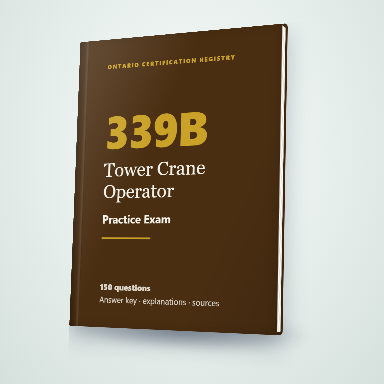
The full 150-question PDF
Includes the 30 free questions plus 120 additional questions, explanations and references. One payment, no subscription.
| Questions | 150, all original |
|---|---|
| Answer key | Correct answer, the reasoning, and a cited source for each question |
| Distinct references | 52 distinct citations across the bank |
| Free samples here | 30, with answers, below |
| Format | PDF, emailed on purchase, plus a download link valid 30 days |
| Price | $67.49 CAD, one payment, no subscription |
Payment is handled by Stripe. This is study material, not an official exam, and it is not affiliated with Skilled Trades Ontario, TSSA or the Red Seal program.
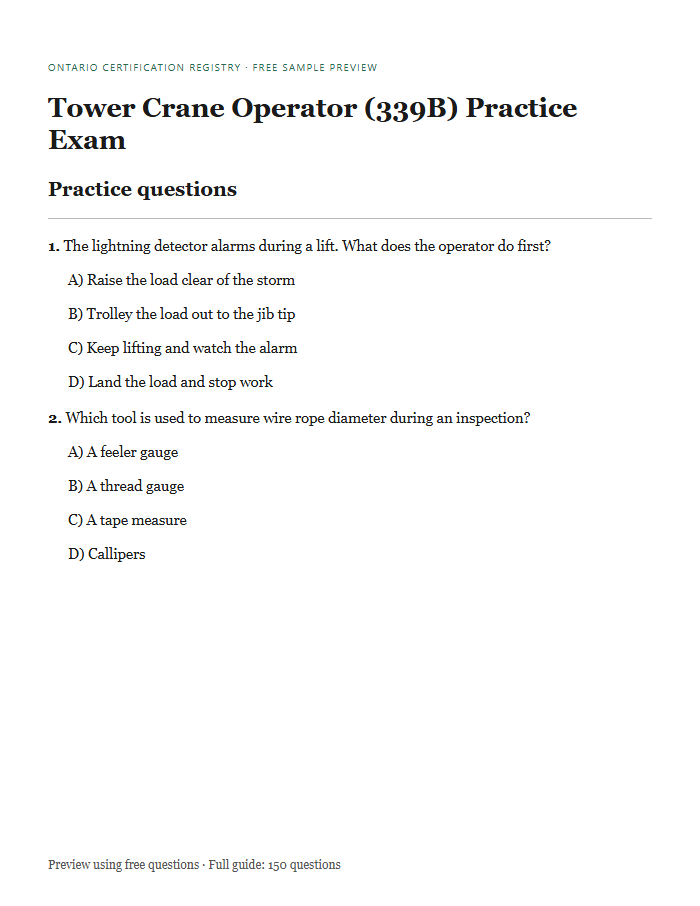
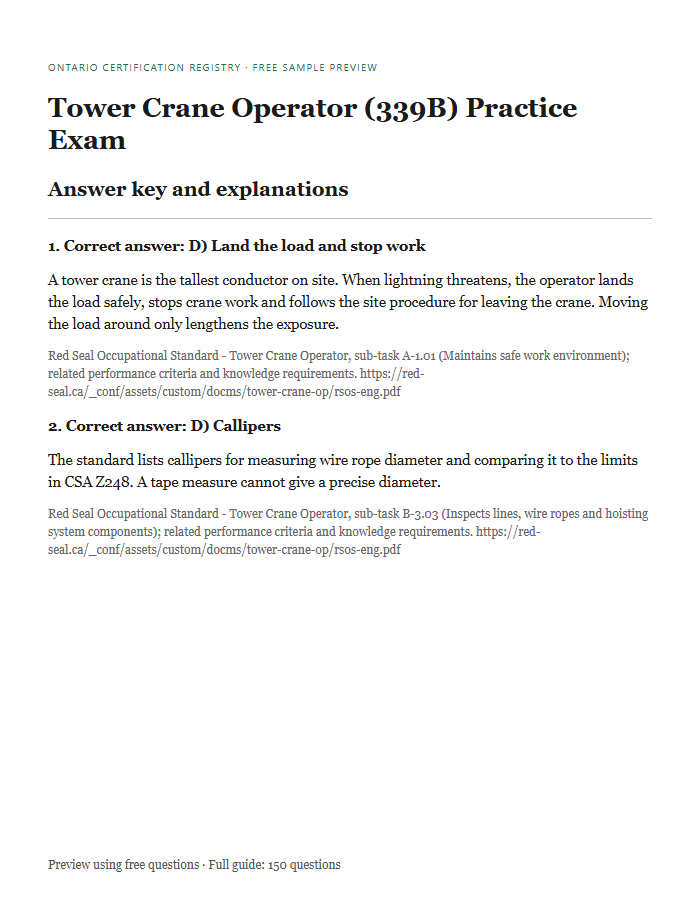
Look inside the PDF
A preview of the question and answer-key layout, using questions from the free sample. The full guide contains all 150 questions.
What this guide covers
Published Red Seal exam question counts (100) scaled to 150 with whole-question rounding (largest remainder). The table shows the actual counts and shares in this guide.
| Major work activity | Questions here | Share of this guide |
|---|---|---|
| A. Performs common occupational skills | 17 | 11.3% |
| B. Inspects and maintains crane | 32 | 21.3% |
| C. Performs crane set-up, hoisting calculations and lift planning | 34 | 22.7% |
| D. Performs rigging | 25 | 16.7% |
| E. Operates crane | 42 | 28% |
The published official exam has 100 questions. This guide contains 150 original study questions, with topic counts rounded to fit that length.
Coverage source: Published Red Seal exam breakdown
The mix of question types
The table compares this guide's mix with the published Red Seal ranges for this trade.
| Type | Questions here | Share | Published range |
|---|---|---|---|
| Knowledge and recall | 75 | 50% | 45 to 55% |
| Procedural and application | 45 | 30% | 25 to 35% |
| Critical thinking | 30 | 20% | 15 to 25% |
30 free sample questions from the Tower Crane Operator bank
This fixed selection comes straight from the bank and covers every major work activity, with the answers and sources shown. Read them before you decide whether the rest is worth $67.49 to you.
Question 1: The lightning detector alarms during a lift. What does the operator do first?
Sample 1 · Activity A
The lightning detector alarms during a lift. What does the operator do first?
- Raise the load clear of the storm
- Trolley the load out to the jib tip
- Keep lifting and watch the alarm
- Land the load and stop work (correct)
A tower crane is the tallest conductor on site. When lightning threatens, the operator lands the load safely, stops crane work and follows the site procedure for leaving the crane. Moving the load around only lengthens the exposure.
Red Seal Occupational Standard - Tower Crane Operator, sub-task A-1.01 (Maintains safe work environment); related performance criteria and knowledge requirements. https://red-seal.ca/_conf/assets/custom/docms/tower-crane-op/rsos-eng.pdf
Question 2: The maker's manual and a site memo give different wind limits for the crane. Which one governs?
Sample 2 · Activity A
The maker's manual and a site memo give different wind limits for the crane. Which one governs?
- Whichever one the superintendent picks
- The site memo, as it is more recent
- The stricter one, never above the maker's (correct)
- The manual, even if the memo is lower
The manufacturer's limit is the most the crane may ever be operated in. A site may set a lower limit for its own reasons, and then the lower one applies. No memo can raise the maker's limit.
Red Seal Occupational Standard - Tower Crane Operator, sub-task A-1.03 (Uses documentation); related performance criteria and knowledge requirements. https://red-seal.ca/_conf/assets/custom/docms/tower-crane-op/rsos-eng.pdf
Question 3: Which hand signal must the operator obey no matter who on site gives it?
Sample 3 · Activity A
Which hand signal must the operator obey no matter who on site gives it?
- Hoist slowly
- Emergency stop (correct)
- Lower the load
- Trolley out
Only the designated signaller directs the lift, but an emergency stop is obeyed from anyone, because the person giving it may see a danger nobody else can.
Red Seal Occupational Standard - Tower Crane Operator, sub-task A-2.01 (Uses communication techniques); related performance criteria and knowledge requirements. https://red-seal.ca/_conf/assets/custom/docms/tower-crane-op/rsos-eng.pdf
Question 4: Which tool is used to measure wire rope diameter during an inspection?
Sample 4 · Activity B
Which tool is used to measure wire rope diameter during an inspection?
- A feeler gauge
- A thread gauge
- A tape measure
- Callipers (correct)
The standard lists callipers for measuring wire rope diameter and comparing it to the limits in CSA Z248. A tape measure cannot give a precise diameter.
Red Seal Occupational Standard - Tower Crane Operator, sub-task B-3.03 (Inspects lines, wire ropes and hoisting system components); related performance criteria and knowledge requirements. https://red-seal.ca/_conf/assets/custom/docms/tower-crane-op/rsos-eng.pdf
Question 5: Which parts tie a top-climbing crane's mast to the building and are inspected?
Sample 5 · Activity B
Which parts tie a top-climbing crane's mast to the building and are inspected?
- The counterjib and ballast
- The cab and walkways
- Tie-ins and anchor shoes (correct)
- The trolley and hook block
The standard lists support arms, tie-ins, anchor shoes, collars and the climbing pump and cylinder as support components. Tie-ins and anchor shoes carry the mast's loads into the structure.
Red Seal Occupational Standard - Tower Crane Operator, sub-task B-3.06 (Inspects support components); related performance criteria and knowledge requirements. https://red-seal.ca/_conf/assets/custom/docms/tower-crane-op/rsos-eng.pdf
Question 6: During the cab check, the deadman control does not stop motion when released. What does the operator do?
Sample 6 · Activity B
During the cab check, the deadman control does not stop motion when released. What does the operator do?
- Report it and do not operate (correct)
- Hold the controls more firmly
- Operate at slow speed only
- Use the emergency stop instead
The deadman control is a safety device listed in the cab check. If it fails, the crane can keep moving after the operator lets go, so the crane is not used until it is repaired.
Red Seal Occupational Standard - Tower Crane Operator, sub-task B-3.08 (Inspects cab components); related performance criteria and knowledge requirements. https://red-seal.ca/_conf/assets/custom/docms/tower-crane-op/rsos-eng.pdf
Question 7: Wind is gusting near the crane's limit, and the next lift is a large flat formwork panel. What is the best decision?
Sample 7 · Activity B
Wind is gusting near the crane's limit, and the next lift is a large flat formwork panel. What is the best decision?
- Use two tag lines and lift anyway
- Wait; the panel catches the wind (correct)
- Lift it fast before the gusts grow
- Lift it at the jib tip for stability
A large flat panel catches the wind like a sail and can spin or swing out of control even below the crane's limit. The lift waits for calmer wind. Speed, tag lines and a long radius do not tame it.
Red Seal Occupational Standard - Tower Crane Operator, sub-task B-4.01 (Monitors weather conditions); related performance criteria and knowledge requirements. https://red-seal.ca/_conf/assets/custom/docms/tower-crane-op/rsos-eng.pdf
Question 8: In spring, why is ground thaw a concern for a self-erecting crane on outriggers?
Sample 8 · Activity B
In spring, why is ground thaw a concern for a self-erecting crane on outriggers?
- The ground can soften under the pads (correct)
- The rails expand and bind
- The crane's oil thickens in the cold
- The anemometer reads low
Frozen ground can carry a lot until it thaws, then lose strength quickly. The standard names ground thaw as a site condition, because a pad sinking on soft ground can tip the crane.
Red Seal Occupational Standard - Tower Crane Operator, sub-task B-4.02 (Monitors site conditions); related performance criteria and knowledge requirements. https://red-seal.ca/_conf/assets/custom/docms/tower-crane-op/rsos-eng.pdf
Question 9: By which methods is lubricant applied to crane parts?
Sample 9 · Activity B
By which methods is lubricant applied to crane parts?
- Spraying, brushing or injecting (correct)
- Soaking, baking or freeze-drying
- Heating, pouring or burning
- Sanding, wiping or rinsing
The standard lists spraying, brushing and injecting as application methods for greases, oils, open gear lubricant and wire rope lubricant.
Red Seal Occupational Standard - Tower Crane Operator, sub-task B-5.02 (Lubricates wire ropes and crane components); related performance criteria and knowledge requirements. https://red-seal.ca/_conf/assets/custom/docms/tower-crane-op/rsos-eng.pdf
Question 10: After a tower crane is assembled, what must be done before it lifts loads?
Sample 10 · Activity C
After a tower crane is assembled, what must be done before it lifts loads?
- Set and test all limits (correct)
- Remove the anemometer
- Run it for an hour at full speed
- Paint the mast sections
Limits keep the crane inside its safe range. The standard lists setting and testing them as part of assembly, before the crane goes to work.
Red Seal Occupational Standard - Tower Crane Operator, sub-task C-6.01 (Participates in crane assembly); related performance criteria and knowledge requirements. https://red-seal.ca/_conf/assets/custom/docms/tower-crane-op/rsos-eng.pdf
Question 11: A self-erecting crane must be set up beside a recently backfilled trench. What is the best choice?
Sample 11 · Activity C
A self-erecting crane must be set up beside a recently backfilled trench. What is the best choice?
- Put the outrigger on the trench edge
- Confirm compaction or move the setup (correct)
- Set up there and use bigger pads
- Set up there and lift lighter loads
Fresh backfill may not be compacted and can give way under an outrigger. Its compaction is confirmed by a competent person, or the crane is set elsewhere. Bigger pads and lighter loads guess at a strength nobody has confirmed.
Red Seal Occupational Standard - Tower Crane Operator, sub-task C-6.04 (Participates in assembly and disassembly of self-erecting tower cranes); related performance criteria and knowledge requirements. https://red-seal.ca/_conf/assets/custom/docms/tower-crane-op/rsos-eng.pdf
Question 12: In bottom-climbing, what carries the crane after it is raised?
Sample 12 · Activity C
In bottom-climbing, what carries the crane after it is raised?
- The crane's original footing
- Beams or collars on the building (correct)
- A new mast section at the base
- Extra counterweight blocks
The standard describes bottom-climbing as raising the whole crane and mast and supporting it on beams or collars resting on the building around it.
Red Seal Occupational Standard - Tower Crane Operator, sub-task C-7.01 (Participates in bottom-climbing procedures); related performance criteria and knowledge requirements. https://red-seal.ca/_conf/assets/custom/docms/tower-crane-op/rsos-eng.pdf
Question 13: Midway through a top climb, the wind rises past the climbing limit. What does the crew do?
Sample 13 · Activity C
Midway through a top climb, the wind rises past the climbing limit. What does the crew do?
- Secure the crane per the manual (correct)
- Finish the climb as fast as possible
- Swing the jib to face the wind
- Release the climbing frame and wait
Climbing has its own wind limit in the manufacturer's instructions. When it is exceeded, the crew follows the manual's steps to make the crane secure, then waits. Rushing or releasing the frame risks the whole crane.
Red Seal Occupational Standard - Tower Crane Operator, sub-task C-7.02 (Participates in top-climbing procedures); related performance criteria and knowledge requirements. https://red-seal.ca/_conf/assets/custom/docms/tower-crane-op/rsos-eng.pdf
Question 14: Who must approve a change to a tower crane's configuration?
Sample 14 · Activity C
Who must approve a change to a tower crane's configuration?
- The rigging crew's foreman
- The site superintendent, on their own
- The maker or a professional engineer (correct)
- The crane operator on shift
The standard requires reconfigurations to be approved by the manufacturer or a professional engineer. Site staff cannot approve a change to the crane's design.
Red Seal Occupational Standard - Tower Crane Operator, sub-task C-7.03 (Participates in crane reconfiguration); related performance criteria and knowledge requirements. https://red-seal.ca/_conf/assets/custom/docms/tower-crane-op/rsos-eng.pdf
Question 15: A concrete block is 5 ft by 4 ft by 3 ft. Using 150 lb./ft³ for concrete, what does it weigh?
Sample 15 · Activity C
A concrete block is 5 ft by 4 ft by 3 ft. Using 150 lb./ft³ for concrete, what does it weigh?
- 4 500 lb.
- 9 000 lb. (correct)
- 12 000 lb.
- 6 000 lb.
Cube = L × w × H × U.W. = 5 × 4 × 3 × 150 = 60 × 150 = 9 000 lb.
Red Seal Occupational Standard - Tower Crane Operator, sub-task C-8.01 (Determines load weights); related performance criteria and knowledge requirements. https://red-seal.ca/_conf/assets/custom/docms/tower-crane-op/rsos-eng.pdf
Question 16: The chart allows 4 000 kg at 40 m, but the lift plan limits all picks to 75% of chart. What is the most the crane may lift at 40 m?
Sample 16 · Activity C
The chart allows 4 000 kg at 40 m, but the lift plan limits all picks to 75% of chart. What is the most the crane may lift at 40 m?
- 3 000 kg (correct)
- 2 500 kg
- 4 000 kg
- 5 333 kg
The standard has gross capacity de-rated for site and regulatory limits. 75% of 4 000 kg = 0.75 × 4 000 = 3 000 kg.
Red Seal Occupational Standard - Tower Crane Operator, sub-task C-8.02 (Interprets load charts); related performance criteria and knowledge requirements. https://red-seal.ca/_conf/assets/custom/docms/tower-crane-op/rsos-eng.pdf
Question 17: Which damage to a chain sling requires removal?
Sample 17 · Activity D
Which damage to a chain sling requires removal?
- Surface rust that wipes off
- A coat of paint
- Dust from concrete
- Stretched or worn links (correct)
Stretched or worn links mean the chain has been overloaded or worn below safe limits. The standard lists stretching and worn links as sling deficiencies.
Red Seal Occupational Standard - Tower Crane Operator, sub-task D-9.01 (Identifies deficiencies in slings and hardware); related performance criteria and knowledge requirements. https://red-seal.ca/_conf/assets/custom/docms/tower-crane-op/rsos-eng.pdf
Question 18: Why are synthetic slings stored away from sunlight?
Sample 18 · Activity D
Why are synthetic slings stored away from sunlight?
- It shrinks them shorter
- It makes them too stiff to hitch
- UV light weakens the fibres (correct)
- It fades the colour code only
Ultraviolet light breaks down synthetic fibres over time. The standard lists UV among storage factors.
Red Seal Occupational Standard - Tower Crane Operator, sub-task D-9.03 (Stores rigging equipment); related performance criteria and knowledge requirements. https://red-seal.ca/_conf/assets/custom/docms/tower-crane-op/rsos-eng.pdf
Question 19: During a storage check, a sling's certification is found to have expired. What happens?
Sample 19 · Activity D
During a storage check, a sling's certification is found to have expired. What happens?
- Write a new date on its tag
- Pull it until recertified (correct)
- Use it until it shows damage
- Use it for half its rated load
The standard lists expired certifications as a storage concern. The sling is held out of use until it is inspected and recertified. Rewriting the tag is falsifying the record.
Red Seal Occupational Standard - Tower Crane Operator, sub-task D-9.03 (Stores rigging equipment); related performance criteria and knowledge requirements. https://red-seal.ca/_conf/assets/custom/docms/tower-crane-op/rsos-eng.pdf
Question 20: A 6 000 lb. load hangs from 2 slings, each 10 ft long, with the hook 8 ft above the load. Using Stress = w/# slings × L/H, what is the tension in each sling?
Sample 20 · Activity D
A 6 000 lb. load hangs from 2 slings, each 10 ft long, with the hook 8 ft above the load. Using Stress = w/# slings × L/H, what is the tension in each sling?
- 2 400 lb.
- 3 750 lb. (correct)
- 7 500 lb.
- 3 000 lb.
Stress = 6 000/2 × 10/8 = 3 000 × 1.25 = 3 750 lb. in each sling.
Red Seal Occupational Standard - Tower Crane Operator, sub-task D-10.01 (Selects required rigging equipment and configuration); related performance criteria and knowledge requirements. https://red-seal.ca/_conf/assets/custom/docms/tower-crane-op/rsos-eng.pdf
Question 21: A rebar bundle is lifted with one choker. Partway up, bars start sliding out. What is best?
Sample 21 · Activity D
A rebar bundle is lifted with one choker. Partway up, bars start sliding out. What is best?
- Swing over the street to drop clear
- Keep hoisting to clear the area fast
- Trolley in quickly to steady it
- Stop, lower and re-rig with two chokers (correct)
Loose bars can slide out of a single choker. The lift stops, the load is lowered gently and re-rigged with two chokers spaced apart. Speed only shakes more bars loose.
Red Seal Occupational Standard - Tower Crane Operator, sub-task D-10.03 (Monitors rigging); related performance criteria and knowledge requirements. https://red-seal.ca/_conf/assets/custom/docms/tower-crane-op/rsos-eng.pdf
Question 22: How is the LMI's calibration confirmed before work?
Sample 22 · Activity E
How is the LMI's calibration confirmed before work?
- Ask the last operator if it was fine
- Lift a known load and compare readings (correct)
- Check that the display lights up
- Read the calibration sticker date
The standard has the operator compare a known load against the LMI reading. A matching reading shows the system is measuring correctly today.
Red Seal Occupational Standard - Tower Crane Operator, sub-task E-11.01 (Performs function test); related performance criteria and knowledge requirements. https://red-seal.ca/_conf/assets/custom/docms/tower-crane-op/rsos-eng.pdf
Question 23: In the morning test, the hoist upper limit does not stop the hook. What is the best action?
Sample 23 · Activity E
In the morning test, the hoist upper limit does not stop the hook. What is the best action?
- Report it and do not operate (correct)
- Let the slow-down limit stop it
- Hoist only partway all day
- Operate, watching the hook closely
A failed limit removes protection against hitting the trolley. The crane is not used until the limit is repaired and tested. Care cannot replace a limit.
Red Seal Occupational Standard - Tower Crane Operator, sub-task E-11.02 (Confirms limits); related performance criteria and knowledge requirements. https://red-seal.ca/_conf/assets/custom/docms/tower-crane-op/rsos-eng.pdf
Question 24: As the trolley moves in toward the mast, what happens to the crane's capacity?
Sample 24 · Activity E
As the trolley moves in toward the mast, what happens to the crane's capacity?
- It stays the same
- It rises (correct)
- It drops to zero
- It falls
The standard says moving the trolley in raises capacity and shortens the working range. A shorter radius means less load moment on the crane.
Red Seal Occupational Standard - Tower Crane Operator, sub-task E-12.01 (Moves trolley in and out); related performance criteria and knowledge requirements. https://red-seal.ca/_conf/assets/custom/docms/tower-crane-op/rsos-eng.pdf
Question 25: After a swing stops, the load sways like a pendulum. How does the operator settle it?
Sample 25 · Activity E
After a swing stops, the load sways like a pendulum. How does the operator settle it?
- Hold the brake, then hoist fast
- Ease the hook over the load's sway (correct)
- Drop the load quickly to the ground
- Swing the other way at full speed
Moving the hook gently in the direction of the sway brings it back over the load and calms it. Sharp moves add energy.
Red Seal Occupational Standard - Tower Crane Operator, sub-task E-12.03 (Swings (slews) jib); related performance criteria and knowledge requirements. https://red-seal.ca/_conf/assets/custom/docms/tower-crane-op/rsos-eng.pdf
Question 26: After travelling a rail crane to its new spot, what is done?
Sample 26 · Activity E
After travelling a rail crane to its new spot, what is done?
- Release the swing brake fully
- Leave it free to drift in the wind
- Raise the counterweight
- Reinstall the rail locks and clamps (correct)
The standard lists reinstalling locking devices after travel, so the crane cannot roll on its rails.
Red Seal Occupational Standard - Tower Crane Operator, sub-task E-12.05 (Travels crane); related performance criteria and knowledge requirements. https://red-seal.ca/_conf/assets/custom/docms/tower-crane-op/rsos-eng.pdf
Question 27: Which system on a busy site stops one tower crane's jib from hitting another's?
Sample 27 · Activity E
Which system on a busy site stops one tower crane's jib from hitting another's?
- A load moment indicator
- A jib angle indicator
- An anemometer
- An anti-collision system (correct)
An anti-collision system tracks cranes whose radii overlap and slows or stops motions before they collide. The standard lists it for multi-crane sites.
Red Seal Occupational Standard - Tower Crane Operator, sub-task E-13.02 (Operates in multi-crane site); related performance criteria and knowledge requirements. https://red-seal.ca/_conf/assets/custom/docms/tower-crane-op/rsos-eng.pdf
Question 28: Workers are riding in a personnel basket. What must each one do?
Sample 28 · Activity E
Workers are riding in a personnel basket. What must each one do?
- Wear a vest and hold the rails
- Wear fall arrest and stay tied off (correct)
- Wear a hard hat and stand on a rail
- Wear gloves and sit on the floor
The standard lists fall arrest tied off for personnel lifts, so a worker who falls or is thrown is caught.
Red Seal Occupational Standard - Tower Crane Operator, sub-task E-13.03 (Hoists personnel); related performance criteria and knowledge requirements. https://red-seal.ca/_conf/assets/custom/docms/tower-crane-op/rsos-eng.pdf
Question 29: When leaving the controls for a short time, what is done with the swing brake?
Sample 29 · Activity E
When leaving the controls for a short time, what is done with the swing brake?
- Apply and lock it (correct)
- Remove its fuse
- Leave it as found
- Release it fully
The standard lists locking the swing brake for a short-term stop. Releasing it so the jib can weathervane is the out-of-service step.
Red Seal Occupational Standard - Tower Crane Operator, sub-task E-14.01 (Secures crane while leaving controls (short-term)); related performance criteria and knowledge requirements. https://red-seal.ca/_conf/assets/custom/docms/tower-crane-op/rsos-eng.pdf
Question 30: Where is the trolley parked when the crane is out of service?
Sample 30 · Activity E
Where is the trolley parked when the crane is out of service?
- At the manual's parking position (correct)
- Over the busiest part of the site
- Wherever the last load was
- At the far tip of the jib
The standard has the trolley placed at the parking position the manufacturer sets for an unattended crane. That position keeps the crane balanced as it weathervanes.
Red Seal Occupational Standard - Tower Crane Operator, sub-task E-14.02 (Secures crane while out of service); related performance criteria and knowledge requirements. https://red-seal.ca/_conf/assets/custom/docms/tower-crane-op/rsos-eng.pdf
Before you buy
- These questions use the cited occupational standards, curriculum and technical references. Nothing here is reproduced from a real exam.
- Passing this does not guarantee passing the certifying exam, and nothing here is a substitute for the training standard or your in-school hours.
- It is a PDF. There is no login, no expiry and no subscription, and you can print it.
- Automated structure and distribution checks are complete. Technical accuracy review by a licensed tradesperson remains outstanding.
Questions about your purchase or a missing PDF? Contact Blue Crane Works with the email used at checkout. The download link lasts 30 days; your saved PDF does not expire.
When you are ready for the real exam
You book the 339B certifying exam yourself in the Skilled Trades Ontario Portal ($150 plus HST) and write it at one of 24 exam centres, or at your college in your final level of school. How to book it and find the nearest centre.
Writing in Alberta, BC or Manitoba? Same Red Seal exam
The Tower Crane Operator exam is the national Red Seal exam, so this practice exam fits writers in other provinces too, wherever the trade carries the Red Seal. Trade names differ by province.
Where the exam facts on this page come from
Published Red Seal exam question counts (100) scaled to 150 with whole-question rounding (largest remainder). The regulation and issuing authority explain the actual credential and examination requirements.
The free reference material for this trade
Everything about the certification itself, the classification, the hours, the ratio and the official sources, stays free on this site and always will. The practice exam is the only thing here that costs anything.
Other practice exams
 309AConstruction Electrician
 G.2Gas Technician 2
 306APlumber
 433AIndustrial Mechanic Millwright
 310SAutomotive Service Technician
 G.3Gas Technician 3
 310TTruck and Coach Technician
 332AHairstylist
 442AIndustrial Electrician
 308ASheet Metal Worker
 415ACook
 456AWelder
 429AGeneral Machinist
 339AMobile Crane Operator