Free practice test
Try 30 questions free
Work through 30 questions, then see your score, results by topic and an explanation for every answer. No account or email needed.
These are 30 of the 150 questions in the full PDF. You can also read the questions and answers below.
The full 150-question PDF
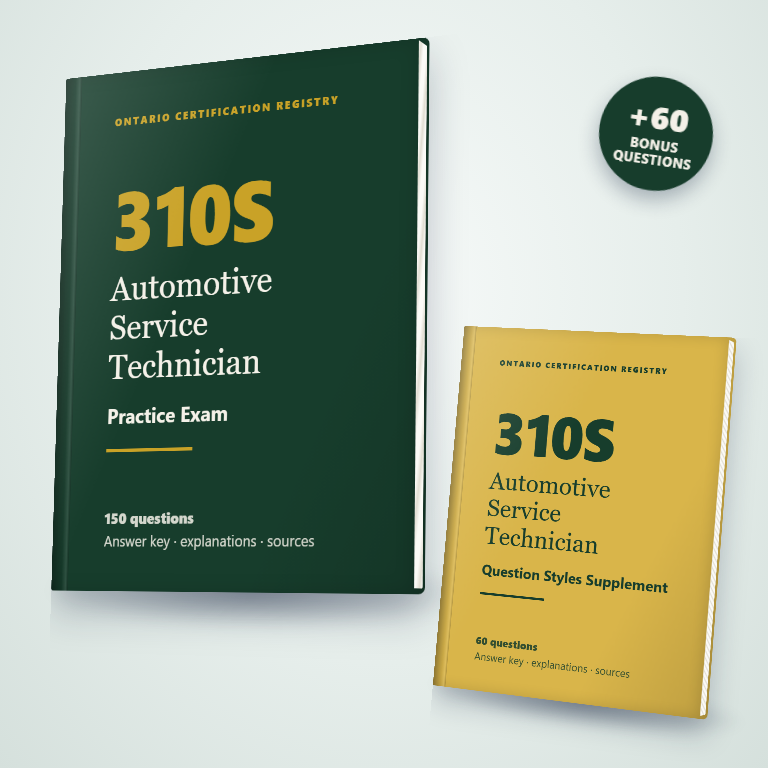
Includes the 30 free questions plus 120 additional questions, explanations and references. One payment, no subscription.
Also included at no extra cost: a second PDF, the Automotive Service Technician (310S) Question Styles Supplement. It has 60 more original questions with answers and explanations, written in the same forms as Red Seal's own published sample questions for this trade. They are not real exam questions, and none repeats a question in the main PDF.
| Questions | 150, all original |
|---|---|
| Answer key | Correct answer, the reasoning, and a cited source for each question |
| Distinct references | 91 distinct citations across the bank |
| Free samples here | 30, with answers, below |
| Bonus supplement | 60 more original questions with answers, in a second PDF |
| Format | PDF, emailed on purchase, plus a download link valid 30 days |
| Price | $67.49 CAD, one payment, no subscription |
Payment is handled by Stripe. This is study material, not an official exam, and it is not affiliated with Skilled Trades Ontario, TSSA or the Red Seal program.
Look inside the PDF
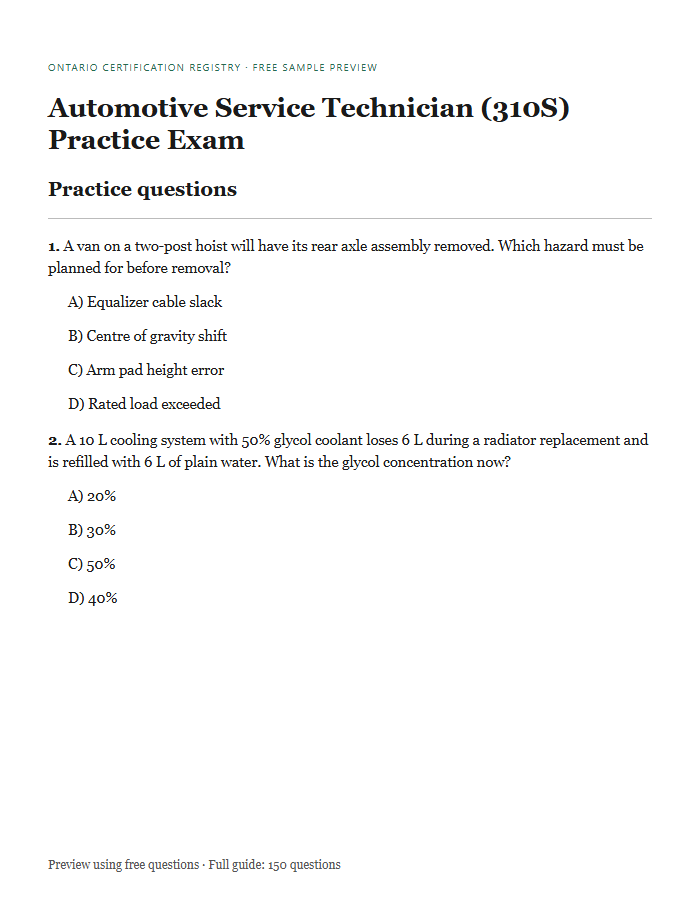
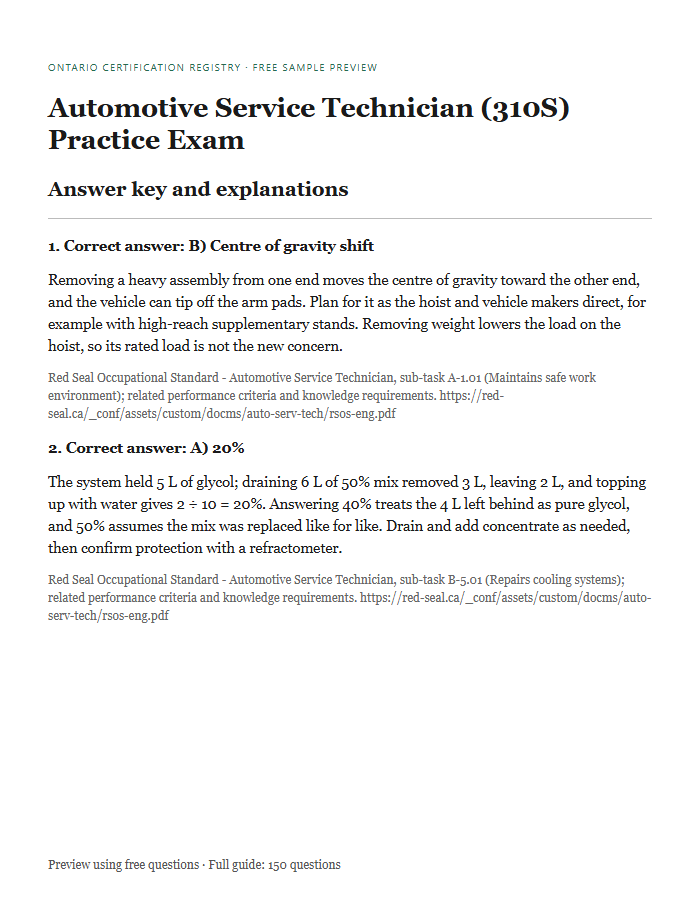
A preview of the question and answer-key layout, using questions from the free sample. The full guide contains all 150 questions.
What this guide covers
Published Red Seal exam question counts scaled to 150 with whole-question rounding. The table shows the actual counts and shares in this guide.
| Major work activity | Questions here | Share of this guide |
|---|---|---|
| A. Common occupational skills | 11 | 7.3% |
| B. Engine and engine support systems | 26 | 17.3% |
| C. Vehicle module communications | 14 | 9.3% |
| D. Driveline systems | 20 | 13.3% |
| E. Electrical and comfort control systems | 28 | 18.7% |
| F. Steering, suspension, brakes, tires and hubs | 28 | 18.7% |
| G. Restraints, body components and trim | 12 | 8% |
| H. Hybrid and electric vehicle systems | 11 | 7.3% |
The published official exam has 125 questions. This guide contains 150 original study questions, with topic counts rounded to fit that length.
Coverage source: Published Red Seal exam breakdown
The mix of question types
The table compares this guide's mix with the published Red Seal ranges for this trade.
| Type | Questions here | Share | Published range |
|---|---|---|---|
| Knowledge and recall | 15 | 10% | 5 to 15% |
| Procedural and application | 68 | 45.3% | 40 to 50% |
| Critical thinking | 67 | 44.7% | 40 to 50% |
30 free sample questions from the Automotive Service Technician bank
This fixed selection comes straight from the bank and covers every major work activity, with the answers and sources shown. Read them before you decide whether the rest is worth $67.49 to you.
Question 1: A van on a two-post hoist will have its rear axle assembly removed. Which hazard must be planned for before removal?
Sample 1 · Activity A
A van on a two-post hoist will have its rear axle assembly removed. Which hazard must be planned for before removal?
- Equalizer cable slack
- Centre of gravity shift (correct)
- Arm pad height error
- Rated load exceeded
Removing a heavy assembly from one end moves the centre of gravity toward the other end, and the vehicle can tip off the arm pads. Plan for it as the hoist and vehicle makers direct, for example with high-reach supplementary stands. Removing weight lowers the load on the hoist, so its rated load is not the new concern.
Red Seal Occupational Standard - Automotive Service Technician, sub-task A-1.01 (Maintains safe work environment); related performance criteria and knowledge requirements. https://red-seal.ca/_conf/assets/custom/docms/auto-serv-tech/rsos-eng.pdf
Question 2: A 25-50 mm micrometer reads 25.04 mm on its 25.00 mm setting standard, then 47.62 mm on a crankshaft journal. The journal minimum is 47.60 mm. What is the conclusion?
Sample 2 · Activity A
A 25-50 mm micrometer reads 25.04 mm on its 25.00 mm setting standard, then 47.62 mm on a crankshaft journal. The journal minimum is 47.60 mm. What is the conclusion?
- Undersize by 0.02 mm (correct)
- Undersize by 0.06 mm
- Within limit by 0.06 mm
- Within limit by 0.02 mm
The micrometer reads 0.04 mm high, so the journal is really 47.62 - 0.04 = 47.58 mm, which is 0.02 mm below the 47.60 mm minimum. Taking the reading uncorrected gives the tempting within-limit answer, and adding the error instead gives 47.66 mm. Reset the micrometer on the standard and re-measure at several positions before condemning the crankshaft.
Red Seal Occupational Standard - Automotive Service Technician, sub-task A-2.01 (Uses tools and equipment); related performance criteria and knowledge requirements. https://red-seal.ca/_conf/assets/custom/docms/auto-serv-tech/rsos-eng.pdf
Question 3: A 10 L cooling system with 50% glycol coolant loses 6 L during a radiator replacement and is refilled with 6 L of plain water. What is the glycol concentration now?
Sample 3 · Activity B
A 10 L cooling system with 50% glycol coolant loses 6 L during a radiator replacement and is refilled with 6 L of plain water. What is the glycol concentration now?
- 20% (correct)
- 30%
- 50%
- 40%
The system held 5 L of glycol; draining 6 L of 50% mix removed 3 L, leaving 2 L, and topping up with water gives 2 ÷ 10 = 20%. Answering 40% treats the 4 L left behind as pure glycol, and 50% assumes the mix was replaced like for like. Drain and add concentrate as needed, then confirm protection with a refractometer.
Red Seal Occupational Standard - Automotive Service Technician, sub-task B-5.01 (Repairs cooling systems); related performance criteria and knowledge requirements. https://red-seal.ca/_conf/assets/custom/docms/auto-serv-tech/rsos-eng.pdf
Question 4: A gasoline car losing coolant holds 100 kPa for 15 minutes on a cold pressure test with no visible leak. With the engine running, block-test fluid turns from blue to yellow. What is indicated?
Sample 4 · Activity B
A gasoline car losing coolant holds 100 kPa for 15 minutes on a cold pressure test with no visible leak. With the engine running, block-test fluid turns from blue to yellow. What is indicated?
- Combustion gas in coolant (correct)
- Leaking heater core
- Weeping water pump seal
- Pressure cap opening low
The block-test fluid changes from blue toward yellow when it absorbs CO2 from combustion gases, which points to a head gasket breach or a cracked head or block. A heater core or pump seal leak would normally show as pressure loss on the cold test and does not put exhaust gas into the coolant. Keep liquid coolant out of the tester, which can give a false result, and confirm with a cylinder leakage test.
Red Seal Occupational Standard - Automotive Service Technician, sub-task B-4.01 (Diagnoses cooling systems); related performance criteria and knowledge requirements. https://red-seal.ca/_conf/assets/custom/docms/auto-serv-tech/rsos-eng.pdf
Question 5: After an oil pump replacement, a gauge with oil at 80 °C reads 90 kPa at idle and 380 kPa at 3000 rpm. The specification is 200 kPa minimum at 3000 rpm, 80 °C. What do the readings show?
Sample 5 · Activity B
After an oil pump replacement, a gauge with oil at 80 °C reads 90 kPa at idle and 380 kPa at 3000 rpm. The specification is 200 kPa minimum at 3000 rpm, 80 °C. What do the readings show?
- Fails, pressure too high
- Retest with cold oil
- Meets the specification (correct)
- Fails, idle pressure low
The only stated limit is a minimum at 3000 rpm with hot oil, and 380 kPa exceeds it. Lower pressure at hot idle is normal because pump output rises with speed, so it is judged only against an idle figure if service data gives one. Cold oil reads higher and would not test the specified condition; finish with a leak check and road test.
Red Seal Occupational Standard - Automotive Service Technician, sub-task B-5.02 (Repairs lubricating systems); related performance criteria and knowledge requirements. https://red-seal.ca/_conf/assets/custom/docms/auto-serv-tech/rsos-eng.pdf
Question 6: After an overnight cold soak, scan data shows ECT 135 °C and IAT 12 °C. The ECT signal is 0.08 V on a 5 V reference. What is indicated?
Sample 6 · Activity B
After an overnight cold soak, scan data shows ECT 135 °C and IAT 12 °C. The ECT signal is 0.08 V on a 5 V reference. What is indicated?
- Low coolant at sensor
- ECT signal circuit open
- Thermostat stuck closed
- ECT signal shorted low (correct)
The coolant cannot be at 135 °C after a cold soak, and with an NTC sensor a near-zero signal means very low resistance, so the sensor is shorted internally or its signal wire is shorted to ground. An open circuit lets the signal rise toward 5 V and reads very cold. Unplugging the sensor separates the two: if the reading jumps to its cold limit the sensor is at fault, and if it stays hot the wiring is.
Red Seal Occupational Standard - Automotive Service Technician, sub-task B-4.01 (Diagnoses cooling systems); related performance criteria and knowledge requirements. https://red-seal.ca/_conf/assets/custom/docms/auto-serv-tech/rsos-eng.pdf
Question 7: During the final 90° angle stage on new torque-to-yield head bolts, one bolt suddenly turns with almost no resistance. What is the correct action?
Sample 7 · Activity B
During the final 90° angle stage on new torque-to-yield head bolts, one bolt suddenly turns with almost no resistance. What is the correct action?
- Remove it, inspect threads (correct)
- Back off and re-torque it
- Finish the angle, continue
- Add 45° more to that bolt
A sudden loss of resistance means the bolt has yielded too far or the block threads have pulled, so it cannot hold clamp load. Remove it, inspect the bolt and block threads, repair any threads by an approved method, and fit a new bolt following the manufacturer's procedure. Finishing the angle or adding more only stretches a failed fastener further.
Red Seal Occupational Standard - Automotive Service Technician, sub-task B-5.03 (Repairs engine assembly); related performance criteria and knowledge requirements. https://red-seal.ca/_conf/assets/custom/docms/auto-serv-tech/rsos-eng.pdf
Question 8: A car has intermittent warning lamps and history U-codes in several modules. What should be done before any codes are cleared?
Sample 8 · Activity C
A car has intermittent warning lamps and history U-codes in several modules. What should be done before any codes are cleared?
- Disconnect the battery first
- Save the PCM codes only
- Reflash the cluster module
- Record codes and snapshots (correct)
Codes, their status and freeze-frame or snapshot data from every module show when and under what conditions the intermittent fault occurred. Clearing codes or disconnecting the battery can erase that record, and saving the PCM alone misses the body network modules. Reprogramming before diagnosis is guesswork.
Red Seal Occupational Standard - Automotive Service Technician, sub-task C-10.01 (Reads diagnostic trouble codes (DTCs)); related performance criteria and knowledge requirements. https://red-seal.ca/_conf/assets/custom/docms/auto-serv-tech/rsos-eng.pdf
Question 9: With the engine running, a meter reads 14.3 V across the battery posts, but every module's scan data reports 12.0 V system voltage. What is the most likely cause?
Sample 9 · Activity C
With the engine running, a meter reads 14.3 V across the battery posts, but every module's scan data reports 12.0 V system voltage. What is the most likely cause?
- Low battery capacity
- Weak alternator output
- Several failed modules
- Shared feed or ground (correct)
Charging voltage at the battery is normal, so the alternator and battery are not the cause; the 2.3 V missing at every module points to resistance in a path they share, such as a main feed, fusible link or body ground. Several modules failing identically at once is far less likely than one shared connection. Voltage-drop test the feed and ground paths under load to find it.
Red Seal Occupational Standard - Automotive Service Technician, sub-task C-10.02 (Monitors data); related performance criteria and knowledge requirements. https://red-seal.ca/_conf/assets/custom/docms/auto-serv-tech/rsos-eng.pdf
Question 10: An instrument cluster stores U0100. Which module has it lost communication with?
Sample 10 · Activity C
An instrument cluster stores U0100. Which module has it lost communication with?
- Transmission module
- ABS control module
- Engine control module (correct)
- Body control module
U0100 is lost communication with the ECM/PCM; U0101, U0121 and U0140 cover the TCM, ABS module and BCM. The code is set by the module that stopped receiving messages, so it records a symptom, and the ECM's power, ground and network connection must be tested before the ECM is condemned.
Red Seal Occupational Standard - Automotive Service Technician, sub-task C-10.01 (Reads diagnostic trouble codes (DTCs)); related performance criteria and knowledge requirements. https://red-seal.ca/_conf/assets/custom/docms/auto-serv-tech/rsos-eng.pdf Also: HELLA OBD-II U-code list (U0100, U0101, U0121, U0140). https://www.hella.com/hotsecdocs/OBDII/dtc_db/codelists/en_u-codes.htm
Question 11: A two-piece driveshaft must be separated at its slip joint to replace the centre bearing. How are the halves rejoined?
Sample 11 · Activity D
A two-piece driveshaft must be separated at its slip joint to replace the centre bearing. How are the halves rejoined?
- With the splines left dry
- In their original phasing (correct)
- With yokes 90° apart
- In any spline position
Cardan joints cancel each other's speed fluctuation only when the yokes are phased as designed, so the halves go back on their match marks or master spline. Rejoining them a quarter turn out makes the fluctuations add instead of cancel and causes vibration. The slip splines are lubricated as specified.
Red Seal Occupational Standard - Automotive Service Technician, sub-task D-13.01 (Repairs drive shafts and axles); related performance criteria and knowledge requirements. https://red-seal.ca/_conf/assets/custom/docms/auto-serv-tech/rsos-eng.pdf
Question 12: After a lift kit on a leaf-spring truck, the one-piece driveshaft vibrates on acceleration but not when coasting. Front U-joint working angle is 1.0° and rear is 4.0°; the specification is within 1° of each other. What correction is indicated?
Sample 12 · Activity D
After a lift kit on a leaf-spring truck, the one-piece driveshaft vibrates on acceleration but not when coasting. Front U-joint working angle is 1.0° and rear is 4.0°; the specification is within 1° of each other. What correction is indicated?
- Replace both U-joints
- Re-phase the shaft yokes
- Install tapered axle shims (correct)
- Rebalance the driveshaft
Two cardan joints cancel each other's speed fluctuation only when their working angles are nearly equal, and the lift moved the axle so the angles now differ by 4.0 - 1.0 = 3.0°. Tapered shims between the springs and axle tilt the pinion to bring the rear angle back into line, and the angles are then re-measured. Imbalance is speed-sensitive and would be felt when coasting too, and the data does not point to phasing or joint wear.
Red Seal Occupational Standard - Automotive Service Technician, sub-task D-12.01 (Diagnoses drive shafts and axles); related performance criteria and knowledge requirements. https://red-seal.ca/_conf/assets/custom/docms/auto-serv-tech/rsos-eng.pdf
Question 13: On a front-drive half shaft, why is the inboard joint a plunging type?
Sample 13 · Activity D
On a front-drive half shaft, why is the inboard joint a plunging type?
- Cancels joint speed variation
- Reduces torque steer effects
- Allows shaft length change (correct)
- Allows large steering angles
Suspension travel changes the distance between the transaxle and the wheel hub, so the inboard tripod or double-offset joint slides in and out to absorb it. Large steering angles are handled by the fixed outboard ball-type joint, and both joints are constant-velocity designs, so speed cancellation is not what the plunge feature adds. Torque steer is managed by shaft length and layout, not by the plunge joint.
Red Seal Occupational Standard - Automotive Service Technician, sub-task D-12.01 (Diagnoses drive shafts and axles); related performance criteria and knowledge requirements. https://red-seal.ca/_conf/assets/custom/docms/auto-serv-tech/rsos-eng.pdf
Question 14: A semi-floating rear axle shaft is retained by a C-clip at its inner end. After the cover is removed, what is removed next to free the shaft?
Sample 14 · Activity D
A semi-floating rear axle shaft is retained by a C-clip at its inner end. After the cover is removed, what is removed next to free the shaft?
- Differential pinion shaft (correct)
- Carrier bearing caps
- Axle bearing retainer plate
- Drive pinion flange nut
The C-clip sits in a groove on the axle's inner end inside the side gear, so the lock bolt and differential pinion (cross) shaft come out first, letting the axle be pushed inward to remove the clip. The drive pinion nut sets pinion bearing preload and is not disturbed, and retainer plates belong to bearing-retained axles, not C-clip designs.
Red Seal Occupational Standard - Automotive Service Technician, sub-task D-13.01 (Repairs drive shafts and axles); related performance criteria and knowledge requirements. https://red-seal.ca/_conf/assets/custom/docms/auto-serv-tech/rsos-eng.pdf
Question 15: A crimped splice in an engine-bay harness will be exposed to road spray. What should seal it?
Sample 15 · Activity E
A crimped splice in an engine-bay harness will be exposed to road spray. What should seal it?
- Split loom over the splice
- Adhesive-lined heat-shrink (correct)
- Vinyl electrical tape
- Plain thin-wall heat-shrink
Adhesive-lined (dual-wall) heat-shrink melts its inner liner around the conductor and insulation as it shrinks, sealing out water that would otherwise wick into the strands and corrode them. Plain heat-shrink and tape insulate but do not seal, and split loom only guards against abrasion. Use the splice and sleeve the manufacturer's repair kit specifies.
Red Seal Occupational Standard - Automotive Service Technician, sub-task E-15.01 (Repairs wiring and electrical systems); related performance criteria and knowledge requirements. https://red-seal.ca/_conf/assets/custom/docms/auto-serv-tech/rsos-eng.pdf
Question 16: A 12.6 V supply feeds a fixed 2.0 ohm load, but measured current is only 4.2 A. How much unwanted resistance is in the circuit?
Sample 16 · Activity E
A 12.6 V supply feeds a fixed 2.0 ohm load, but measured current is only 4.2 A. How much unwanted resistance is in the circuit?
- 3.0 ohm
- 2.0 ohm
- 1.0 ohm (correct)
- 0.33 ohm
Total resistance is V/I = 12.6 / 4.2 = 3.0 ohm, and subtracting the 2.0 ohm load leaves 1.0 ohm of unwanted resistance in the feed or ground. That resistance drops 4.2 A x 1.0 ohm = 4.2 V, leaving 8.4 V at the load (8.4 + 4.2 = 12.6 V). 3.0 ohm is the whole circuit, not the fault, and 0.33 ohm comes from dividing current by voltage; locate the fault with voltage-drop tests.
Red Seal Occupational Standard - Automotive Service Technician, sub-task E-14.01 (Diagnoses wiring and electrical systems); related performance criteria and knowledge requirements. https://red-seal.ca/_conf/assets/custom/docms/auto-serv-tech/rsos-eng.pdf
Question 17: A connector in a single-load series circuit develops added resistance. What effect does it have?
Sample 17 · Activity E
A connector in a single-load series circuit develops added resistance. What effect does it have?
- Circuit current decreases (correct)
- Total resistance decreases
- Circuit current increases
- Load voltage increases
Total resistance rises, so by Ohm's law (I = V/R) current falls, and the connector now drops part of the source voltage, leaving less for the load. The load runs dim, slow or weak. That is why a loaded voltage-drop test finds it while an unloaded voltage check can read normal.
Red Seal Occupational Standard - Automotive Service Technician, sub-task E-14.01 (Diagnoses wiring and electrical systems); related performance criteria and knowledge requirements. https://red-seal.ca/_conf/assets/custom/docms/auto-serv-tech/rsos-eng.pdf
Question 18: Two fog lamps, each rated 55 W at 12 V, are wired in parallel on a new circuit. What total current do they draw at 12 V?
Sample 18 · Activity E
Two fog lamps, each rated 55 W at 12 V, are wired in parallel on a new circuit. What total current do they draw at 12 V?
- 0.11 A
- 9.2 A (correct)
- 4.6 A
- 2.3 A
Power is voltage times current, so I = P / V = (2 x 55 W) / 12 V = 110 / 12 = 9.2 A. One lamp alone draws 4.6 A, the same two lamps wired in series would draw about 2.3 A, and 0.11 A comes from dividing volts by watts. The fuse and wire are then sized above this load as the vehicle or accessory instructions specify.
Red Seal Occupational Standard - Automotive Service Technician, sub-task E-15.01 (Repairs wiring and electrical systems); related performance criteria and knowledge requirements. https://red-seal.ca/_conf/assets/custom/docms/auto-serv-tech/rsos-eng.pdf
Question 19: With a headlamp on, battery voltage is 12.6 V, the feed-side drop is 0.2 V and 8.4 V is measured across the lamp. What is indicated?
Sample 19 · Activity E
With a headlamp on, battery voltage is 12.6 V, the feed-side drop is 0.2 V and 8.4 V is measured across the lamp. What is indicated?
- Lamp resistance too high
- Ground side drops 0.2 V
- Feed side drops 4.0 V
- Ground side drops 4.0 V (correct)
In a series circuit the drops add up to the source voltage, so 12.6 - 0.2 - 8.4 = 4.0 V is being lost on the ground side, far more than a sound ground path should drop, and the lamp is dim on 8.4 V. A high-resistance lamp would take more of the voltage itself, not leave 4.0 V missing outside it. Measure across each ground connection and conductor with the lamp on.
Red Seal Occupational Standard - Automotive Service Technician, sub-task E-14.01 (Diagnoses wiring and electrical systems); related performance criteria and knowledge requirements. https://red-seal.ca/_conf/assets/custom/docms/auto-serv-tech/rsos-eng.pdf
Question 20: Which alternator component changes AC to DC for the vehicle's electrical system?
Sample 20 · Activity E
Which alternator component changes AC to DC for the vehicle's electrical system?
- Rectifier diode bridge (correct)
- Brushes and slip rings
- Three-phase stator
- Voltage regulator
The stator produces three-phase AC as the magnetized rotor turns, and the rectifier bridge (commonly six diodes) converts it to DC for the battery and loads. The regulator controls output by switching rotor field current, and the brushes and slip rings carry that field current to the rotor.
Red Seal Occupational Standard - Automotive Service Technician, sub-task E-14.02 (Diagnoses starting/charging systems and low voltage (12 volt) batteries); related performance criteria and knowledge requirements. https://red-seal.ca/_conf/assets/custom/docms/auto-serv-tech/rsos-eng.pdf
Question 21: A tie-rod end castle nut is at its specified torque, but the cotter-pin hole does not line up with a slot. What is done?
Sample 21 · Activity F
A tie-rod end castle nut is at its specified torque, but the cotter-pin hole does not line up with a slot. What is done?
- Tighten to the next slot (correct)
- Back off to the last slot
- Drill a new pin hole
- Use a thinner cotter pin
Turn the nut further to the next slot, within any maximum extra rotation the service information allows. Backing off lowers the clamp on the tapered stud and can let it work loose in the knuckle bore, and a new hole or smaller pin weakens retention. Fit a new cotter pin and bend it as specified.
Red Seal Occupational Standard - Automotive Service Technician, sub-task F-19.01 (Repairs steering, suspension and control systems); related performance criteria and knowledge requirements. https://red-seal.ca/_conf/assets/custom/docms/auto-serv-tech/rsos-eng.pdf
Question 22: A car pulls right. After its non-directional front wheel assemblies are swapped side to side, it pulls left. What is the cause?
Sample 22 · Activity F
A car pulls right. After its non-directional front wheel assemblies are swapped side to side, it pulls left. What is the cause?
- Cross-caster
- Cross-camber
- Dragging caliper
- Tire conicity (correct)
A pull that reverses when the assemblies change sides travels with the tires, which points to a radial tire pull such as conicity. Cross-camber, cross-caster and a dragging caliper stay with the chassis side, so the pull would have stayed to the right. The test does not show which tire is at fault; swap one at a time or fit a known-good tire to isolate it.
Red Seal Occupational Standard - Automotive Service Technician, sub-task F-18.01 (Diagnoses steering, suspension and control systems); related performance criteria and knowledge requirements. https://red-seal.ca/_conf/assets/custom/docms/auto-serv-tech/rsos-eng.pdf
Question 23: Viewed from the front, the tops of a car's front wheels lean outward from vertical. Which angle is this?
Sample 23 · Activity F
Viewed from the front, the tops of a car's front wheels lean outward from vertical. Which angle is this?
- Positive camber (correct)
- Negative camber
- Included angle
- Positive caster
Camber is the wheel's tilt from vertical seen from the front, and top-outward is positive. Negative camber leans the tops inward, caster is the steering axis tilt seen from the side, and the included angle is steering axis inclination plus camber, not the wheel tilt alone.
Red Seal Occupational Standard - Automotive Service Technician, sub-task F-18.01 (Diagnoses steering, suspension and control systems); related performance criteria and knowledge requirements. https://red-seal.ca/_conf/assets/custom/docms/auto-serv-tech/rsos-eng.pdf
Question 24: When are the pivot bolts of a control arm with bonded rubber bushings given their final torque?
Sample 24 · Activity F
When are the pivot bolts of a control arm with bonded rubber bushings given their final torque?
- At full suspension droop
- At full jounce on the stop
- Before the spring is fitted
- At normal ride height (correct)
A bonded bushing twists instead of sliding, so clamping it at ride height makes that its relaxed position. Final-torquing at full droop leaves the rubber wound up at normal height, which tears bushings early and can alter ride height. Raise the arm with a jack or load the vehicle on its wheels as the service information directs.
Red Seal Occupational Standard - Automotive Service Technician, sub-task F-19.01 (Repairs steering, suspension and control systems); related performance criteria and knowledge requirements. https://red-seal.ca/_conf/assets/custom/docms/auto-serv-tech/rsos-eng.pdf
Question 25: In a dry-park check the pinion shaft turns about 15° before the tie rods move. The rack housing is solid in its mounts and the inner tie-rod joints are tight. What is worn?
Sample 25 · Activity F
In a dry-park check the pinion shaft turns about 15° before the tie rods move. The rack housing is solid in its mounts and the inner tie-rod joints are tight. What is worn?
- Rack mount bushings
- Internal steering gear (correct)
- Inner tie-rod sockets
- Intermediate shaft U-joint
The lost motion appears after the pinion shaft turns and before the tie rods move, so it is inside the rack-and-pinion gear, in the teeth or the rack support yoke. A worn intermediate shaft joint would let the steering wheel turn before the pinion does, and the mounts and inner joints were checked tight. Some gears allow a yoke adjustment and others are replaced, per the service information.
Red Seal Occupational Standard - Automotive Service Technician, sub-task F-18.01 (Diagnoses steering, suspension and control systems); related performance criteria and knowledge requirements. https://red-seal.ca/_conf/assets/custom/docms/auto-serv-tech/rsos-eng.pdf
Question 26: Why does glycol-based DOT 3 or DOT 4 brake fluid need replacement at intervals?
Sample 26 · Activity F
Why does glycol-based DOT 3 or DOT 4 brake fluid need replacement at intervals?
- It separates into layers
- It swells the rubber seals
- It absorbs water from the air (correct)
- It loses viscosity with age
Glycol-ether fluid is hygroscopic: absorbed water lowers its boiling point, so hard braking can vaporize it and give a soft pedal, and the water promotes internal corrosion. Seal swelling comes from contamination with mineral oil rather than normal ageing, and glycol fluid mixes with water instead of separating, which is why the moisture goes unseen.
Red Seal Occupational Standard - Automotive Service Technician, sub-task F-18.02 (Diagnoses braking and control systems); related performance criteria and knowledge requirements. https://red-seal.ca/_conf/assets/custom/docms/auto-serv-tech/rsos-eng.pdf
Question 27: A live driver airbag module has been removed. How is it carried and set down?
Sample 27 · Activity G
A live driver airbag module has been removed. How is it carried and set down?
- Trim cover toward you; cover down
- Trim cover away; set cover up (correct)
- Trim cover away; set cover down
- Trim cover toward you; cover up
Carry it with the trim cover facing away from your body so an accidental deployment is directed away from you, and set it on the bench cover up so the bag deploys upward instead of launching the module. Nothing is stacked on it, and it is not carried by its wires or connector. Follow the vehicle's storage and disposal requirements.
Red Seal Occupational Standard - Automotive Service Technician, sub-task G-21.01 (Repairs restraint systems); related performance criteria and knowledge requirements. https://red-seal.ca/_conf/assets/custom/docms/auto-serv-tech/rsos-eng.pdf
Question 28: A side airbag high-resistance DTC sets only while the driver seat is moved fore and aft. What is the likely fault?
Sample 28 · Activity G
A side airbag high-resistance DTC sets only while the driver seat is moved fore and aft. What is the likely fault?
- Seat airbag module
- SRS control module
- Seat track sensor
- Under-seat harness (correct)
A fault that appears only as the seat travels points to wiring or a connector flexed by that movement, typically the harness under the seat. The airbag and control module do not change condition with seat position, and the seat track sensor is a separate circuit with its own codes. Disable the system per the manufacturer's procedure and never probe the initiator with a test light or ohmmeter; use the specified load tool.
Red Seal Occupational Standard - Automotive Service Technician, sub-task G-20.01 (Diagnoses restraint systems); related performance criteria and knowledge requirements. https://red-seal.ca/_conf/assets/custom/docms/auto-serv-tech/rsos-eng.pdf
Question 29: A hybrid's inverter has its own coolant loop with an electric pump. After the inverter is replaced and the loop refilled, how is trapped air worked out?
Sample 29 · Activity H
A hybrid's inverter has its own coolant loop with an electric pump. After the inverter is replaced and the loop refilled, how is trapped air worked out?
- Hold engine at fast idle
- Cycle its pump as specified (correct)
- Leave it to self-bleed
- Pressure it with shop air
The inverter loop is separate from engine cooling and only its electric pump moves that coolant, so air is purged by running the pump through the specified scan-tool test or READY procedure while topping up at the reservoir until no bubbles return. Engine speed does not circulate the inverter loop, and an air-bound inverter can overheat and set faults. Shop air pushes coolant out rather than bleeding the loop; check for leaks and recheck the level after the first drive.
Red Seal Occupational Standard - Automotive Service Technician, sub-task H-23.01 (Repairs hybrid vehicle systems); related performance criteria and knowledge requirements. https://red-seal.ca/_conf/assets/custom/docms/auto-serv-tech/rsos-eng.pdf
Question 30: After inverter work, a hybrid will not enter READY and stores an HV interlock (HVIL) open-circuit code. What is most likely?
Sample 30 · Activity H
After inverter work, a hybrid will not enter READY and stores an HV interlock (HVIL) open-circuit code. What is most likely?
- Welded main contactor
- Connector not fully seated (correct)
- Weak 12 V auxiliary battery
- Low HV battery charge
The interlock is a low-voltage loop through the high-voltage connectors, covers and service plug, and the system keeps its contactors open while any one is unlatched. Recent work makes a disturbed connector or cover the first check, under the isolation procedure. A weak 12 V battery can also stop READY but would not set an interlock code, and the loop must never be bypassed.
Red Seal Occupational Standard - Automotive Service Technician, sub-task H-22.01 (Diagnoses hybrid vehicle systems); related performance criteria and knowledge requirements. https://red-seal.ca/_conf/assets/custom/docms/auto-serv-tech/rsos-eng.pdf
Before you buy
- These questions use the cited occupational standards, curriculum and technical references. Nothing here is reproduced from a real exam.
- Passing this does not guarantee passing the certifying exam, and nothing here is a substitute for the training standard or your in-school hours.
- It is a PDF. There is no login, no expiry and no subscription, and you can print it.
- Automated structure and distribution checks are complete. Technical accuracy review by a licensed tradesperson remains outstanding.
Questions about your purchase or a missing PDF? Contact Blue Crane Works with the email used at checkout. The download link lasts 30 days; your saved PDF does not expire.
When you are ready for the real exam
You book the 310S certifying exam yourself in the Skilled Trades Ontario Portal ($150 plus HST) and write it at one of 24 exam centres, or at your college in your final level of school. How to book it and find the nearest centre.
Writing in Alberta, BC or Manitoba? Same Red Seal exam
The Automotive Service Technician exam is the national Red Seal exam, so this practice exam fits writers in other provinces too, wherever the trade carries the Red Seal. Trade names differ by province.
Where the exam facts on this page come from
Published Red Seal exam question counts scaled to 150 with whole-question rounding. The regulation and issuing authority explain the actual credential and examination requirements.
The free reference material for this trade
Everything about the certification itself, the classification, the hours, the ratio and the official sources, stays free on this site and always will. The practice exam is the only thing here that costs anything.