Free practice test
Try 30 questions free
Work through 30 questions, then see your score, results by topic and an explanation for every answer. No account or email needed.
These are 30 of the 150 questions in the full PDF. You can also read the questions and answers below.
The full 150-question PDF
Includes the 30 free questions plus 120 additional questions, explanations and references. One payment, no subscription.
| Questions | 150, all original |
|---|---|
| Answer key | Correct answer, the reasoning, and a cited source for each question |
| Distinct references | 71 distinct citations across the bank |
| Free samples here | 30, with answers, below |
| Format | PDF, emailed on purchase, plus a download link valid 30 days |
| Price | $67.49 CAD, one payment, no subscription |
Payment is handled by Stripe. This is study material, not an official exam, and it is not affiliated with Skilled Trades Ontario, TSSA or the Red Seal program.
Look inside the PDF
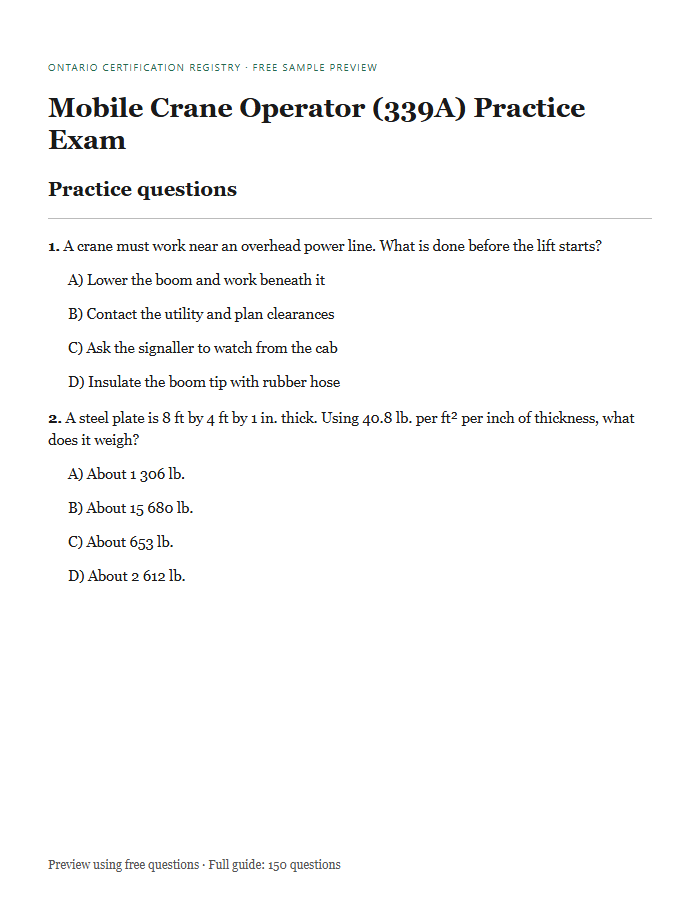
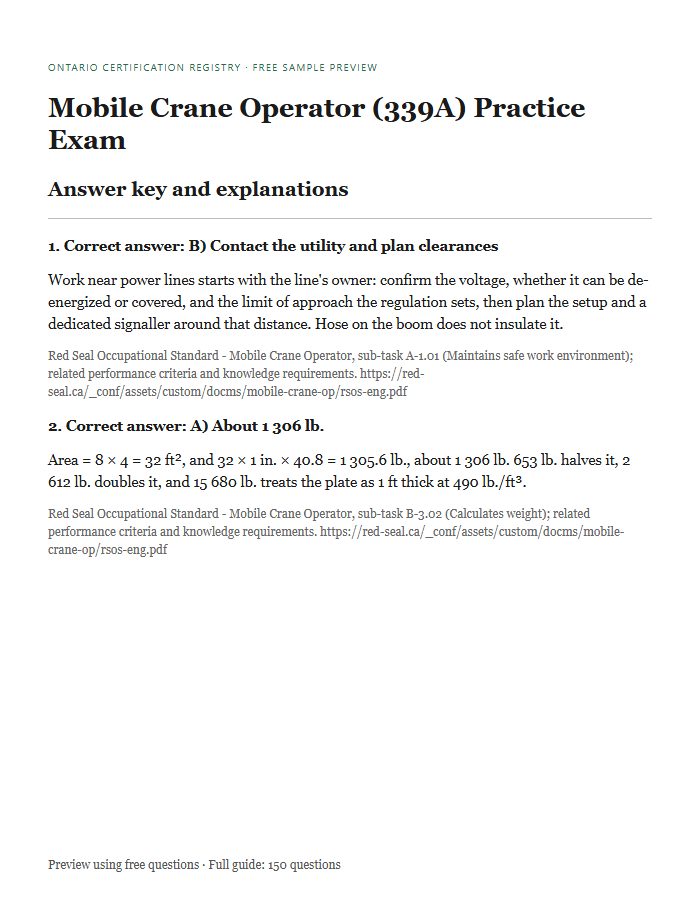
A preview of the question and answer-key layout, using questions from the free sample. The full guide contains all 150 questions.
What this guide covers
Published Red Seal exam question counts (110) scaled to 150 with whole-question rounding (largest remainder). The table shows the actual counts and shares in this guide.
| Major work activity | Questions here | Share of this guide |
|---|---|---|
| A. Performs common occupational skills | 10 | 6.7% |
| B. Performs hoisting calculations | 27 | 18% |
| C. Inspects and maintains crane | 19 | 12.7% |
| D. Performs rigging | 18 | 12% |
| E. Plans lift, prepares site and sets up crane | 22 | 14.7% |
| F. Assembles, disassembles and transports crane | 20 | 13.3% |
| G. Operates crane | 34 | 22.7% |
The published official exam has 110 questions. This guide contains 150 original study questions, with topic counts rounded to fit that length.
Coverage source: Published Red Seal exam breakdown
The mix of question types
The table compares this guide's mix with the published Red Seal ranges for this trade.
| Type | Questions here | Share | Published range |
|---|---|---|---|
| Knowledge and recall | 32 | 21.3% | 15 to 25% |
| Procedural and application | 93 | 62% | 60 to 70% |
| Critical thinking | 25 | 16.7% | 10 to 20% |
30 free sample questions from the Mobile Crane Operator bank
This fixed selection comes straight from the bank and covers every major work activity, with the answers and sources shown. Read them before you decide whether the rest is worth $67.49 to you.
Question 1: A crane must work near an overhead power line. What is done before the lift starts?
Sample 1 · Activity A
A crane must work near an overhead power line. What is done before the lift starts?
- Lower the boom and work beneath it
- Contact the utility and plan clearances (correct)
- Ask the signaller to watch from the cab
- Insulate the boom tip with rubber hose
Work near power lines starts with the line's owner: confirm the voltage, whether it can be de-energized or covered, and the limit of approach the regulation sets, then plan the setup and a dedicated signaller around that distance. Hose on the boom does not insulate it.
Red Seal Occupational Standard - Mobile Crane Operator, sub-task A-1.01 (Maintains safe work environment); related performance criteria and knowledge requirements. https://red-seal.ca/_conf/assets/custom/docms/mobile-crane-op/rsos-eng.pdf
Question 2: A load will be landed where the operator cannot see it. How is the lift directed?
Sample 2 · Activity A
A load will be landed where the operator cannot see it. How is the lift directed?
- By two signallers taking turns
- By any worker near the landing
- By one designated signaller in view (correct)
- By the operator judging the landing alone
A blind lift is directed by one designated, qualified signaller who can see both the load and the operator or is on a dedicated radio channel. Several people giving signals causes confusion, and the operator cannot judge a landing they cannot see.
Red Seal Occupational Standard - Mobile Crane Operator, sub-task A-2.01 (Uses communication techniques); related performance criteria and knowledge requirements. https://red-seal.ca/_conf/assets/custom/docms/mobile-crane-op/rsos-eng.pdf
Question 3: A steel plate is 8 ft by 4 ft by 1 in. thick. Using 40.8 lb. per ft² per inch of thickness, what does it weigh?
Sample 3 · Activity B
A steel plate is 8 ft by 4 ft by 1 in. thick. Using 40.8 lb. per ft² per inch of thickness, what does it weigh?
- About 1 306 lb. (correct)
- About 15 680 lb.
- About 653 lb.
- About 2 612 lb.
Area = 8 × 4 = 32 ft², and 32 × 1 in. × 40.8 = 1 305.6 lb., about 1 306 lb. 653 lb. halves it, 2 612 lb. doubles it, and 15 680 lb. treats the plate as 1 ft thick at 490 lb./ft³.
Red Seal Occupational Standard - Mobile Crane Operator, sub-task B-3.02 (Calculates weight); related performance criteria and knowledge requirements. https://red-seal.ca/_conf/assets/custom/docms/mobile-crane-op/rsos-eng.pdf
Question 4: A chart allows 42 000 lb. at a 40 ft radius. Deductions are a hook block of 1 200 lb., a stowed jib of 2 800 lb. and rigging of 500 lb. What load can be lifted?
Sample 4 · Activity B
A chart allows 42 000 lb. at a 40 ft radius. Deductions are a hook block of 1 200 lb., a stowed jib of 2 800 lb. and rigging of 500 lb. What load can be lifted?
- 37 500 lb. (correct)
- 39 200 lb.
- 41 500 lb.
- 42 000 lb.
Chart ratings are gross. Net capacity = 42 000 - 1 200 - 2 800 - 500 = 37 500 lb. 42 000 lb. ignores every deduction, 41 500 lb. takes off only the rigging, and 39 200 lb. takes off only the jib.
Red Seal Occupational Standard - Mobile Crane Operator, sub-task B-4.02 (Interprets load charts); related performance criteria and knowledge requirements. https://red-seal.ca/_conf/assets/custom/docms/mobile-crane-op/rsos-eng.pdf
Question 5: A chart lists 18 500 lb. at 50 ft and 15 200 lb. at 60 ft. The load radius will be 54 ft. Which rating is used?
Sample 5 · Activity B
A chart lists 18 500 lb. at 50 ft and 15 200 lb. at 60 ft. The load radius will be 54 ft. Which rating is used?
- 16 850 lb., the midpoint value
- 17 180 lb., interpolated between them
- 15 200 lb., the next longer radius (correct)
- 18 500 lb., the nearest radius
Load charts are not interpolated. When the radius falls between two listed values, the rating for the next longer radius, which is the lower capacity, is used: 15 200 lb.
Red Seal Occupational Standard - Mobile Crane Operator, sub-task B-4.02 (Interprets load charts); related performance criteria and knowledge requirements. https://red-seal.ca/_conf/assets/custom/docms/mobile-crane-op/rsos-eng.pdf
Question 6: A 12 000 lb. load hangs from a 2-leg bridle. Each leg is 10 ft long, and the hook is 8 ft above the load. What is the tension in each leg?
Sample 6 · Activity B
A 12 000 lb. load hangs from a 2-leg bridle. Each leg is 10 ft long, and the hook is 8 ft above the load. What is the tension in each leg?
- 7 500 lb. (correct)
- 9 600 lb.
- 6 000 lb.
- 4 800 lb.
Stress = W/N × L/H = 12 000 ÷ 2 × 10 ÷ 8 = 6 000 × 1.25 = 7 500 lb. 6 000 lb. ignores the sling angle, and 9 600 lb. and 4 800 lb. turn the L/H ratio upside down.
Red Seal Occupational Standard - Mobile Crane Operator, sub-task B-5.01 (Performs sling angle calculations); related performance criteria and knowledge requirements. https://red-seal.ca/_conf/assets/custom/docms/mobile-crane-op/rsos-eng.pdf
Question 7: A wire rope sling is used in a choker hitch. How does its capacity compare with its vertical rating?
Sample 7 · Activity B
A wire rope sling is used in a choker hitch. How does its capacity compare with its vertical rating?
- It is lower than the vertical rating (correct)
- It depends only on the load's weight
- It is double the vertical rating
- It is the same as the vertical rating
A choker bends the sling sharply where it chokes and puts uneven stress on it, so its rated capacity is lower than the vertical rating. The sling tag or maker's table gives the choker value.
Red Seal Occupational Standard - Mobile Crane Operator, sub-task B-5.02 (Performs working load limit (WLL) calculations); related performance criteria and knowledge requirements. https://red-seal.ca/_conf/assets/custom/docms/mobile-crane-op/rsos-eng.pdf
Question 8: A pinhole leak is suspected in a pressurized hydraulic hose. How is it located?
Sample 8 · Activity C
A pinhole leak is suspected in a pressurized hydraulic hose. How is it located?
- With cardboard held near the hose (correct)
- By running a hand along the hose
- By looking closely for a fine mist
- By loosening fittings one at a time
A pinhole jet of hydraulic oil can inject oil through skin, a serious injury. Leaks are found by passing cardboard or wood near the hose with the system safely managed, never with a hand or face close to it.
Red Seal Occupational Standard - Mobile Crane Operator, sub-task C-6.04 (Inspects hydraulic systems); related performance criteria and knowledge requirements. https://red-seal.ca/_conf/assets/custom/docms/mobile-crane-op/rsos-eng.pdf
Question 9: Which wire rope condition shows the outer strands opened up like a cage?
Sample 9 · Activity C
Which wire rope condition shows the outer strands opened up like a cage?
- Birdcaging (correct)
- Kinking
- Crushing
- Core protrusion
Birdcaging is when the outer strands open away from the core, usually after a sudden release of load or shock loading. It is a reason to remove the rope from service.
Red Seal Occupational Standard - Mobile Crane Operator, sub-task C-6.08 (Inspects hoisting systems); related performance criteria and knowledge requirements. https://red-seal.ca/_conf/assets/custom/docms/mobile-crane-op/rsos-eng.pdf
Question 10: How is the anti-two-block system checked before work?
Sample 10 · Activity C
How is the anti-two-block system checked before work?
- By testing it as the maker describes (correct)
- By reading the last inspection date
- By hoisting the block hard into the tip
- By checking the cab warning light only
The anti-two-block system is function-tested at the start of each shift following the maker's procedure, so it is proven to stop hoisting before the block contacts the boom tip. A date or a light alone does not prove it works.
Red Seal Occupational Standard - Mobile Crane Operator, sub-task C-7.02 (Inspects monitoring and warning systems); related performance criteria and knowledge requirements. https://red-seal.ca/_conf/assets/custom/docms/mobile-crane-op/rsos-eng.pdf
Question 11: How is lubricant best applied to a running wire rope in service?
Sample 11 · Activity C
How is lubricant best applied to a running wire rope in service?
- Brushed on while under full load
- Where it bends over a sheave or drum (correct)
- Sprayed only on the dead end
- Only on the drum's outer wraps
Applying lubricant where the rope bends over a sheave or drum, where the strands open, lets it work into the core. Coating only the outside, or only the dead end, leaves the inner wires dry.
Red Seal Occupational Standard - Mobile Crane Operator, sub-task C-8.03 (Lubricates wire ropes); related performance criteria and knowledge requirements. https://red-seal.ca/_conf/assets/custom/docms/mobile-crane-op/rsos-eng.pdf
Question 12: Which defect removes a synthetic web sling from service?
Sample 12 · Activity D
Which defect removes a synthetic web sling from service?
- A cut or burn on the webbing (correct)
- Mud on the webbing
- Being one year old
- A slight twist left from storage
Cuts, burns, melting, broken stitching and exposed red warning yarns remove a web sling from service. Dirt can be cleaned off, a twist straightened, and age alone is not a removal criterion.
Red Seal Occupational Standard - Mobile Crane Operator, sub-task D-9.02 (Identifies deficiencies in slings and hardware); related performance criteria and knowledge requirements. https://red-seal.ca/_conf/assets/custom/docms/mobile-crane-op/rsos-eng.pdf
Question 13: A rigger finds a hook whose throat has opened noticeably and whose latch no longer closes. What is done?
Sample 13 · Activity D
A rigger finds a hook whose throat has opened noticeably and whose latch no longer closes. What is done?
- Bend the throat back closed
- Tie the latch shut with wire
- Use it for lighter loads only
- Remove the hook from service (correct)
An opened throat shows the hook has been overloaded or damaged, so it is removed from service. Bending it back or wiring the latch does not restore its strength.
Red Seal Occupational Standard - Mobile Crane Operator, sub-task D-9.02 (Identifies deficiencies in slings and hardware); related performance criteria and knowledge requirements. https://red-seal.ca/_conf/assets/custom/docms/mobile-crane-op/rsos-eng.pdf
Question 14: Wire rope clips are installed on a rope end. Where does the saddle go?
Sample 14 · Activity D
Wire rope clips are installed on a rope end. Where does the saddle go?
- Wherever the clip fits best
- Alternating from clip to clip
- On the live (load) end of the rope (correct)
- On the dead (tail) end of the rope
The saddle goes on the live, load-carrying part and the U-bolt on the dead end ("never saddle a dead horse"). Reversed clips crush the live line and greatly reduce the termination's strength.
Red Seal Occupational Standard - Mobile Crane Operator, sub-task D-10.02 (Rigs loads); related performance criteria and knowledge requirements. https://red-seal.ca/_conf/assets/custom/docms/mobile-crane-op/rsos-eng.pdf
Question 15: A load starts to tilt as it lifts, showing the hook is not over the centre of gravity. What is done?
Sample 15 · Activity D
A load starts to tilt as it lifts, showing the hook is not over the centre of gravity. What is done?
- Pull it level with tag lines
- Lift faster to steady it
- Swing so it hangs straighter
- Land it and re-rig over the centre (correct)
A tilting load shows the rigging is not balanced over the centre of gravity, which can shift the load or overload one sling. The load is landed and re-rigged; tag lines and speed do not correct the balance.
Red Seal Occupational Standard - Mobile Crane Operator, sub-task D-10.03 (Monitors rigging); related performance criteria and knowledge requirements. https://red-seal.ca/_conf/assets/custom/docms/mobile-crane-op/rsos-eng.pdf
Question 16: An outrigger carries 64 000 lb. on a 4 ft by 4 ft mat. The soil allows 5 000 lb./ft². What is the bearing pressure, and is it within the limit?
Sample 16 · Activity E
An outrigger carries 64 000 lb. on a 4 ft by 4 ft mat. The soil allows 5 000 lb./ft². What is the bearing pressure, and is it within the limit?
- 4 000 lb./ft², within the limit (correct)
- 1 000 lb./ft², within the limit
- 16 000 lb./ft², over the limit
- 64 000 lb./ft², over the limit
Pressure = load ÷ area = 64 000 ÷ (4 × 4) = 4 000 lb./ft², below the 5 000 lb./ft² allowed. 16 000 divides by one side only, and 1 000 divides by the area twice.
Red Seal Occupational Standard - Mobile Crane Operator, sub-task E-11.01 (Participates in routine, engineered and specialty lift planning); related performance criteria and knowledge requirements. https://red-seal.ca/_conf/assets/custom/docms/mobile-crane-op/rsos-eng.pdf
Question 17: The lift path passes over a lunchroom that is in use. What is done?
Sample 17 · Activity E
The lift path passes over a lunchroom that is in use. What is done?
- Clear and barricade the area below (correct)
- Lift quickly over the roof
- Warn people with the horn only
- Keep the load as high as possible
Loads are not carried over people. The area under the lift path is cleared and barricaded for the lift, or the path is changed; speed, height and a horn do not protect people below.
Red Seal Occupational Standard - Mobile Crane Operator, sub-task E-11.02 (Evaluates risks and hazards); related performance criteria and knowledge requirements. https://red-seal.ca/_conf/assets/custom/docms/mobile-crane-op/rsos-eng.pdf
Question 18: A crane on outriggers is set up for a lift from the outrigger chart. What is the state of the tires?
Sample 18 · Activity E
A crane on outriggers is set up for a lift from the outrigger chart. What is the state of the tires?
- Carrying half the weight
- Resting firmly on the ground
- Clear of the ground (correct)
- Deflated to lower the crane
Outrigger charts assume the crane's whole weight is on the outriggers, so the tires are raised clear of the ground. Tires carrying weight change the support and can let the crane move.
Red Seal Occupational Standard - Mobile Crane Operator, sub-task E-12.03 (Completes setup); related performance criteria and knowledge requirements. https://red-seal.ca/_conf/assets/custom/docms/mobile-crane-op/rsos-eng.pdf
Question 19: A crane must set up on frozen ground that will thaw by afternoon. What is planned?
Sample 19 · Activity E
A crane must set up on frozen ground that will thaw by afternoon. What is planned?
- Mats sized for frozen ground
- Mats sized for thawed soil (correct)
- Morning lifts only, with no mats
- No mats; frozen ground is solid
Frozen ground can lose most of its strength as it thaws during the day. Support is planned for the weakest condition the crane will see, so mats are sized for the thawed soil.
Red Seal Occupational Standard - Mobile Crane Operator, sub-task E-12.02 (Positions crane); related performance criteria and knowledge requirements. https://red-seal.ca/_conf/assets/custom/docms/mobile-crane-op/rsos-eng.pdf
Question 20: Under the National Safety Code cargo securement standard, the tiedowns' working load limits must total at least what share of the cargo's weight?
Sample 20 · Activity F
Under the National Safety Code cargo securement standard, the tiedowns' working load limits must total at least what share of the cargo's weight?
- 25%
- 10%
- 100%
- 50% (correct)
National Safety Code Standard 10 requires the aggregate working load limit of the tiedowns securing an article to be at least half of its weight, along with minimum numbers of tiedowns for its length.
Red Seal Occupational Standard - Mobile Crane Operator, sub-task F-13.01 (Loads crane and components); related performance criteria and knowledge requirements. https://red-seal.ca/_conf/assets/custom/docms/mobile-crane-op/rsos-eng.pdf
Question 21: A telescopic crane is prepared for road travel. What is done with the hook block?
Sample 21 · Activity F
A telescopic crane is prepared for road travel. What is done with the hook block?
- Removed and left on site
- Raised hard against the tip
- Secured so it cannot swing (correct)
- Left hanging below the tip
A hanging block can swing into traffic or the cab, and raising it hard against the tip strains the rope and anti-two-block system. It is secured to its tie-down point as the maker describes.
Red Seal Occupational Standard - Mobile Crane Operator, sub-task F-14.02 (Prepares crane for transport); related performance criteria and knowledge requirements. https://red-seal.ca/_conf/assets/custom/docms/mobile-crane-op/rsos-eng.pdf
Question 22: A lattice crawler crane's boom has been removed, but full counterweight is still on. What is the danger?
Sample 22 · Activity F
A lattice crawler crane's boom has been removed, but full counterweight is still on. What is the danger?
- Tipping backward (correct)
- Tipping forward
- Track slippage
- Boom deflection
Counterweight balances the boom and load. With the boom removed and full counterweight on, the crane can tip backward, especially on a slope or when swinging. The maker's sequence prevents this.
Red Seal Occupational Standard - Mobile Crane Operator, sub-task F-15.10 (Removes counterweights (lattice boom)); related performance criteria and knowledge requirements. https://red-seal.ca/_conf/assets/custom/docms/mobile-crane-op/rsos-eng.pdf
Question 23: A stowed jib stays on the side of the boom during a main-boom lift. How does it affect capacity?
Sample 23 · Activity F
A stowed jib stays on the side of the boom during a main-boom lift. How does it affect capacity?
- It adds to the crane's rated capacity
- It has no effect when stowed
- It is deducted as the chart says (correct)
- It only affects the swing speed
A stowed jib's weight is carried by the boom, so the chart notes give a deduction for it from main-boom capacity. Ignoring it overstates what the crane can lift.
Red Seal Occupational Standard - Mobile Crane Operator, sub-task F-16.07 (Installs jibs and inserts (telescopic boom)); related performance criteria and knowledge requirements. https://red-seal.ca/_conf/assets/custom/docms/mobile-crane-op/rsos-eng.pdf
Question 24: A clamshell bucket is attached for excavation. How is capacity read?
Sample 24 · Activity F
A clamshell bucket is attached for excavation. How is capacity read?
- Use the full lifting chart rating
- Add the bucket weight to capacity
- Use the maker's duty-cycle rating (correct)
- Ignore the bucket weight while digging
Clamshell work is repetitive, dynamic duty-cycle work, so the maker's duty-cycle ratings apply, which are lower than lifting crane ratings. The bucket and its load count toward that rating.
Red Seal Occupational Standard - Mobile Crane Operator, sub-task F-17.01 (Assembles specialty equipment and attachments); related performance criteria and knowledge requirements. https://red-seal.ca/_conf/assets/custom/docms/mobile-crane-op/rsos-eng.pdf
Question 25: The crane's outriggers are at mid-extension, but the LMI is set for full extension. What is the risk?
Sample 25 · Activity G
The crane's outriggers are at mid-extension, but the LMI is set for full extension. What is the risk?
- The LMI will allow more than is safe (correct)
- The LMI shuts down every lift
- There is no risk at all on a level site
- The boom cannot be raised
Full extension has higher ratings than mid-extension. With the wrong setting, the LMI uses the higher limits and will not warn before the crane exceeds its real capacity.
Red Seal Occupational Standard - Mobile Crane Operator, sub-task G-18.01 (Configures electronic operational aids); related performance criteria and knowledge requirements. https://red-seal.ca/_conf/assets/custom/docms/mobile-crane-op/rsos-eng.pdf
Question 26: On a friction crane, how is a load normally lowered under control?
Sample 26 · Activity G
On a friction crane, how is a load normally lowered under control?
- By releasing the drum brake fully
- By reversing the engine
- By applying the swing brake
- By modulating the drum brake (correct)
Friction machines lower loads by controlled release of the drum brake, letting the load descend at the speed the operator chooses. Releasing it fully drops the load.
Red Seal Occupational Standard - Mobile Crane Operator, sub-task G-19.02 (Operates friction drive truck-mounted lattice boom cranes); related performance criteria and knowledge requirements. https://red-seal.ca/_conf/assets/custom/docms/mobile-crane-op/rsos-eng.pdf
Question 27: Before swinging a crawler crane under load, what is checked behind the upper?
Sample 27 · Activity G
Before swinging a crawler crane under load, what is checked behind the upper?
- The tail swing clearance (correct)
- The track tension
- The fuel gauge reading
- The boom angle reading
The counterweight swings behind the upper, so the clearance to structures, equipment and people is checked before swinging. Track tension and fuel are not swing hazards.
Red Seal Occupational Standard - Mobile Crane Operator, sub-task G-20.01 (Operates hydraulic drive crawler-mounted lattice boom cranes); related performance criteria and knowledge requirements. https://red-seal.ca/_conf/assets/custom/docms/mobile-crane-op/rsos-eng.pdf
Question 28: A rough terrain crane must telescope the boom with a load on. What is checked first?
Sample 28 · Activity G
A rough terrain crane must telescope the boom with a load on. What is checked first?
- The engine oil temperature
- The tires are fully inflated to spec
- The cab door is closed and latched
- The chart permits telescoping loaded (correct)
Not every crane may telescope under load, and those that can have limits. The chart and maker's notes are checked before extending with a load on the hook.
Red Seal Occupational Standard - Mobile Crane Operator, sub-task G-21.02 (Operates rubber tire-mounted telescopic cranes); related performance criteria and knowledge requirements. https://red-seal.ca/_conf/assets/custom/docms/mobile-crane-op/rsos-eng.pdf
Question 29: Workers will be lifted in a personnel basket. What is done before they ride?
Sample 29 · Activity G
Workers will be lifted in a personnel basket. What is done before they ride?
- Lifting them at top hoist speed
- Only a check of the basket tag
- A test with one worker inside
- A trial lift with the basket weighted (correct)
Before personnel are hoisted, the empty basket is loaded with weight and lifted through the planned path as a trial, proving the crane, rigging and route. Workers never ride a test.
Red Seal Occupational Standard - Mobile Crane Operator, sub-task G-22.05 (Uses personnel hoisting equipment); related performance criteria and knowledge requirements. https://red-seal.ca/_conf/assets/custom/docms/mobile-crane-op/rsos-eng.pdf
Question 30: An operator must leave the controls briefly. What is done with the load?
Sample 30 · Activity G
An operator must leave the controls briefly. What is done with the load?
- Lower it halfway down
- Leave it hanging with the brake set
- Land it before leaving the seat (correct)
- Ask the signaller to hold it
An operator does not leave the controls with a load suspended. The load is landed, the controls set to neutral and the brakes and locks applied first.
Red Seal Occupational Standard - Mobile Crane Operator, sub-task G-23.01 (Secures crane for short term); related performance criteria and knowledge requirements. https://red-seal.ca/_conf/assets/custom/docms/mobile-crane-op/rsos-eng.pdf
Before you buy
- These questions use the cited occupational standards, curriculum and technical references. Nothing here is reproduced from a real exam.
- Passing this does not guarantee passing the certifying exam, and nothing here is a substitute for the training standard or your in-school hours.
- It is a PDF. There is no login, no expiry and no subscription, and you can print it.
- Automated structure and distribution checks are complete. Technical accuracy review by a licensed tradesperson remains outstanding.
Questions about your purchase or a missing PDF? Contact Blue Crane Works with the email used at checkout. The download link lasts 30 days; your saved PDF does not expire.
When you are ready for the real exam
You book the 339A certifying exam yourself in the Skilled Trades Ontario Portal ($150 plus HST) and write it at one of 24 exam centres, or at your college in your final level of school. How to book it and find the nearest centre.
Writing in Alberta, BC or Manitoba? Same Red Seal exam
The Mobile Crane Operator exam is the national Red Seal exam, so this practice exam fits writers in other provinces too, wherever the trade carries the Red Seal. Trade names differ by province.
Where the exam facts on this page come from
Published Red Seal exam question counts (110) scaled to 150 with whole-question rounding (largest remainder). The regulation and issuing authority explain the actual credential and examination requirements.
The free reference material for this trade
Everything about the certification itself, the classification, the hours, the ratio and the official sources, stays free on this site and always will. The practice exam is the only thing here that costs anything.
Other practice exams
 309AConstruction Electrician
 G.2Gas Technician 2
 306APlumber
 433AIndustrial Mechanic Millwright
 310SAutomotive Service Technician
 G.3Gas Technician 3
 310TTruck and Coach Technician
 332AHairstylist
 442AIndustrial Electrician
 308ASheet Metal Worker
 415ACook
 456AWelder
 429AGeneral Machinist
 339BTower Crane Operator