Free practice test
Try 30 questions free
Work through 30 questions, then see your score, results by topic and an explanation for every answer. No account or email needed.
These are 30 of the 150 questions in the full PDF. You can also read the questions and answers below.
The full 150-question PDF
Includes the 30 free questions plus 120 additional questions, explanations and references. One payment, no subscription.
| Questions | 150, all original |
|---|---|
| Answer key | Correct answer, the reasoning, and a cited source for each question |
| Distinct references | 84 distinct citations across the bank |
| Free samples here | 30, with answers, below |
| Format | PDF, emailed on purchase, plus a download link valid 30 days |
| Price | $67.49 CAD, one payment, no subscription |
Payment is handled by Stripe. This is study material, not an official exam, and it is not affiliated with Skilled Trades Ontario, TSSA or the Red Seal program.
Look inside the PDF
A preview of the question and answer-key layout, using questions from the free sample. The full guide contains all 150 questions.
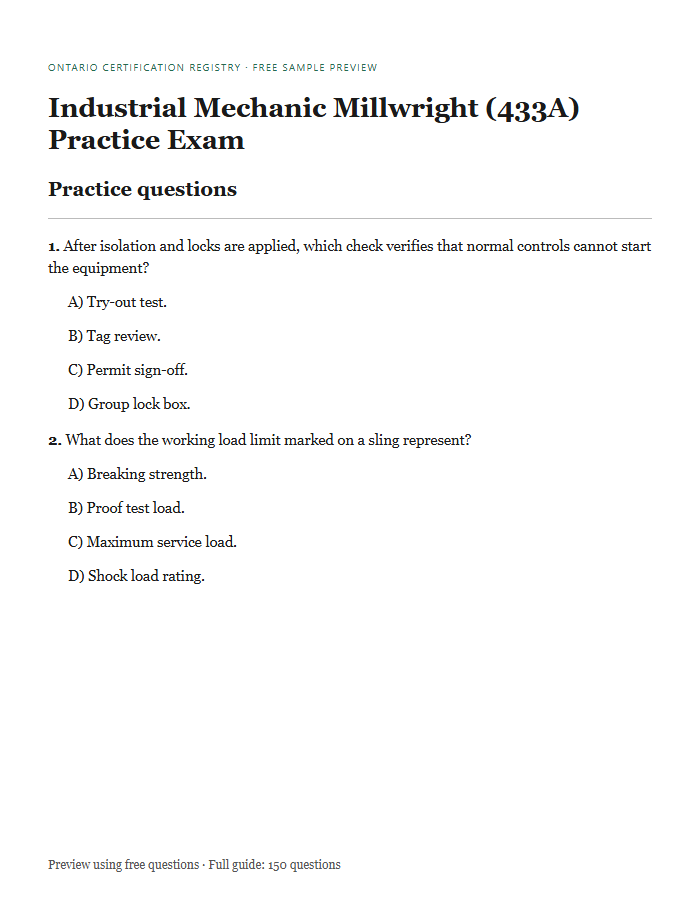
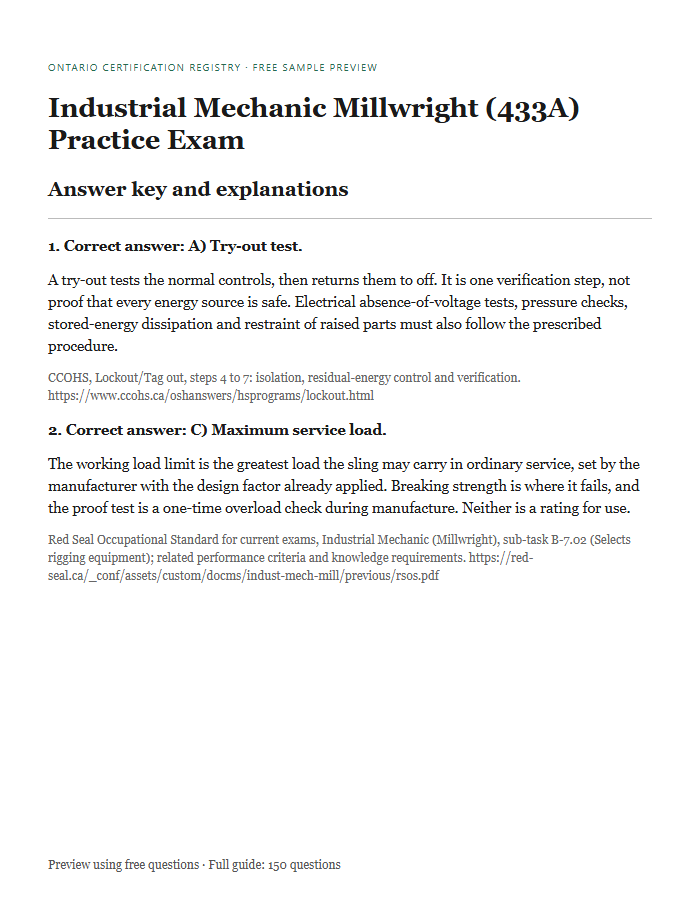
What this guide covers
This guide scales the published Red Seal major-work-activity distribution to 150 questions, rounded to whole questions. The table shows the actual counts and shares in this guide.
| Major work activity | Questions here | Share of this guide |
|---|---|---|
| A. Performs common occupational skills | 28 | 18.7% |
| B. Performs rigging, hoisting/lifting and moving | 19 | 12.7% |
| C. Services mechanical power transmission components and systems | 35 | 23.3% |
| D. Services material handling / process systems | 27 | 18% |
| E. Services fluid power systems | 23 | 15.3% |
| F. Performs preventative and predictive maintenance, commissioning and decommissioning | 18 | 12% |
The published official exam has 135 questions. This guide contains 150 original study questions, with topic counts rounded to fit that length.
Coverage source: Published Red Seal exam breakdown
The mix of question types
The table compares this guide's mix with the published Red Seal ranges for this trade.
| Type | Questions here | Share | Published range |
|---|---|---|---|
| Knowledge and recall | 52 | 34.7% | 30 to 40% |
| Procedural and application | 63 | 42% | 40 to 50% |
| Critical thinking | 35 | 23.3% | 20 to 30% |
30 free sample questions from the Industrial Mechanic Millwright bank
This fixed selection comes straight from the bank and covers every major work activity, with the answers and sources shown. Read them before you decide whether the rest is worth $67.49 to you.
Question 1: After isolation and locks are applied, which check verifies that normal controls cannot start the equipment?
Sample 1 · Activity A
After isolation and locks are applied, which check verifies that normal controls cannot start the equipment?
- Try-out test. (correct)
- Tag review.
- Permit sign-off.
- Group lock box.
A try-out tests the normal controls, then returns them to off. It is one verification step, not proof that every energy source is safe. Electrical absence-of-voltage tests, pressure checks, stored-energy dissipation and restraint of raised parts must also follow the prescribed procedure.
CCOHS, Lockout/Tag out, steps 4 to 7: isolation, residual-energy control and verification. https://www.ccohs.ca/oshanswers/hsprograms/lockout.html
Question 2: A worker applies only a warning tag to an isolating device that can be locked. Why does that fail to physically prevent an unexpected restart?
Sample 2 · Activity A
A worker applies only a warning tag to an isolating device that can be locked. Why does that fail to physically prevent an unexpected restart?
- Tag applied without lock. (correct)
- Lock applied to guard.
- Tag signed by two trades.
- Lock rated for outdoors.
A tag warns but does not physically hold an isolating device in its safe position. Use the required lockout and verification procedure for all energy sources. Actual unexpected restart can have several causes; this question expressly supplies the tag-only defect.
CCOHS, Lockout/Tag out, steps 4 to 7: isolation, residual-energy control and verification. https://www.ccohs.ca/oshanswers/hsprograms/lockout.html
Question 3: Which document gives the hazards of a lubricant before handling?
Sample 3 · Activity A
Which document gives the hazards of a lubricant before handling?
- Purchase order.
- Safety data sheet. (correct)
- Equipment manual.
- Inspection record.
The safety data sheet is the WHMIS document supplied for every hazardous product. It carries the hazard identification, first-aid measures, handling and storage, exposure controls and the personal protective equipment required. The equipment manual covers the machine, not the product's hazards.
Red Seal Occupational Standard for current exams, Industrial Mechanic (Millwright), sub-task A-1.01 (Uses personal protective equipment (PPE) and safety equipment); related performance criteria and knowledge requirements. https://red-seal.ca/_conf/assets/custom/docms/indust-mech-mill/previous/rsos.pdf
Question 4: A workplace atmosphere has not been characterized and its oxygen level is unknown. What is the first action before routine entry?
Sample 4 · Activity A
A workplace atmosphere has not been characterized and its oxygen level is unknown. What is the first action before routine entry?
- Half mask, P100.
- Full face, organic.
- Assess hazards before entry. (correct)
- Powered, HEPA.
Do not enter an uncharacterized atmosphere on a guess about respiratory equipment. Assess oxygen, contaminants and entry hazards and implement the prescribed entry and rescue plan. Air-purifying filters do not supply oxygen. Any required IDLH respirator must meet the complete specified supplied-air/escape or SCBA requirements.
CCOHS, Lockout/Tag out, steps 4 to 7: isolation, residual-energy control and verification. https://www.ccohs.ca/oshanswers/hsprograms/lockout.html; Red Seal Occupational Standard, Industrial Mechanic (Millwright), A-1.01 and A-1.02, hazard assessment and PPE.
Question 5: Where is waste cutting oil placed after a shaft machining job?
Sample 5 · Activity A
Where is waste cutting oil placed after a shaft machining job?
- Shop floor drain.
- General waste bin.
- Labelled waste drum. (correct)
- Parts wash tank.
Used cutting oil is a controlled waste. It goes into a labelled, closed container for collection by a licensed hauler. A floor drain discharges to the storm or sanitary system and is an environmental release; general waste and the parts washer both put the oil where it does not belong.
Red Seal Occupational Standard for current exams, Industrial Mechanic (Millwright), sub-task A-1.03 (Protects the environment); related performance criteria and knowledge requirements. https://red-seal.ca/_conf/assets/custom/docms/indust-mech-mill/previous/rsos.pdf
Question 6: The specified general-purpose twist drill for a mild-steel job has a 118-degree included point. Which point angle matches that specification?
Sample 6 · Activity A
The specified general-purpose twist drill for a mild-steel job has a 118-degree included point. Which point angle matches that specification?
- 90°
- 100°
- 118° (correct)
- 135°
Select the specified 118-degree point for this job. Drill point geometry varies with the tool, material and cutting conditions; 135-degree and other geometries are also used for steel. Follow the drill manufacturer's cutting data instead of treating one angle as universal.
Red Seal Occupational Standard for current exams, Industrial Mechanic (Millwright), sub-task A-2.01 (Uses hand and portable power tools); related performance criteria and knowledge requirements. https://red-seal.ca/_conf/assets/custom/docms/indust-mech-mill/previous/rsos.pdf
Question 7: What does the working load limit marked on a sling represent?
Sample 7 · Activity B
What does the working load limit marked on a sling represent?
- Breaking strength.
- Proof test load.
- Maximum service load. (correct)
- Shock load rating.
The working load limit is the greatest load the sling may carry in ordinary service, set by the manufacturer with the design factor already applied. Breaking strength is where it fails, and the proof test is a one-time overload check during manufacture. Neither is a rating for use.
Red Seal Occupational Standard for current exams, Industrial Mechanic (Millwright), sub-task B-7.02 (Selects rigging equipment); related performance criteria and knowledge requirements. https://red-seal.ca/_conf/assets/custom/docms/indust-mech-mill/previous/rsos.pdf
Question 8: A symmetric two-leg sling is moved from vertical legs to 30 degrees above horizontal without changing the load. What happens to each leg's tension?
Sample 8 · Activity B
A symmetric two-leg sling is moved from vertical legs to 30 degrees above horizontal without changing the load. What happens to each leg's tension?
- It doubles from vertical. (correct)
- Load is off centre.
- Hitch angle too steep.
- Legs are unequal.
For equal legs and a centred load, T = W/(2 sin(theta)). At 90 degrees, T = W/2. At 30 degrees, T = W, twice the vertical per-leg tension. Check the actual sling and attachment ratings at the hitch and angle; a rating for a different configuration cannot be assumed.
CCOHS, Materials Handling: Selecting Slings, manufacturer ratings, geometry and sling strength factors. https://www.ccohs.ca/oshanswers/safety_haz/materials_handling/sling_choosing.html Arithmetic: stated symmetric geometry and sine relationship.
Question 9: Two legs share a 1000 kg load at 60° to horizontal. What is leg tension?
Sample 9 · Activity B
Two legs share a 1000 kg load at 60° to horizontal. What is leg tension?
- 500 kg
- 577 kg (correct)
- 707 kg
- 1000 kg
For the symmetric lift, T = (1000/2)/sin(60 degrees) = 577 kgf, approximately 5.66 kN per leg. The options express the customary equivalent load in kg, rather than an SI force unit. Check rated capacities for the actual hitch and components.
CCOHS, Materials Handling: Selecting Slings, manufacturer ratings, geometry and sling strength factors. https://www.ccohs.ca/oshanswers/safety_haz/materials_handling/sling_choosing.html Arithmetic: supplied load and angle.
Question 10: The sling manufacturer permits this planned lift only at angles of at least 30 degrees to horizontal. What is the minimum permitted angle for this setup?
Sample 10 · Activity B
The sling manufacturer permits this planned lift only at angles of at least 30 degrees to horizontal. What is the minimum permitted angle for this setup?
- 15°
- 30° (correct)
- 45°
- 60°
The supplied manufacturer condition sets 30 degrees for this setup. Other slings, hitches and engineered lifts have their own limits. Verify the actual angle, centre of gravity and all component capacities rather than assuming a universal floor.
CCOHS, Materials Handling: Selecting Slings, manufacturer ratings, geometry and sling strength factors. https://www.ccohs.ca/oshanswers/safety_haz/materials_handling/sling_choosing.html
Question 11: A supplied bearing chart defines bore codes 04 and higher as five times the code in millimetres. What bore does its listed code 05 represent?
Sample 11 · Activity C
A supplied bearing chart defines bore codes 04 and higher as five times the code in millimetres. What bore does its listed code 05 represent?
- 5 mm.
- 10 mm.
- 50 mm.
- 25 mm. (correct)
Apply the supplied chart convention: 5 x 5 = 25 mm. For an actual bearing, use the manufacturer's complete designation information, including exceptions and special codes.
Red Seal Occupational Standard for current exams, Industrial Mechanic (Millwright), sub-task C-10.01 (Installs shafts, bearings and seals); related performance criteria and knowledge requirements. https://red-seal.ca/_conf/assets/custom/docms/indust-mech-mill/previous/rsos.pdf; supplied scenario conditions; verify the applicable approved procedure for actual work.
Question 12: A shaft rotates while the bearing load direction is stationary relative to the housing. Which ring experiences a rotating load and normally needs the interference fit?
Sample 12 · Activity C
A shaft rotates while the bearing load direction is stationary relative to the housing. Which ring experiences a rotating load and normally needs the interference fit?
- Outer ring.
- Both rings.
- Neither ring.
- Inner ring. (correct)
The inner ring turns relative to the supplied stationary load direction, so it experiences the rotating load. Fit selection still depends on the bearing type, duty, temperature, clearance and manufacturer's recommendations; a rotating shaft alone does not define every fit.
Red Seal Occupational Standard for current exams, Industrial Mechanic (Millwright), sub-task C-10.01 (Installs shafts, bearings and seals); related performance criteria and knowledge requirements. https://red-seal.ca/_conf/assets/custom/docms/indust-mech-mill/previous/rsos.pdf
Question 13: An unsealed bearing's supplied installation instruction limits heating to 125 C. Which listed temperature is the maximum permitted by that instruction?
Sample 13 · Activity C
An unsealed bearing's supplied installation instruction limits heating to 125 C. Which listed temperature is the maximum permitted by that instruction?
- 80 °C
- 100 °C
- 125 °C (correct)
- 160 °C
Use the supplied instruction's 125 C limit for this example. Heating limits vary with bearing construction, seals, lubricant and material stabilization. Do not transfer this exercise value to another bearing; use its actual manufacturer limit and approved controlled-heating method.
Red Seal Occupational Standard for current exams, Industrial Mechanic (Millwright), sub-task C-10.01 (Installs shafts, bearings and seals); related performance criteria and knowledge requirements. https://red-seal.ca/_conf/assets/custom/docms/indust-mech-mill/previous/rsos.pdf
Question 14: A new bearing pressed onto a shaft has raceway indentations. What is the cause?
Sample 14 · Activity C
A new bearing pressed onto a shaft has raceway indentations. What is the cause?
- Clearance too tight.
- Grease incompatible.
- Shaft undersized.
- Force through rollers. (correct)
Pressing on the outer ring to seat an inner ring drives the mounting force through the balls or rollers, denting the raceways. This is true brinelling and the bearing is finished before it ever runs. The press force must always be applied to the ring being fitted.
Red Seal Occupational Standard for current exams, Industrial Mechanic (Millwright), sub-task C-10.01 (Installs shafts, bearings and seals); related performance criteria and knowledge requirements. https://red-seal.ca/_conf/assets/custom/docms/indust-mech-mill/previous/rsos.pdf
Question 15: A supplied bearing chart defines C3 as radial internal clearance greater than its normal-clearance category. Which description matches C3 on that chart?
Sample 15 · Activity C
A supplied bearing chart defines C3 as radial internal clearance greater than its normal-clearance category. Which description matches C3 on that chart?
- Ceramic rolling elements.
- Three-piece riveted cage.
- Class 3 bore tolerance.
- Greater internal clearance. (correct)
Use the supplied chart definition: C3 has greater radial internal clearance than the normal category. Verify the actual bearing manufacturer's tables and the application requirements before selecting a bearing.
Red Seal Occupational Standard for current exams, Industrial Mechanic (Millwright), sub-task C-10.01 (Installs shafts, bearings and seals); related performance criteria and knowledge requirements. https://red-seal.ca/_conf/assets/custom/docms/indust-mech-mill/previous/rsos.pdf; supplied scenario conditions; verify the applicable approved procedure for actual work.
Question 16: Bearing damage returns after two replacements. Alignment, lubricant and load are verified within limits. An approved test identifies electrical discharges through the bearing. Which condition should be addressed beyond another replacement?
Sample 16 · Activity C
Bearing damage returns after two replacements. Alignment, lubricant and load are verified within limits. An approved test identifies electrical discharges through the bearing. Which condition should be addressed beyond another replacement?
- Belt over-tension.
- Misalignment.
- Contaminated grease.
- Shaft current passage. (correct)
Replacement alone has not removed the cause. The scenario provides acceptable alignment, lubrication and load measurements plus a procedure-confirmed electrical-discharge finding. Investigate and correct the shaft-current path using the approved equipment procedure. Appearance alone would not establish that cause.
Red Seal Occupational Standard for current exams, Industrial Mechanic (Millwright), sub-task C-10.02 (Diagnoses shafts, bearings and seals); related performance criteria and knowledge requirements. https://red-seal.ca/_conf/assets/custom/docms/indust-mech-mill/previous/rsos.pdf; supplied scenario conditions; verify the applicable approved procedure for actual work.
Question 17: Identical idle bearings are stored with the same lubricant, wrapping and dry conditions. A controlled trial finds damage only on the vibrating idle machine; the isolated set remains undamaged. Which storage exposure should be investigated?
Sample 17 · Activity C
Identical idle bearings are stored with the same lubricant, wrapping and dry conditions. A controlled trial finds damage only on the vibrating idle machine; the isolated set remains undamaged. Which storage exposure should be investigated?
- Vibration while idle. (correct)
- Grease separation.
- Humid storage air.
- Wrapper adhesive.
The controlled comparison holds the bearing, lubricant, wrapping and humidity conditions constant. Damage follows storage on the vibrating idle machine, making idle vibration the exposure to investigate. Verify the actual preservation procedure and cause before choosing a remedy.
Red Seal Occupational Standard for current exams, Industrial Mechanic (Millwright), sub-task C-10.02 (Diagnoses shafts, bearings and seals); related performance criteria and knowledge requirements. https://red-seal.ca/_conf/assets/custom/docms/indust-mech-mill/previous/rsos.pdf; supplied scenario conditions; verify the applicable approved procedure for actual work.
Question 18: What is done before entering the working envelope of an industrial robot?
Sample 18 · Activity D
What is done before entering the working envelope of an industrial robot?
- Reduce program speed.
- Switch to teach mode.
- Lock out and verify. (correct)
- Announce over radio.
A robot can move on a stored program at any time and its reach is not obvious from inside the cell. The cell is locked out and the zero-energy state verified before entry, including stored pneumatic and hydraulic energy and any counterbalance that could drop an arm.
Red Seal Occupational Standard for current exams, Industrial Mechanic (Millwright), sub-task D-15.03 (Maintains robotics and automated equipment); related performance criteria and knowledge requirements. https://red-seal.ca/_conf/assets/custom/docms/indust-mech-mill/previous/rsos.pdf
Question 19: Which reference is restored after replacing a robot axis servo motor?
Sample 19 · Activity D
Which reference is restored after replacing a robot axis servo motor?
- Cycle counter.
- Payload setting.
- Encoder home position. (correct)
- Cell light curtain.
The controller tracks each axis position from its encoder against a stored home reference. Replacing the motor breaks that relationship, so the axis must be mastered or homed to its calibration marks before the robot is allowed to run a program.
Red Seal Occupational Standard for current exams, Industrial Mechanic (Millwright), sub-task D-15.04 (Repairs robotics and automated equipment); related performance criteria and knowledge requirements. https://red-seal.ca/_conf/assets/custom/docms/indust-mech-mill/previous/rsos.pdf
Question 20: In which direction does a centrifugal fan wheel move air?
Sample 20 · Activity D
In which direction does a centrifugal fan wheel move air?
- Along the shaft.
- Against rotation.
- Radially outward. (correct)
- Back to inlet.
A centrifugal fan takes air in at the eye, accelerates it outward by centrifugal force and discharges it at the scroll, turning the flow through ninety degrees. An axial fan moves air parallel to its shaft instead, which is the basic difference between the two families.
Red Seal Occupational Standard for current exams, Industrial Mechanic (Millwright), sub-task D-16.01 (Installs fans and blowers); related performance criteria and knowledge requirements. https://red-seal.ca/_conf/assets/custom/docms/indust-mech-mill/previous/rsos.pdf
Question 21: How is a fan wheel corrected for imbalance after cleaning?
Sample 21 · Activity D
How is a fan wheel corrected for imbalance after cleaning?
- Add balance weights. (correct)
- Increase belt tension.
- Reduce shaft speed.
- Shim the bearings.
Imbalance is corrected at the rotating element by adding or removing weight, guided by a balancing instrument that gives the amount and angular position. Changing speed or tension moves the symptom around but leaves the heavy spot where it was.
Red Seal Occupational Standard for current exams, Industrial Mechanic (Millwright), sub-task D-16.04 (Repairs fans and blowers); related performance criteria and knowledge requirements. https://red-seal.ca/_conf/assets/custom/docms/indust-mech-mill/previous/rsos.pdf
Question 22: A fan draws high current after a new drive sheave is fitted. What is the cause?
Sample 22 · Activity D
A fan draws high current after a new drive sheave is fitted. What is the cause?
- Belt tension low.
- Speed increased. (correct)
- Filter loaded up.
- Damper closed in.
Fan power rises with the cube of speed, so a modest increase in fan speed from a larger drive sheave produces a large increase in absorbed power and can overload the motor. Fan laws make sheave changes a calculation, not a trial.
Red Seal Occupational Standard for current exams, Industrial Mechanic (Millwright), sub-task D-16.02 (Diagnoses fans and blowers); related performance criteria and knowledge requirements. https://red-seal.ca/_conf/assets/custom/docms/indust-mech-mill/previous/rsos.pdf
Question 23: What creates pressure in a hydraulic system?
Sample 23 · Activity E
What creates pressure in a hydraulic system?
- Pump displacement.
- Resistance to flow. (correct)
- Reservoir head.
- Fluid viscosity.
A pump produces flow, not pressure. Pressure appears only when that flow meets resistance, whether a load on a cylinder, a restriction, or a closed valve. A pump discharging to an open tank develops almost no pressure no matter how large it is.
Red Seal Occupational Standard for current exams, Industrial Mechanic (Millwright), sub-task E-21.02 (Diagnoses hydraulic systems); related performance criteria and knowledge requirements. https://red-seal.ca/_conf/assets/custom/docms/indust-mech-mill/previous/rsos.pdf
Question 24: A cylinder has a 50 cm² piston at 10 000 kPa. What force is developed?
Sample 24 · Activity E
A cylinder has a 50 cm² piston at 10 000 kPa. What force is developed?
- 5 kN
- 50 kN (correct)
- 200 kN
- 500 kN
Force equals pressure times area. Converting units, 10 000 kilopascals is 10 000 kilonewtons per square metre, and 50 square centimetres is 0.005 square metres. Multiplying gives 50 kilonewtons. Working in consistent units is where most of these questions are lost.
Red Seal Occupational Standard for current exams, Industrial Mechanic (Millwright), sub-task E-21.02 (Diagnoses hydraulic systems); related performance criteria and knowledge requirements. https://red-seal.ca/_conf/assets/custom/docms/indust-mech-mill/previous/rsos.pdf
Question 25: A double-acting cylinder receives the same supplied flow on both strokes. Why is retraction normally faster than extension?
Sample 25 · Activity E
A double-acting cylinder receives the same supplied flow on both strokes. Why is retraction normally faster than extension?
- Return line shorter.
- Rod side area smaller. (correct)
- Relief setting lower.
- Seals drag less.
With equal supplied flow, v = Q/A. The rod reduces effective area on the retract side, so its speed is greater and force lower at the same pressure. Different control flows or special circuits can change the comparison.
Red Seal Occupational Standard for current exams, Industrial Mechanic (Millwright), sub-task E-21.01 (Installs hydraulic systems); related performance criteria and knowledge requirements. https://red-seal.ca/_conf/assets/custom/docms/indust-mech-mill/previous/rsos.pdf
Question 26: Which valve limits maximum system pressure and protects the pump?
Sample 26 · Activity E
Which valve limits maximum system pressure and protects the pump?
- Sequence valve.
- Relief valve. (correct)
- Reducing valve.
- Counterbalance valve.
The relief valve is normally closed and opens to tank when pressure reaches its setting, capping the whole system. A reducing valve is normally open and limits pressure in one branch below system pressure, which is the distinction most often confused.
Red Seal Occupational Standard for current exams, Industrial Mechanic (Millwright), sub-task E-21.01 (Installs hydraulic systems); related performance criteria and knowledge requirements. https://red-seal.ca/_conf/assets/custom/docms/indust-mech-mill/previous/rsos.pdf
Question 27: Which valve holds a suspended load against gravity on a cylinder?
Sample 27 · Activity E
Which valve holds a suspended load against gravity on a cylinder?
- Pressure relief valve.
- Counterbalance valve. (correct)
- Pilot unloading valve.
- Shuttle check valve.
A counterbalance valve sets a back pressure on the outlet side of the cylinder that resists the load's tendency to run away, so the actuator moves at the speed the pump supplies rather than dropping. It is why a raised boom stays put when the lever is centred.
Red Seal Occupational Standard for current exams, Industrial Mechanic (Millwright), sub-task E-21.01 (Installs hydraulic systems); related performance criteria and knowledge requirements. https://red-seal.ca/_conf/assets/custom/docms/indust-mech-mill/previous/rsos.pdf
Question 28: Which vibration frequency points to rotor imbalance?
Sample 28 · Activity F
Which vibration frequency points to rotor imbalance?
- Half running speed.
- Twice running speed.
- One times running speed. (correct)
- Blade pass frequency.
Rotor imbalance commonly produces a once-per-revolution radial vibration component. Check phase, load and other condition data before assigning the fault; other defects can also produce a one-times peak. The spectrum is evidence for diagnosis, not conclusive proof by itself.
Red Seal Occupational Standard for current exams, Industrial Mechanic (Millwright), sub-task F-23.02 (Performs vibration analysis procedures); related performance criteria and knowledge requirements. https://red-seal.ca/_conf/assets/custom/docms/indust-mech-mill/previous/rsos.pdf
Question 29: A vibration spectrum has a strong twice-running-speed component with substantial axial motion. Which listed fault is a common diagnostic suspect?
Sample 29 · Activity F
A vibration spectrum has a strong twice-running-speed component with substantial axial motion. Which listed fault is a common diagnostic suspect?
- Rotor imbalance.
- Bearing wear.
- Looseness at base.
- Shaft misalignment. (correct)
This pattern commonly prompts an alignment check. Misalignment can produce several running-speed harmonics and axial vibration, but the exact pattern depends on the machine and coupling. Confirm with alignment measurements and other evidence; the spectrum alone is not a unique diagnosis.
Red Seal Occupational Standard for current exams, Industrial Mechanic (Millwright), sub-task F-23.02 (Performs vibration analysis procedures); related performance criteria and knowledge requirements. https://red-seal.ca/_conf/assets/custom/docms/indust-mech-mill/previous/rsos.pdf
Question 30: Which measurement is commonly used for overall vibration severity of many medium-speed industrial machines?
Sample 30 · Activity F
Which measurement is commonly used for overall vibration severity of many medium-speed industrial machines?
- Displacement in µm.
- Acceleration in g.
- Velocity in mm/s. (correct)
- Phase in degrees.
Overall vibration velocity, commonly in mm/s, is widely used for severity assessment of many medium-speed machines. Use the standard and frequency range applicable to the machine. Displacement and acceleration serve other ranges and defects; velocity is not a universal measure of fatigue energy.
Red Seal Occupational Standard for current exams, Industrial Mechanic (Millwright), sub-task F-23.02 (Performs vibration analysis procedures); related performance criteria and knowledge requirements. https://red-seal.ca/_conf/assets/custom/docms/indust-mech-mill/previous/rsos.pdf
Before you buy
- These questions use the cited occupational standards, curriculum and technical references. Nothing here is reproduced from a real exam.
- Passing this does not guarantee passing the certifying exam, and nothing here is a substitute for the training standard or your in-school hours.
- It is a PDF. There is no login, no expiry and no subscription, and you can print it.
- Automated structure and distribution checks are complete. Technical accuracy review by a licensed tradesperson remains outstanding.
Questions about your purchase or a missing PDF? Contact Blue Crane Works with the email used at checkout. The download link lasts 30 days; your saved PDF does not expire.
When you are ready for the real exam
You book the 433A certifying exam yourself in the Skilled Trades Ontario Portal ($150 plus HST) and write it at one of 24 exam centres, or at your college in your final level of school. How to book it and find the nearest centre.
Writing in Alberta, BC or Manitoba? Same Red Seal exam
The Industrial Mechanic (Millwright) exam is the national Red Seal exam, so this practice exam fits writers in other provinces too, wherever the trade carries the Red Seal. Trade names differ by province.
Where the exam facts on this page come from
The study distribution follows the cited occupational or curriculum reference. The regulation and issuing authority explain the actual credential and examination requirements.
The free reference material for this trade
Everything about the certification itself, the classification, the hours, the ratio and the official sources, stays free on this site and always will. The practice exam is the only thing here that costs anything.