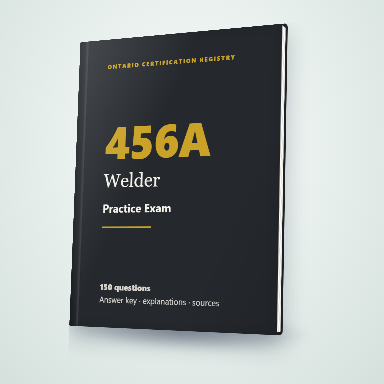
Free practice test
Try 30 questions free
Work through 30 questions, then see your score, results by topic and an explanation for every answer. No account or email needed.
These are 30 of the 150 questions in the full PDF. You can also read the questions and answers below.
The full 150-question PDF
Includes the 30 free questions plus 120 additional questions, explanations and references. One payment, no subscription.
| Questions | 150, all original |
|---|---|
| Answer key | Correct answer, the reasoning, and a cited source for each question |
| Distinct references | 33 distinct citations across the bank |
| Free samples here | 30, with answers, below |
| Format | PDF, emailed on purchase, plus a download link valid 30 days |
| Price | $67.49 CAD, one payment, no subscription |
Payment is handled by Stripe. This is study material, not an official exam, and it is not affiliated with Skilled Trades Ontario, TSSA or the Red Seal program.
Look inside the PDF
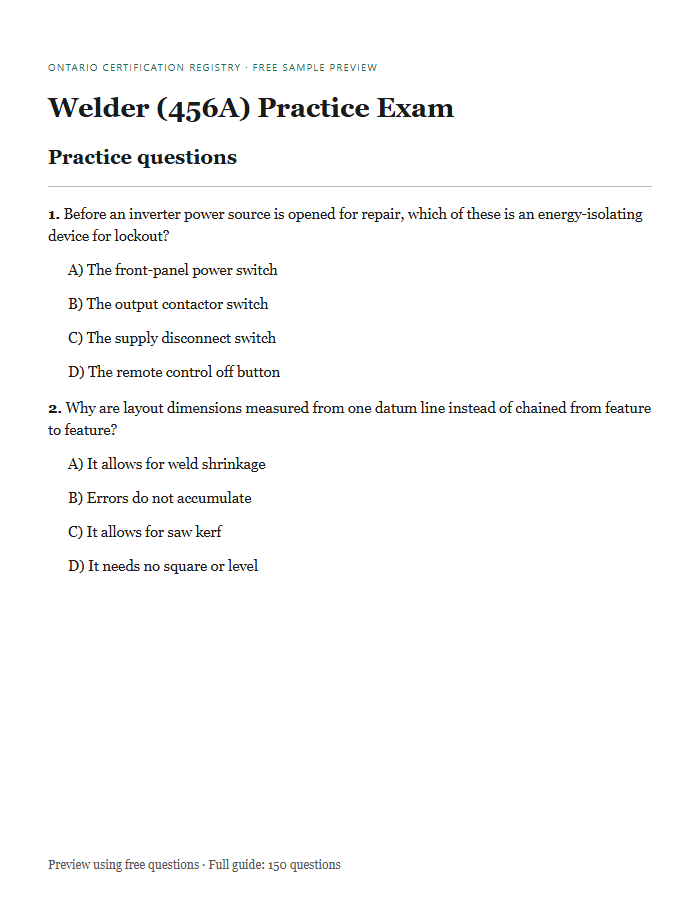
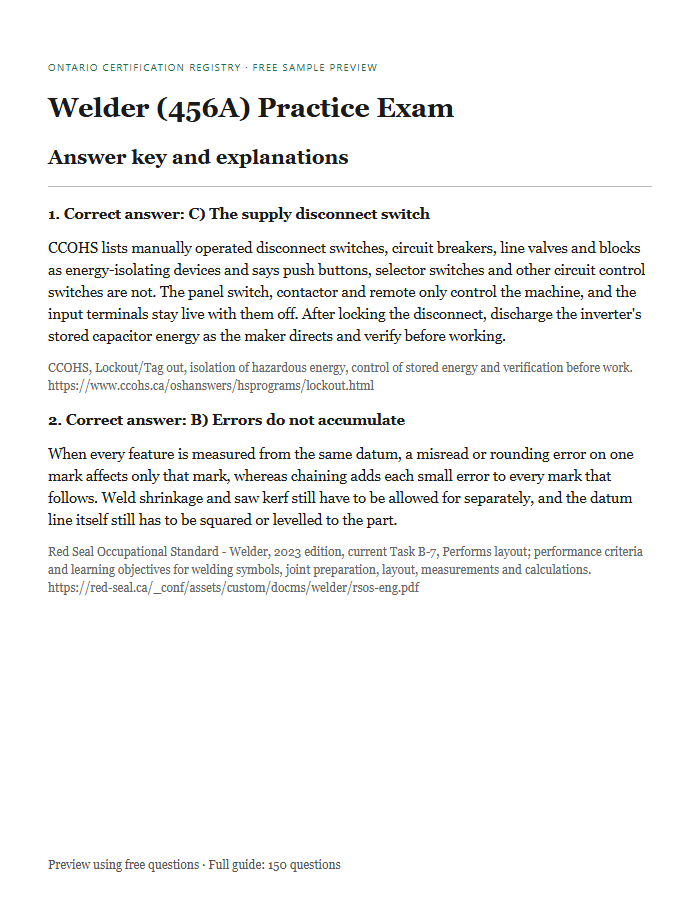
A preview of the question and answer-key layout, using questions from the free sample. The full guide contains all 150 questions.
What this guide covers
The published Red Seal exam-information page lists a 125-question examination and MWA counts A-D of 20/28/23/54. Scaled by 1.2, the exact counts are 24/33.6/27.6/64.8. Whole-question allocation is 24/34/27/65: the tied 0.6 allocation goes to B rather than C and D receives its 0.8 remainder. The 2023 RSOS overview says exams based on that RSOS are currently under development. Therefore the activity counts and cognitive ranges describe the published exam page, while technical references use current lettered RSOS tasks. Published Task 6 has zero questions, so this bank does not add current A-6 communication content to the A activity. This is an editorial practice bank, not an official blueprint for the new RSOS. The table shows the actual counts and shares in this guide.
| Major work activity | Questions here | Share of this guide |
|---|---|---|
| A. Performs common occupational skills | 24 | 16% |
| B. Performs layout and fabrication of components for welding | 34 | 22.7% |
| C. Performs cutting and gouging | 27 | 18% |
| D. Welding processes | 65 | 43.3% |
The published official exam has 125 questions. This guide contains 150 original study questions, with topic counts rounded to fit that length.
Coverage source: Published Red Seal exam breakdown
The mix of question types
The table compares this guide's mix with the published Red Seal ranges for this trade.
| Type | Questions here | Share | Published range |
|---|---|---|---|
| Knowledge and recall | 68 | 45.3% | 40 to 50% |
| Procedural and application | 67 | 44.7% | 35 to 45% |
| Critical thinking | 15 | 10% | 10 to 20% |
30 free sample questions from the Welder (456A) bank
This fixed selection comes straight from the bank and covers every major work activity, with the answers and sources shown. Read them before you decide whether the rest is worth $67.49 to you.
Question 1: Before an inverter power source is opened for repair, which of these is an energy-isolating device for lockout?
Sample 1 · Activity A
Before an inverter power source is opened for repair, which of these is an energy-isolating device for lockout?
- The front-panel power switch
- The output contactor switch
- The supply disconnect switch (correct)
- The remote control off button
CCOHS lists manually operated disconnect switches, circuit breakers, line valves and blocks as energy-isolating devices and says push buttons, selector switches and other circuit control switches are not. The panel switch, contactor and remote only control the machine, and the input terminals stay live with them off. After locking the disconnect, discharge the inverter's stored capacitor energy as the maker directs and verify before working.
CCOHS, Lockout/Tag out, isolation of hazardous energy, control of stored energy and verification before work. https://www.ccohs.ca/oshanswers/hsprograms/lockout.html
Question 2: A worker who watched a nearby arc without eye protection reports gritty, painful, watering eyes several hours later. What caused the injury?
Sample 2 · Activity A
A worker who watched a nearby arc without eye protection reports gritty, painful, watering eyes several hours later. What caused the injury?
- Fume particles in the eye
- Ultraviolet radiation (correct)
- Infrared radiation
- Intense visible light
CCOHS describes arc eye as an inflammation of the front of the eye caused by ultraviolet radiation, with pain, tearing and a sand-in-the-eye feeling that may not be felt until several hours after exposure. Infrared heats the lens and contributes to cataracts over the long term, intense visible light is temporarily blinding at the time, and fume or particles irritate the eye when they enter it rather than hours later. Bystanders need screens or eye protection too.
CCOHS, Welding - Radiation and the Effects on Eyes and Skin, revised 2025-10-15. Supports UV/visible/IR exposure and delayed arc-eye symptoms; it does not provide filter shade selection criteria. https://www.ccohs.ca/oshanswers/safety_haz/welding/eyes.html
Question 3: A power source is rated 60% duty cycle at 200 A on a 10-minute basis. Its manual gives duty cycle at other currents as rated % × (rated A ÷ new A)². How much arc time per 10 minutes is allowed at 250 A?
Sample 3 · Activity A
A power source is rated 60% duty cycle at 200 A on a 10-minute basis. Its manual gives duty cycle at other currents as rated % × (rated A ÷ new A)². How much arc time per 10 minutes is allowed at 250 A?
- 3.8 minutes (correct)
- 6.0 minutes
- 4.8 minutes
- 9.4 minutes
(200 ÷ 250)² = 0.64, and 0.64 × 60% = 38.4%, or about 3.8 minutes of arc time in each 10 minutes. The plain current ratio (0.8 × 60% = 48%) gives 4.8 minutes, but heating rises with the square of current, so that overstates the safe time; 6.0 minutes is the rating at 200 A only, and 9.4 minutes inverts the ratio. Where the maker publishes a duty-cycle chart, use the chart.
Red Seal Occupational Standard - Welder, 2023 edition, current Task A-1, Maintains tools and equipment; performance criteria and knowledge requirements. https://red-seal.ca/_conf/assets/custom/docms/welder/rsos-eng.pdf
Question 4: A uniform 3.0 m beam weighing 300 kg has a 100 kg bracket whose centre of gravity is at the beam's right end. For a level lift, how far from the left end should the hook be?
Sample 4 · Activity A
A uniform 3.0 m beam weighing 300 kg has a 100 kg bracket whose centre of gravity is at the beam's right end. For a level lift, how far from the left end should the hook be?
- 1.13 m
- 2.25 m
- 1.88 m (correct)
- 1.50 m
Take moments about the left end: (300 × 1.5 + 100 × 3.0) ÷ 400 = 750 ÷ 400 = 1.875 m, so the hook goes about 1.88 m from the left end. 1.50 m ignores the bracket, 2.25 m averages the two centres without weighting them by mass, and 1.13 m is the right distance measured from the wrong end. If the load still tilts on a trial lift, land it and adjust the rigging before going higher.
Red Seal Occupational Standard - Welder, 2023 edition, current Task A-2, Uses access and material handling equipment; performance criteria and knowledge requirements. https://red-seal.ca/_conf/assets/custom/docms/welder/rsos-eng.pdf
Question 5: GMAW fillets show porosity only while a nearby fume hood runs. An anemometer at the arc reads 2.5 m/s with the hood on and 0.2 m/s with it off. Gas flow matches the WPS, and the same wire and cleaned plate are used both ways. What is the most likely cause?
Sample 5 · Activity A
GMAW fillets show porosity only while a nearby fume hood runs. An anemometer at the arc reads 2.5 m/s with the hood on and 0.2 m/s with it off. Gas flow matches the WPS, and the same wire and cleaned plate are used both ways. What is the most likely cause?
- Mill scale on the plate
- Moisture in the wire
- Gas flow below the WPS
- Hood draft strips the gas (correct)
The porosity comes and goes with the hood while flow, wire and plate stay the same, and the air speed at the arc rises more than tenfold when the hood runs, so the draft is blowing the shielding gas away from the pool. CCOHS notes that pockets of high-velocity air can affect shielding gases; reposition the hood so it captures the plume without blowing across the nozzle, rather than just raising gas flow, which can add turbulence. The trial identifies the cause here, not a universal air-speed limit.
CCOHS, Welding - Ventilation, revised 2024-08-23. Local exhaust ventilation is the preferred fume-removal strategy; use any numeric hood guidance only where the matching conditions are stated. https://www.ccohs.ca/oshanswers/safety_haz/welding/ventilation.html
Question 6: Why are layout dimensions measured from one datum line instead of chained from feature to feature?
Sample 6 · Activity B
Why are layout dimensions measured from one datum line instead of chained from feature to feature?
- It allows for weld shrinkage
- Errors do not accumulate (correct)
- It allows for saw kerf
- It needs no square or level
When every feature is measured from the same datum, a misread or rounding error on one mark affects only that mark, whereas chaining adds each small error to every mark that follows. Weld shrinkage and saw kerf still have to be allowed for separately, and the datum line itself still has to be squared or levelled to the part.
Red Seal Occupational Standard - Welder, 2023 edition, current Task B-7, Performs layout; performance criteria and learning objectives for welding symbols, joint preparation, layout, measurements and calculations. https://red-seal.ca/_conf/assets/custom/docms/welder/rsos-eng.pdf
Question 7: Plate parts will be bent on a press brake. Why is the rolling (grain) direction transferred to each part?
Sample 7 · Activity B
Plate parts will be bent on a press brake. Why is the rolling (grain) direction transferred to each part?
- It shows the heat lot
- Bends across it crack less (correct)
- It sets the weld direction
- It marks the bevelled face
Rolling stretches inclusions and grain along the rolling direction, so a bend line running parallel to it is more prone to cracking on the outside of the bend; marking the grain lets each part be oriented so bend lines run across it as specified. The RSOS lists grain direction alongside heat numbers, lot numbers and grade as markings transferred to cut parts. Grain direction does not identify the heat or set weld travel.
Red Seal Occupational Standard - Welder, 2023 edition, current Task A-5, Performs routine trade activities; performance criteria and knowledge requirements. https://red-seal.ca/_conf/assets/custom/docms/welder/rsos-eng.pdf
Question 8: Why is the required preheat also applied before tack welding a joint that will be preheated for welding?
Sample 8 · Activity B
Why is the required preheat also applied before tack welding a joint that will be preheated for welding?
- It burns off the mill scale
- Small tacks cool fast and crack (correct)
- It makes tacks easier to grind
- It keeps the root gap open
A tack is a short, small weld on otherwise cold metal, so it cools faster than a full pass and on hardenable or thick steel can leave a hard, crack-prone heat-affected zone. Tacks that stay in the joint become part of the weld, so a cracked tack is a crack in the finished weld; the RSOS includes pre-heating base metals for tacking to job specifications. Preheat does not hold the gap, help grinding or remove mill scale.
Red Seal Occupational Standard - Welder, 2023 edition, current Task B-8, Fabricates components; performance criteria and knowledge requirements. https://red-seal.ca/_conf/assets/custom/docms/welder/rsos-eng.pdf
Question 9: A curved rail follows a 75° arc on a 1500 mm centreline radius. Using the supplied formula, what is the centreline length?
Sample 9 · Activity B
A curved rail follows a 75° arc on a 1500 mm centreline radius. Using the supplied formula, what is the centreline length?
- 1963.5 mm (correct)
- 625.0 mm
- 3927.0 mm
- 1826.3 mm
Arc length = θ × (π/180) × r = 75 × (3.1416 ÷ 180) × 1500 = 1963.5 mm. 1826.3 mm is the straight chord between the ends, which is always shorter than the arc, 3927.0 mm uses the diameter in place of the radius, and 625.0 mm leaves out π.
Red Seal Welder Exam Information, Math Formulas section and supplied formula sheet. The arc-length formula is angle in degrees times pi/180 times radius; each numerical scenario states its own dimensions and units. https://red-seal.ca/eng/trades/weld/exam-information.shtml ; https://red-seal.ca/_conf/assets/custom/docms/welder/formulas.pdf
Question 10: A V-groove weld symbol has 3 written inside the V and 60° written just outside it. What does the 3 specify?
Sample 10 · Activity B
A V-groove weld symbol has 3 written inside the V and 60° written just outside it. What does the 3 specify?
- Root opening, 3 mm (correct)
- Root face, 3 mm
- Weld size, 3 mm
- Bevel depth, 3 mm
On a welding symbol the root opening is written inside the groove weld symbol and the groove angle just outside it, so this joint is fitted with a 3 mm gap and a 60° included angle. Depth of bevel and groove weld size are written to the left of the symbol, and the root face is not given directly but follows from plate thickness minus bevel depth. Gauge the gap at several points before tacking.
Red Seal Occupational Standard - Welder, 2023 edition, current Task B-7, Performs layout; performance criteria and learning objectives for welding symbols, joint preparation, layout, measurements and calculations. https://red-seal.ca/_conf/assets/custom/docms/welder/rsos-eng.pdf
Question 11: A tack on a pipe root shows a crack running across it. What should be done before the root pass?
Sample 11 · Activity B
A tack on a pipe root shows a crack running across it. What should be done before the root pass?
- Fuse it in with the root pass
- Feather its ends and weld on
- Grind it out and re-tack (correct)
- Add a second tack beside it
A cracked tack is a defect, and the root pass cannot be relied on to melt out the whole crack, so it can carry into the finished weld; the tack is ground out completely and remade after checking why it cracked, such as missing preheat or a tack that was too small. Feathering is for sound tacks, and an extra tack beside it leaves the crack in the joint.
Red Seal Occupational Standard - Welder, 2023 edition, current Task B-8, Fabricates components; performance criteria and knowledge requirements. https://red-seal.ca/_conf/assets/custom/docms/welder/rsos-eng.pdf
Question 12: The assembly is specified as a rectangle with equal opposite sides. Its outside dimensions match the drawing, but measured diagonals differ by 12 mm after tacking. What is the strongest inference?
Sample 12 · Activity B
The assembly is specified as a rectangle with equal opposite sides. Its outside dimensions match the drawing, but measured diagonals differ by 12 mm after tacking. What is the strongest inference?
- The rectangular assembly is out of square (correct)
- The root opening is 12 mm too wide
- The joint bevel angle is too small
- The specified outside length is too short
For the stated rectangular assembly, unequal diagonal measurements indicate it is not square.
Red Seal Occupational Standard - Welder, 2023 edition, current Task B-7, Performs layout; performance criteria and learning objectives for welding symbols, joint preparation, layout, measurements and calculations. https://red-seal.ca/_conf/assets/custom/docms/welder/rsos-eng.pdf
Question 13: A repair crew must sever carbon-steel plate at a field location with no electrical supply. Which process fits that constraint?
Sample 13 · Activity C
A repair crew must sever carbon-steel plate at a field location with no electrical supply. Which process fits that constraint?
- Oxy-fuel cutting (correct)
- Air carbon-arc gouging
- Stationary cold sawing
- Plasma arc cutting
Oxy-fuel cutting is portable and does not require an external electrical power source, making it suitable for this stated constraint. Plasma requires electrical power, air carbon-arc is a gouging process, and a stationary cold saw cannot be taken to the field cut. The material and job still determine the approved setup.
Red Seal Occupational Standard - Welder, 2023 edition, current Task C-10, Uses oxy-fuel gas cutting (OFC) process for cutting and gouging; performance criteria and knowledge requirements. https://red-seal.ca/_conf/assets/custom/docms/welder/rsos-eng.pdf
Question 14: A hand plasma cutter lights its pilot arc at the nozzle, but the arc will not transfer to the plate. Why must the work clamp be on clean metal for the cut?
Sample 14 · Activity C
A hand plasma cutter lights its pilot arc at the nozzle, but the arc will not transfer to the plate. Why must the work clamp be on clean metal for the cut?
- The cutting arc returns through it (correct)
- It feeds the pilot arc
- It drains heat from the plate
- It grounds the machine frame
In transferred-arc cutting the main arc runs from the electrode to the plate, and the current returns to the power source through the work lead and clamp, so a clamp on paint, rust or a loose connection leaves the arc nowhere to go. The pilot arc burns between the electrode and the nozzle inside the torch and does not need the clamp, which is why it still lights. The work clamp is not the equipment safety ground, which comes through the supply, and it has no cooling role.
Red Seal Occupational Standard - Welder, 2023 edition, current Task C-11, Uses plasma arc cutting (PAC) process for cutting and gouging; performance criteria and knowledge requirements. https://red-seal.ca/_conf/assets/custom/docms/welder/rsos-eng.pdf
Question 15: A repair plan calls for removing a deep crack by CAC-A gouging. Which detail primarily guides carbon-electrode size?
Sample 15 · Activity C
A repair plan calls for removing a deep crack by CAC-A gouging. Which detail primarily guides carbon-electrode size?
- Air-hose length at station
- Power-source brand name
- Amount of metal to remove (correct)
- Torch cable insulation type
The amount of material to be removed drives electrode size for the gouging task. Hose length, cable construction and brand alone do not define the required groove volume; match the selected electrode and equipment to the application and maker instructions.
Red Seal Occupational Standard - Welder, 2023 edition, current Task C-12, Uses air carbon arc cutting (CAC-A) process for cutting and gouging; performance criteria and knowledge requirements. https://red-seal.ca/_conf/assets/custom/docms/welder/rsos-eng.pdf
Question 16: A long plate shifts under a dry run on a shear. What should be corrected before the cut?
Sample 16 · Activity C
A long plate shifts under a dry run on a shear. What should be corrected before the cut?
- Reduce the hold-down setting
- Reposition the back gauge
- Secure the plate as specified (correct)
- Increase the blade clearance
The stock must be secured using the maker’s setup before cutting; a shifting plate can move into the blade or produce an inaccurate cut. Blade clearance and back-gauge position do not restrain the plate, and reducing hold-down would worsen the movement. Stop and correct the setup before cycling the shear.
Red Seal Occupational Standard - Welder, 2023 edition, current Task C-9, Uses tools and equipment for non-thermal cutting and grinding; performance criteria and knowledge requirements. https://red-seal.ca/_conf/assets/custom/docms/welder/rsos-eng.pdf
Question 17: A repair plan requires a 10 mm plate opening cut with a conventional oxy-fuel torch, without powder or other special cutting aids. Which stock suits that plan?
Sample 17 · Activity C
A repair plan requires a 10 mm plate opening cut with a conventional oxy-fuel torch, without powder or other special cutting aids. Which stock suits that plan?
- Copper alloy plate
- Aluminium alloy plate
- 304 stainless steel plate
- Low-carbon steel plate (correct)
Conventional oxy-fuel cutting relies on rapid oxidation of heated iron and removal of the oxide by the oxygen jet, which suits low-carbon steel. Stainless steel and the non-ferrous choices need other processes or special aids because their oxides and thermal behaviour do not support this ordinary cut. This is process selection, not a cutting-speed or tip-size recommendation.
Red Seal Occupational Standard - Welder, 2023 edition, current Task C-10, Uses oxy-fuel gas cutting (OFC) process for cutting and gouging; performance criteria and knowledge requirements. https://red-seal.ca/_conf/assets/custom/docms/welder/rsos-eng.pdf
Question 18: Why is a constant-current (drooping) power source used for SMAW?
Sample 18 · Activity D
Why is a constant-current (drooping) power source used for SMAW?
- Amps hold as arc length varies (correct)
- It feeds the rod automatically
- It holds arc voltage steady
- It needs no polarity setting
A welder's hand cannot hold arc length exactly, and on a constant-current source a change in arc length changes voltage much more than current, so heat input and melt-off stay steady. Holding voltage steady is the constant-voltage characteristic used with wire feeders, where the wire's self-regulation keeps the arc length. SMAW has no feeder, and polarity is still set to suit the electrode.
Red Seal Occupational Standard - Welder, 2023 edition, current Task D-13, Welds using shielded metal arc welding (SMAW); performance criteria and knowledge requirements for power sources, electrodes, joint preparation, welding and inspection. https://red-seal.ca/_conf/assets/custom/docms/welder/rsos-eng.pdf
Question 19: Why are low-hydrogen electrodes such as E7018 kept in a heated holding oven once their sealed container is opened?
Sample 19 · Activity D
Why are low-hydrogen electrodes such as E7018 kept in a heated holding oven once their sealed container is opened?
- Coating soaks up air moisture (correct)
- Warm rods strike more easily
- It stops the flux binder setting
- The coating cracks when cold
Low-hydrogen coatings are made with very little moisture, and once exposed they absorb water from the air; in the arc that water breaks down into hydrogen that can cause cracking in hardenable or restrained steel. The holding oven keeps the coating dry until use, at the temperature and for the exposure limits the electrode maker sets. Ease of striking and coating strength are not why they are ovened.
Red Seal Occupational Standard - Welder, 2023 edition, current Task D-13, Welds using shielded metal arc welding (SMAW); performance criteria and knowledge requirements for power sources, electrodes, joint preparation, welding and inspection. https://red-seal.ca/_conf/assets/custom/docms/welder/rsos-eng.pdf
Question 20: Why is straight CO2 not used when a GMAW procedure on steel calls for spray transfer?
Sample 20 · Activity D
Why is straight CO2 not used when a GMAW procedure on steel calls for spray transfer?
- It is inert and cools the arc
- It will not give true spray (correct)
- It penetrates too shallowly
- It costs more than argon mixes
Spray transfer needs an argon-rich gas, generally at least about 80% argon; with straight CO2 the transfer stays globular or short-circuiting and spatters heavily at spray currents. CO2 is an active gas, not inert, it is the cheapest shielding gas, and it gives deep, broad penetration. Use the gas named in the WPS.
Red Seal Occupational Standard - Welder, 2023 edition, current Task D-14, Welds using FCAW, MCAW and GMAW; performance criteria and knowledge requirements for equipment, consumables, setup, welding and inspection. https://red-seal.ca/_conf/assets/custom/docms/welder/rsos-eng.pdf
Question 21: Aluminium GMAW wire keeps bird-nesting at the drive rolls of a standard steel-wire setup. Which change suits soft wire?
Sample 21 · Activity D
Aluminium GMAW wire keeps bird-nesting at the drive rolls of a standard steel-wire setup. Which change suits soft wire?
- Smaller tip, tighter rolls
- Knurled rolls, more tension
- U-groove rolls, plastic liner (correct)
- V-groove rolls, steel liner
Soft aluminium wire is fed with U-groove rolls at light tension and a nylon or Teflon-type liner, often through a spool gun or push-pull gun, because V-grooves and steel liners shave and kink it. Knurled rolls are for tubular flux-cored wire and would chew aluminium, extra tension crushes it, and aluminium contact tips are sized slightly oversize for expansion, not smaller.
Red Seal Occupational Standard - Welder, 2023 edition, current Task D-14, Welds using FCAW, MCAW and GMAW; performance criteria and knowledge requirements for equipment, consumables, setup, welding and inspection. https://red-seal.ca/_conf/assets/custom/docms/welder/rsos-eng.pdf
Question 22: Why is GTAW of carbon steel done on DC electrode-negative rather than electrode-positive?
Sample 22 · Activity D
Why is GTAW of carbon steel done on DC electrode-negative rather than electrode-positive?
- It needs no high frequency
- It balls the tungsten end
- Most heat goes to the work (correct)
- It gives cathodic cleaning
With electrode negative, roughly two thirds of the arc heat goes into the work and the tungsten stays cool enough to hold a sharp point, giving deep, narrow fusion on steel. Electrode positive gives the oxide-cleaning action used on aluminium but puts most of the heat into the tungsten, which balls and can melt, and the start method is chosen separately from polarity.
Red Seal Occupational Standard - Welder, 2023 edition, current Task D-15, Welds using GTAW; performance criteria and knowledge requirements for equipment, consumables, setup, welding and inspection. https://red-seal.ca/_conf/assets/custom/docms/welder/rsos-eng.pdf
Question 23: In tandem SAW, the lead wire usually runs DCEP and the trail wire AC. Why is the trail wire on AC?
Sample 23 · Activity D
In tandem SAW, the lead wire usually runs DCEP and the trail wire AC. Why is the trail wire on AC?
- AC lead wire penetrates deeper
- DCEP trail gives a flatter cap
- Both wires share one feeder
- Less arc blow between the arcs (correct)
Two DC arcs close together pull on each other's magnetic fields and wander, so the common arrangement runs the lead wire DCEP for deep penetration and the trail wire on AC, which interacts far less and fills and shapes the cap. Each wire has its own power source and feeder, and putting AC on the lead would give up the lead's deeper penetration.
Red Seal Occupational Standard - Welder, 2023 edition, current Task D-16, Welds using SAW; performance criteria and knowledge requirements for equipment, consumables, setup, welding and inspection. https://red-seal.ca/_conf/assets/custom/docms/welder/rsos-eng.pdf
Question 24: A procedure calls for DC electrode-negative, but the machine selector is set to AC. What must be corrected before welding?
Sample 24 · Activity D
A procedure calls for DC electrode-negative, but the machine selector is set to AC. What must be corrected before welding?
- Connect for electrode-positive
- Set the specified current type (correct)
- Change electrode diameter
- Raise amperage on AC
The source must provide the current type and polarity specified by the WPS. Keeping AC or connecting for electrode-positive would not meet the stated procedure, and electrode diameter is a separate selection. Verify the output at the machine before striking an arc.
Red Seal Occupational Standard - Welder, 2023 edition, current Task D-13, Welds using shielded metal arc welding (SMAW); performance criteria and knowledge requirements for power sources, electrodes, joint preparation, welding and inspection. https://red-seal.ca/_conf/assets/custom/docms/welder/rsos-eng.pdf
Question 25: A WPDS requires the entire joint thickness above 100 °C with neither face above 200 °C. After heating one face of thick plate, it reads 190 °C and the reverse face 70 °C. What is the next step?
Sample 25 · Activity D
A WPDS requires the entire joint thickness above 100 °C with neither face above 200 °C. After heating one face of thick plate, it reads 190 °C and the reverse face 70 °C. What is the next step?
- Cool both faces to 70 °C
- Start welding from the hot face
- Let heat soak; recheck faces (correct)
- Heat the 190 °C face harder
Heat must conduct through the section, so allow equalization and recheck both faces before deciding whether more heating is needed. The cold face is below the minimum, while the heated face is already near the stated maximum. Neither welding immediately nor simply adding intense heat to the hot face verifies the through-thickness condition.
Red Seal Occupational Standard - Welder, 2023 edition, current Task D-13, Welds using shielded metal arc welding (SMAW); performance criteria and knowledge requirements for power sources, electrodes, joint preparation, welding and inspection. https://red-seal.ca/_conf/assets/custom/docms/welder/rsos-eng.pdf
Question 26: A calibrated collection check at a GMAW nozzle captures 1.8 L of shielding gas in 6 seconds while flowing steadily. What flow rate does that represent?
Sample 26 · Activity D
A calibrated collection check at a GMAW nozzle captures 1.8 L of shielding gas in 6 seconds while flowing steadily. What flow rate does that represent?
- 10.8 L/min
- 3.0 L/min
- 108.0 L/min
- 18.0 L/min (correct)
The rate is 1.8 ÷ 6 = 0.30 L/s, or 0.30 × 60 = 18.0 L/min. Multiplying volume by the six-second interval instead of dividing gives the wrong result. Compare the measured flowing rate with the procedure rather than treating this value as a universal requirement.
Red Seal Occupational Standard - Welder, 2023 edition, current Task D-14, Welds using FCAW, MCAW and GMAW; performance criteria and knowledge requirements for equipment, consumables, setup, welding and inspection. https://red-seal.ca/_conf/assets/custom/docms/welder/rsos-eng.pdf
Question 27: A GMAW contact tip is recessed 4 mm inside the nozzle. During welding the nozzle is 8 mm above the plate and the arc is 3 mm long. What electrical stick-out lies between the tip and wire end?
Sample 27 · Activity D
A GMAW contact tip is recessed 4 mm inside the nozzle. During welding the nozzle is 8 mm above the plate and the arc is 3 mm long. What electrical stick-out lies between the tip and wire end?
- 5.0 mm stick-out
- 15.0 mm stick-out
- 12.0 mm stick-out
- 9.0 mm stick-out (correct)
The tip-to-work distance is 4 + 8 = 12 mm, and 3 mm of that is arc, so the unmelted wire extension is 9 mm. The 12 mm choice includes the arc, while 5 mm ignores the recessed tip. These are supplied geometry dimensions, not a recommended universal extension.
Red Seal Occupational Standard - Welder, 2023 edition, current Task D-14, Welds using FCAW, MCAW and GMAW; performance criteria and knowledge requirements for equipment, consumables, setup, welding and inspection. https://red-seal.ca/_conf/assets/custom/docms/welder/rsos-eng.pdf
Question 28: For a GTAW job, the torch maker's post-flow guidance is welding amperage divided by 10, with a minimum of 8 seconds. At 170 A, which setting follows that guidance?
Sample 28 · Activity D
For a GTAW job, the torch maker's post-flow guidance is welding amperage divided by 10, with a minimum of 8 seconds. At 170 A, which setting follows that guidance?
- 10 seconds
- 25 seconds
- 17 seconds (correct)
- 8 seconds
The calculation gives 170 ÷ 10 = 17 seconds, exceeding the eight-second minimum. Using the minimum alone ignores the current-dependent part. This is the supplied guidance for this setup; the WPS and equipment instructions govern actual work.
Red Seal Occupational Standard - Welder, 2023 edition, current Task D-15, Welds using GTAW; performance criteria and knowledge requirements for equipment, consumables, setup, welding and inspection. https://red-seal.ca/_conf/assets/custom/docms/welder/rsos-eng.pdf Also: Miller, Best Practices for Proper Shielding Gas in TIG Welding, gas lenses, tungsten extension and post-flow. https://www.millerwelds.com/en-us/resources/knowledge-hub/tig-welding/how-to/best-practices-for-proper-shielding-gas-in-tig-welding
Question 29: A SAW setup feeds 1.2 kg of flux per minute for a 20-minute run. Its approved recovery process returns 70% of the feed for reuse and discards the rest. What fresh flux mass replaces that loss?
Sample 29 · Activity D
A SAW setup feeds 1.2 kg of flux per minute for a 20-minute run. Its approved recovery process returns 70% of the feed for reuse and discards the rest. What fresh flux mass replaces that loss?
- 24.0 kg of fresh flux
- 16.8 kg of fresh flux
- 7.2 kg of fresh flux (correct)
- 31.2 kg of fresh flux
The total feed is 1.2 × 20 = 24 kg, with 30% lost, so fresh replacement is 24 × 0.30 = 7.2 kg. The 16.8 kg choice is the recovered amount, not the loss. This assumes the stated recovery is approved and does not include an extra hopper reserve.
Red Seal Occupational Standard - Welder, 2023 edition, current Task D-16, Welds using SAW; performance criteria and knowledge requirements for equipment, consumables, setup, welding and inspection. https://red-seal.ca/_conf/assets/custom/docms/welder/rsos-eng.pdf
Question 30: A stainless pipe root is oxidized inside, while its outside surface is clean. External shielding flow meets the WPS; the purge oxygen reading exceeds the job limit only where a dam is damaged. Which cause best fits?
Sample 30 · Activity D
A stainless pipe root is oxidized inside, while its outside surface is clean. External shielding flow meets the WPS; the purge oxygen reading exceeds the job limit only where a dam is damaged. Which cause best fits?
- A change in travel speed on the outside
- Loss of purge control at the damaged dam (correct)
- Excess external shielding flow at the torch
- A change in filler-metal diameter
The internal-only oxidation coincides with a damaged purge dam and out-of-limit purge reading while external shielding meets its requirement.
Red Seal Occupational Standard - Welder, 2023 edition, current Task D-15, Welds using GTAW; performance criteria and knowledge requirements for equipment, consumables, setup, welding and inspection. https://red-seal.ca/_conf/assets/custom/docms/welder/rsos-eng.pdf
Before you buy
- These questions use the cited occupational standards, curriculum and technical references. Nothing here is reproduced from a real exam.
- Passing this does not guarantee passing the certifying exam, and nothing here is a substitute for the training standard or your in-school hours.
- It is a PDF. There is no login, no expiry and no subscription, and you can print it.
- Automated structure and distribution checks are complete. Technical accuracy review by a licensed tradesperson remains outstanding.
Questions about your purchase or a missing PDF? Contact Blue Crane Works with the email used at checkout. The download link lasts 30 days; your saved PDF does not expire.
When you are ready for the real exam
You book the 456A certifying exam yourself in the Skilled Trades Ontario Portal ($150 plus HST) and write it at one of 24 exam centres, or at your college in your final level of school. How to book it and find the nearest centre.
Writing in Alberta, BC or Manitoba? Same Red Seal exam
The Welder exam is the national Red Seal exam, so this practice exam fits writers in other provinces too, wherever the trade carries the Red Seal. Trade names differ by province.
Where the exam facts on this page come from
The published Red Seal exam-information page lists a 125-question examination and MWA counts A-D of 20/28/23/54. Scaled by 1.2, the exact counts are 24/33.6/27.6/64.8. Whole-question allocation is 24/34/27/65: the tied 0.6 allocation goes to B rather than C and D receives its 0.8 remainder. The 2023 RSOS overview says exams based on that RSOS are currently under development. Therefore the activity counts and cognitive ranges describe the published exam page, while technical references use current lettered RSOS tasks. Published Task 6 has zero questions, so this bank does not add current A-6 communication content to the A activity. This is an editorial practice bank, not an official blueprint for the new RSOS. The regulation and issuing authority explain the actual credential and examination requirements.
The free reference material for this trade
Everything about the certification itself, the classification, the hours, the ratio and the official sources, stays free on this site and always will. The practice exam is the only thing here that costs anything.
Other practice exams
 309AConstruction Electrician
 G.2Gas Technician 2
 306APlumber
 433AIndustrial Mechanic Millwright
 310SAutomotive Service Technician
 G.3Gas Technician 3
 310TTruck and Coach Technician
 332AHairstylist
 442AIndustrial Electrician
 308ASheet Metal Worker
 415ACook
 429AGeneral Machinist
 339AMobile Crane Operator
 339BTower Crane Operator