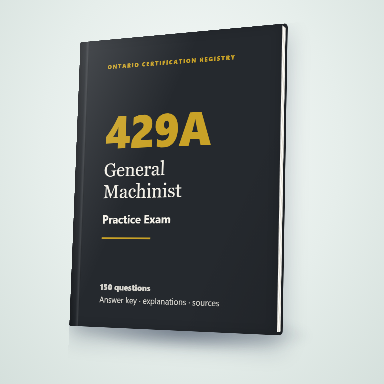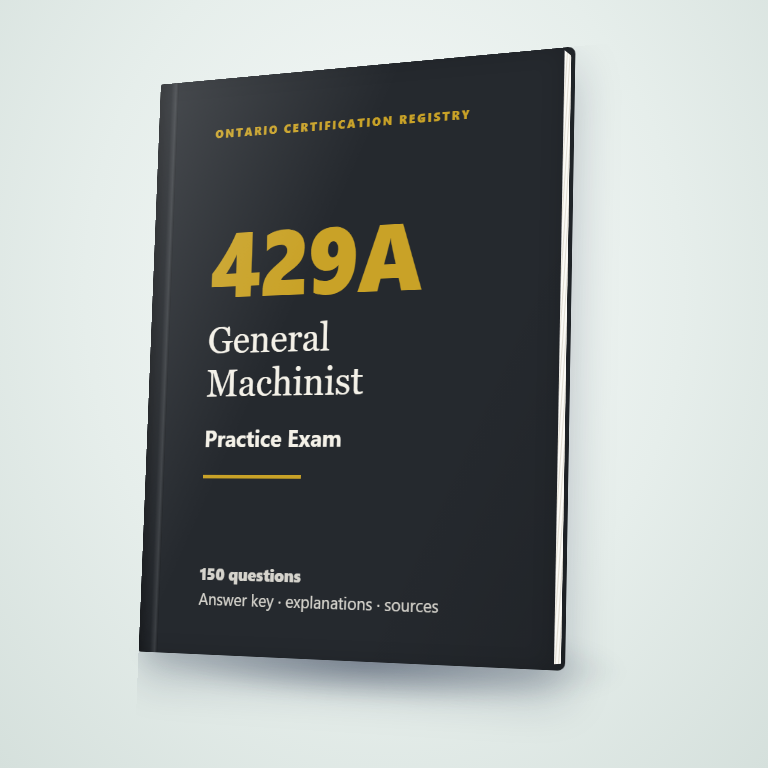
Free practice test
Try 30 questions free
Work through 30 questions, then see your score, results by topic and an explanation for every answer. No account or email needed.
These are 30 of the 150 questions in the full PDF. You can also read the questions and answers below.
The full 150-question PDF
Includes the 30 free questions plus 120 additional questions, explanations and references. One payment, no subscription.
| Questions | 150, all original |
|---|---|
| Answer key | Correct answer, the reasoning, and a cited source for each question |
| Distinct references | 99 distinct citations across the bank |
| Free samples here | 30, with answers, below |
| Format | PDF, emailed on purchase, plus a download link valid 30 days |
| Price | $67.49 CAD, one payment, no subscription |
Payment is handled by Stripe. This is study material, not an official exam, and it is not affiliated with Skilled Trades Ontario, TSSA or the Red Seal program.
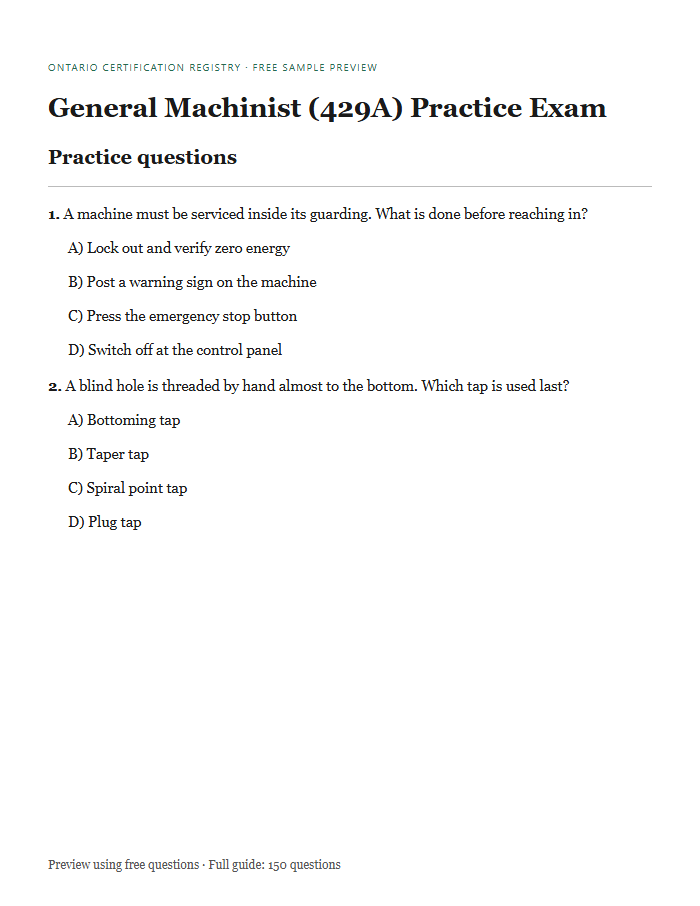
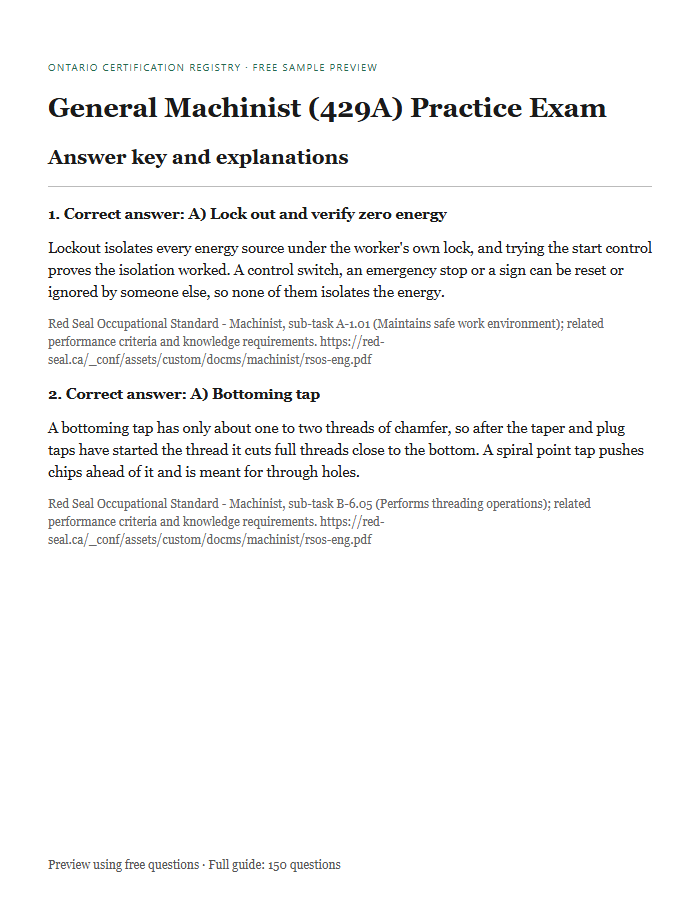
Look inside the PDF
A preview of the question and answer-key layout, using questions from the free sample. The full guide contains all 150 questions.
What this guide covers
Published Red Seal exam question counts (135) scaled to 150 with whole-question rounding (largest remainder). The table shows the actual counts and shares in this guide.
| Major work activity | Questions here | Share of this guide |
|---|---|---|
| A. Performs common occupational skills | 15 | 10% |
| B. Performs benchwork | 12 | 8% |
| C. Machines using power saws | 9 | 6% |
| D. Machines using drill presses | 10 | 6.7% |
| E. Machines using conventional lathes | 31 | 20.7% |
| F. Machines using conventional milling machines | 31 | 20.7% |
| G. Machines using precision grinding machines | 12 | 8% |
| H. Machines using computer numerical control (CNC) machines | 30 | 20% |
The published official exam has 135 questions. This guide contains 150 original study questions, with topic counts rounded to fit that length.
Coverage source: Published Red Seal exam breakdown
The mix of question types
The table compares this guide's mix with the published Red Seal ranges for this trade.
| Type | Questions here | Share | Published range |
|---|---|---|---|
| Knowledge and recall | 25 | 16.7% | 10 to 20% |
| Procedural and application | 78 | 52% | 50 to 60% |
| Critical thinking | 47 | 31.3% | 25 to 35% |
30 free sample questions from the General Machinist bank
This fixed selection comes straight from the bank and covers every major work activity, with the answers and sources shown. Read them before you decide whether the rest is worth $67.49 to you.
Question 1: A machine must be serviced inside its guarding. What is done before reaching in?
Sample 1 · Activity A
A machine must be serviced inside its guarding. What is done before reaching in?
- Lock out and verify zero energy (correct)
- Post a warning sign on the machine
- Press the emergency stop button
- Switch off at the control panel
Lockout isolates every energy source under the worker's own lock, and trying the start control proves the isolation worked. A control switch, an emergency stop or a sign can be reset or ignored by someone else, so none of them isolates the energy.
Red Seal Occupational Standard - Machinist, sub-task A-1.01 (Maintains safe work environment); related performance criteria and knowledge requirements. https://red-seal.ca/_conf/assets/custom/docms/machinist/rsos-eng.pdf
Question 2: A print calls for Ø25.000 +0.000/-0.013 mm. A part measures 24.990 mm. What is its condition?
Sample 2 · Activity A
A print calls for Ø25.000 +0.000/-0.013 mm. A part measures 24.990 mm. What is its condition?
- Undersize, rework
- Oversize
- Within tolerance (correct)
- Undersize, scrap
The limits are 25.000 mm and 24.987 mm, and 24.990 mm lies between them, so the part is good. It is not above the 25.000 mm upper limit, and it is not below the 24.987 mm lower limit.
Red Seal Occupational Standard - Machinist, sub-task A-2.01 (Interprets documentation); related performance criteria and knowledge requirements. https://red-seal.ca/_conf/assets/custom/docms/machinist/rsos-eng.pdf
Question 3: A batch of 200 bushings must be checked for a Ø20H7 bore. Which tool suits this best?
Sample 3 · Activity A
A batch of 200 bushings must be checked for a Ø20H7 bore. Which tool suits this best?
- Go/no-go plug gauge (correct)
- Inside caliper and steel rule
- Vernier caliper inside jaws
- Telescopic gauge and micrometer
A fixed-limit plug gauge checks each bore against both limits in seconds without reading a scale, which suits a production batch. A telescopic gauge is accurate but slow, and an inside caliper or vernier jaws are not accurate enough for an H7 tolerance of about 0.02 mm.
Red Seal Occupational Standard - Machinist, sub-task A-4.05 (Performs quality control of workpiece); related performance criteria and knowledge requirements. https://red-seal.ca/_conf/assets/custom/docms/machinist/rsos-eng.pdf
Question 4: A blind hole is threaded by hand almost to the bottom. Which tap is used last?
Sample 4 · Activity B
A blind hole is threaded by hand almost to the bottom. Which tap is used last?
- Bottoming tap (correct)
- Taper tap
- Spiral point tap
- Plug tap
A bottoming tap has only about one to two threads of chamfer, so after the taper and plug taps have started the thread it cuts full threads close to the bottom. A spiral point tap pushes chips ahead of it and is meant for through holes.
Red Seal Occupational Standard - Machinist, sub-task B-6.05 (Performs threading operations); related performance criteria and knowledge requirements. https://red-seal.ca/_conf/assets/custom/docms/machinist/rsos-eng.pdf
Question 5: A stripped M8 thread in an aluminum housing must be restored to M8. What is used?
Sample 5 · Activity B
A stripped M8 thread in an aluminum housing must be restored to M8. What is used?
- Thread-locking compound
- A longer M8 bolt
- A wire thread insert (correct)
- An M10 bolt and tap
A wire thread insert is installed in a hole drilled and tapped with the insert's own tap and gives back an M8 thread that is stronger than the parent aluminum. A larger bolt changes the fastener size, and a longer bolt or thread locker does not restore stripped threads.
Red Seal Occupational Standard - Machinist, sub-task B-6.06 (Installs thread inserts); related performance criteria and knowledge requirements. https://red-seal.ca/_conf/assets/custom/docms/machinist/rsos-eng.pdf
Question 6: A journal in a standard-size bronze bushing is scored and 0.03 mm undersize. The bushing size must not change. What is done?
Sample 6 · Activity B
A journal in a standard-size bronze bushing is scored and 0.03 mm undersize. The bushing size must not change. What is done?
- Polish the journal and reuse it
- Fit a new standard bushing
- Knurl the journal to size
- Restore the journal to size (correct)
With the bushing size fixed, the journal must be brought back to its specified size, by replacing the shaft or building it up and regrinding, so the running clearance is right. A new standard bushing leaves the excess clearance, polishing removes more metal, and knurling only raises ridges that soon wear down.
Red Seal Occupational Standard - Machinist, sub-task B-7.02 (Analyzes components); related performance criteria and knowledge requirements. https://red-seal.ca/_conf/assets/custom/docms/machinist/rsos-eng.pdf
Question 7: Thin-wall steel tubing keeps stripping bandsaw teeth. What is changed?
Sample 7 · Activity C
Thin-wall steel tubing keeps stripping bandsaw teeth. What is changed?
- A higher blade speed
- A slower feed only
- A wider blade
- A finer tooth pitch (correct)
At least three teeth should be in the wall at all times; with a coarse pitch, single teeth straddle the thin wall and strip off. A finer pitch fixes this. Blade width, feed alone and blade speed do not change how many teeth are engaged.
Red Seal Occupational Standard - Machinist, sub-task C-8.02 (Selects saw blades); related performance criteria and knowledge requirements. https://red-seal.ca/_conf/assets/custom/docms/machinist/rsos-eng.pdf
Question 8: A 12 mm wide blade will not follow a 6 mm radius in a contour cut. What is the fix?
Sample 8 · Activity C
A 12 mm wide blade will not follow a 6 mm radius in a contour cut. What is the fix?
- Use a finer tooth pitch
- Increase the feed force
- Slow the blade speed
- Use a narrower blade (correct)
The smallest radius a band can follow depends on its width, and a 12 mm blade binds and twists on a 6 mm radius, so a narrower blade is fitted. Speed, feed force and tooth pitch do not change the radius a blade can turn.
Red Seal Occupational Standard - Machinist, sub-task C-9.02 (Cuts irregular shapes); related performance criteria and knowledge requirements. https://red-seal.ca/_conf/assets/custom/docms/machinist/rsos-eng.pdf
Question 9: A Ø12 mm hole is reamed after drilling, and the shop leaves 0.3 mm on diameter for reaming. Which drill is used?
Sample 9 · Activity D
A Ø12 mm hole is reamed after drilling, and the shop leaves 0.3 mm on diameter for reaming. Which drill is used?
- 12.0 mm
- 12.3 mm
- 11.7 mm (correct)
- 11.4 mm
With 0.3 mm left on diameter, the drill is 12.0 - 0.3 = 11.7 mm. A 12.0 mm drill leaves nothing for the reamer, 11.4 mm leaves twice the stated allowance, and 12.3 mm is already oversize.
Red Seal Occupational Standard - Machinist, sub-task D-10.02 (Plans operation of drill presses); related performance criteria and knowledge requirements. https://red-seal.ca/_conf/assets/custom/docms/machinist/rsos-eng.pdf
Question 10: A reamed hole has a single spiral score along its wall. What is the likely cause?
Sample 10 · Activity D
A reamed hole has a single spiral score along its wall. What is the likely cause?
- Reamer speed too low
- Too much reaming allowance
- A chip trapped at the reamer (correct)
- Reamer slightly oversize
A chip caught between a reamer margin and the hole wall is dragged around as the reamer feeds and scores a spiral. Too much allowance, a low speed or an oversize reamer affect size or finish over the whole bore, not a single spiral line.
Red Seal Occupational Standard - Machinist, sub-task D-11.04 (Finishes holes using a drill press); related performance criteria and knowledge requirements. https://red-seal.ca/_conf/assets/custom/docms/machinist/rsos-eng.pdf
Question 11: A shaft is turned between centres and then threaded. When is the thread cut?
Sample 11 · Activity E
A shaft is turned between centres and then threaded. When is the thread cut?
- Before any rough turning
- Before the centre holes are drilled
- After finish turning the diameter (correct)
- Before the shaft is faced
The thread is cut on the finished major diameter, so that diameter is turned to size first; cutting the thread earlier would leave crests that are later turned off. Facing and centre drilling come first because the centre holes carry the work between centres.
Red Seal Occupational Standard - Machinist, sub-task E-12.02 (Plans operation of conventional lathes); related performance criteria and knowledge requirements. https://red-seal.ca/_conf/assets/custom/docms/machinist/rsos-eng.pdf
Question 12: A turning tool set above centre rubs instead of cutting. Why?
Sample 12 · Activity E
A turning tool set above centre rubs instead of cutting. Why?
- Its effective rake shrinks
- Its effective clearance shrinks (correct)
- Its nose radius grows
- Its lead angle reverses
Above centre the tool meets the work higher on the curve, so the effective clearance under the cutting edge shrinks and the flank rubs; the effective rake actually increases. Tool height does not change the nose radius or lead angle.
Red Seal Occupational Standard - Machinist, sub-task E-12.04 (Sets up tooling for conventional lathes); related performance criteria and knowledge requirements. https://red-seal.ca/_conf/assets/custom/docms/machinist/rsos-eng.pdf
Question 13: A thin-walled ring distorts when gripped in a three-jaw chuck. What is used instead?
Sample 13 · Activity E
A thin-walled ring distorts when gripped in a three-jaw chuck. What is used instead?
- A four-jaw independent chuck
- Soft jaws bored to its diameter (correct)
- Tighten the chuck harder
- Reverse the hard jaws
Soft jaws bored to the ring's diameter grip it over a large arc, spreading the clamping load so the thin wall does not lobe. More pressure makes the distortion worse, a four-jaw chuck grips at only four points, and reversed hard jaws still grip at three points.
Red Seal Occupational Standard - Machinist, sub-task E-12.03 (Sets up work holding devices for conventional lathes); related performance criteria and knowledge requirements. https://red-seal.ca/_conf/assets/custom/docms/machinist/rsos-eng.pdf
Question 14: A faced surface is not flat. The carriage was left unlocked during the cut. What is done?
Sample 14 · Activity E
A faced surface is not flat. The carriage was left unlocked during the cut. What is done?
- Lock the cross slide
- Lock the carriage to the bed (correct)
- Feed with the compound rest
- Engage the half-nuts
During facing, the cross slide moves the tool across the work; a free carriage can creep along the bed under cutting pressure and spoil the flatness, so it is locked. Locking the cross slide would stop the facing feed, and the half-nuts are only used for threading.
Red Seal Occupational Standard - Machinist, sub-task E-13.01 (Faces surfaces using a conventional lathe); related performance criteria and knowledge requirements. https://red-seal.ca/_conf/assets/custom/docms/machinist/rsos-eng.pdf
Question 15: A shaft must be 35.00 +0.00/-0.02 mm. Roughing left it at 35.40 mm. What is done before the final cut?
Sample 15 · Activity E
A shaft must be 35.00 +0.00/-0.02 mm. Roughing left it at 35.40 mm. What is done before the final cut?
- Set the dial to 34.98 mm
- Take a light cut and measure (correct)
- Polish it to size with emery
- Cut directly to 35.00 mm
A light trial cut followed by a measurement shows how much the setup really removes after tool pressure and deflection, so the last cut can be set accurately. Cutting straight to size risks scrap, aiming at the lower limit leaves no margin, and emery is not a sizing method.
Red Seal Occupational Standard - Machinist, sub-task E-13.02 (Turns external surfaces using a conventional lathe); related performance criteria and knowledge requirements. https://red-seal.ca/_conf/assets/custom/docms/machinist/rsos-eng.pdf
Question 16: A bore measures 24.98 mm and must be 25.00 mm. How far is the boring tool moved out?
Sample 16 · Activity E
A bore measures 24.98 mm and must be 25.00 mm. How far is the boring tool moved out?
- 0.04 mm on radius
- 0.02 mm on radius
- 0.005 mm on radius
- 0.01 mm on radius (correct)
Boring cuts on the radius, so enlarging the diameter by 0.02 mm needs the tool moved out 0.01 mm. Moving it 0.02 mm on the radius opens the bore by 0.04 mm and leaves it oversize.
Red Seal Occupational Standard - Machinist, sub-task E-13.04 (Bores holes using a conventional lathe); related performance criteria and knowledge requirements. https://red-seal.ca/_conf/assets/custom/docms/machinist/rsos-eng.pdf
Question 17: Which milling machine has a table that swivels to cut helices?
Sample 17 · Activity F
Which milling machine has a table that swivels to cut helices?
- Plain horizontal mill
- Universal horizontal mill (correct)
- Vertical knee mill
- Bed-type mill
A universal horizontal mill's table swivels in the horizontal plane so it can be set to the helix angle for helical milling with a dividing head. Plain horizontal, vertical knee and bed-type mills do not have a swivelling table.
Red Seal Occupational Standard - Machinist, sub-task F-14.01 (Selects conventional milling machine types); related performance criteria and knowledge requirements. https://red-seal.ca/_conf/assets/custom/docms/machinist/rsos-eng.pdf
Question 18: A block will be milled square on all six sides in a vise. Which face is milled first?
Sample 18 · Activity F
A block will be milled square on all six sides in a vise. Which face is milled first?
- The largest, flattest face (correct)
- Either end face
- The smallest face
- The face with the most stock
The largest face is milled first to give a flat reference, then it is placed against the fixed jaw to mill the next faces square to it. A small face or an end face gives a poor reference for the rest of the block.
Red Seal Occupational Standard - Machinist, sub-task F-14.02 (Plans operation of milling machines); related performance criteria and knowledge requirements. https://red-seal.ca/_conf/assets/custom/docms/machinist/rsos-eng.pdf
Question 19: A dividing head has a 40:1 ratio. How is it indexed for 27 divisions?
Sample 19 · Activity F
A dividing head has a 40:1 ratio. How is it indexed for 27 divisions?
- 1 turn and 13 holes, 27 circle (correct)
- 2 turns and 13 holes, 27 circle
- 1 turn and 13 holes, 33 circle
- 1 turn and 27 holes, 40 circle
Crank turns = 40 ÷ 27 = 1 13/27, so one full turn plus 13 holes on a 27-hole circle. 13 holes on a 33-hole circle is a different fraction, there is no reason to use a 40 circle, and two turns overshoots.
Red Seal Occupational Standard - Machinist, sub-task F-14.05 (Sets up milling accessories); related performance criteria and knowledge requirements. https://red-seal.ca/_conf/assets/custom/docms/machinist/rsos-eng.pdf
Question 20: Involute gear cutters come in a set of eight. What decides which cutter number is used?
Sample 20 · Activity F
Involute gear cutters come in a set of eight. What decides which cutter number is used?
- The face width of the gear
- The bore diameter of the gear
- The number of teeth on the gear (correct)
- The material of the gear
Each cutter number covers a range of tooth counts for a given pitch, because the tooth shape changes with the number of teeth. Face width, bore size and material do not change which cutter number is used.
Red Seal Occupational Standard - Machinist, sub-task F-15.04 (Cuts gears and splines using a conventional milling machine); related performance criteria and knowledge requirements. https://red-seal.ca/_conf/assets/custom/docms/machinist/rsos-eng.pdf
Question 21: A vertical mill head is trammed. How is the indicator used?
Sample 21 · Activity F
A vertical mill head is trammed. How is the indicator used?
- Swept in a circle on the table (correct)
- Held still on the quill
- Moved along the X axis only
- Run along the vise jaw
Tramming checks that the spindle is square to the table, so an indicator mounted in the spindle is swept in a circle over the table and the readings front, back, left and right are made equal. Running along the jaw or one axis checks alignment of the vise or travel, not the head.
Red Seal Occupational Standard - Machinist, sub-task F-15.01 (Mills surfaces using a conventional milling machine); related performance criteria and knowledge requirements. https://red-seal.ca/_conf/assets/custom/docms/machinist/rsos-eng.pdf
Question 22: A milled keyway is 0.05 mm too wide. The cutter is on size. What is the cause?
Sample 22 · Activity F
A milled keyway is 0.05 mm too wide. The cutter is on size. What is the cause?
- Cutter runout in the spindle (correct)
- The table gib is too tight
- The cutter is too sharp
- The feed was too slow
A cutter that runs out sweeps a path wider than its own diameter, so the keyway comes out wide even with an on-size cutter. A tight gib, slow feed or sharp cutter does not widen the slot.
Red Seal Occupational Standard - Machinist, sub-task F-15.03 (Mills slots, grooves and keyways using a conventional milling machine); related performance criteria and knowledge requirements. https://red-seal.ca/_conf/assets/custom/docms/machinist/rsos-eng.pdf
Question 23: Which grinder produces round, ground diameters on work held between centres?
Sample 23 · Activity G
Which grinder produces round, ground diameters on work held between centres?
- Pedestal grinder
- Surface grinder
- Tool and cutter grinder
- Cylindrical grinder (correct)
A cylindrical grinder turns the work between centres while the wheel traverses it, producing precise round diameters and tapers. A surface grinder produces flat surfaces, a tool and cutter grinder sharpens cutters, and a pedestal grinder is for offhand work.
Red Seal Occupational Standard - Machinist, sub-task G-16.01 (Selects precision grinding machine types); related performance criteria and knowledge requirements. https://red-seal.ca/_conf/assets/custom/docms/machinist/rsos-eng.pdf
Question 24: A 3 mm corner radius is form ground on a surface grinder. How is the wheel shaped?
Sample 24 · Activity G
A 3 mm corner radius is form ground on a surface grinder. How is the wheel shaped?
- With a radius dresser (correct)
- Freehand with a single diamond
- With a dressing stick
- By grinding a test piece
A radius dresser swings the diamond about a pivot set to the required radius, forming an accurate radius on the wheel corner. Freehand dressing cannot hold a 3 mm radius, a dressing stick only cleans the wheel, and grinding a test piece does not shape it.
Red Seal Occupational Standard - Machinist, sub-task G-17.02 (Grinds profiles); related performance criteria and knowledge requirements. https://red-seal.ca/_conf/assets/custom/docms/machinist/rsos-eng.pdf
Question 25: Which G-code selects absolute positioning?
Sample 25 · Activity H
Which G-code selects absolute positioning?
- G92
- G91
- G90 (correct)
- G94
G90 makes every coordinate a position measured from the work zero. G91 selects incremental moves, G92 sets a coordinate system or spindle limit, and G94 selects feed per minute.
Red Seal Occupational Standard - Machinist, sub-task H-18.02 (Creates manual input program); related performance criteria and knowledge requirements. https://red-seal.ca/_conf/assets/custom/docms/machinist/rsos-eng.pdf
Question 26: What does a CNC setup sheet give the operator?
Sample 26 · Activity H
What does a CNC setup sheet give the operator?
- Tools, offsets, datum, holding (correct)
- The full G-code listing
- The part's selling price
- The CAM file settings
A setup sheet lists what the operator needs to set up the job: the tools and their offsets, the work holding and the datum location. The program itself is a separate file, and prices and CAM settings are not setup information.
Red Seal Occupational Standard - Machinist, sub-task H-18.01 (Creates process documentation); related performance criteria and knowledge requirements. https://red-seal.ca/_conf/assets/custom/docms/machinist/rsos-eng.pdf
Question 27: A tool length offset was entered 0.05 mm shorter than the real tool. What happens on the part?
Sample 27 · Activity H
A tool length offset was entered 0.05 mm shorter than the real tool. What happens on the part?
- Depths cut 0.05 mm too shallow
- Diameters cut 0.05 mm oversize
- No change to depths or sizes
- Depths cut 0.05 mm too deep (correct)
The control believes the tool is shorter than it is, so it drives the spindle 0.05 mm lower to reach each programmed Z, and the real tip cuts 0.05 mm too deep. Length offsets do not affect diameters.
Red Seal Occupational Standard - Machinist, sub-task H-19.02 (Sets up tooling and tool holders on CNC machines); related performance criteria and knowledge requirements. https://red-seal.ca/_conf/assets/custom/docms/machinist/rsos-eng.pdf
Question 28: An ER32 collet is marked 10-9. Which shank sizes does it grip?
Sample 28 · Activity H
An ER32 collet is marked 10-9. Which shank sizes does it grip?
- 10 mm only
- 9 mm to 10 mm (correct)
- 8 mm to 10 mm
- 9 mm only
An ER collet marking gives its clamping range, so a 10-9 collet grips shanks from 9 mm to 10 mm. It does not grip only one size, and 8 mm is outside its range.
Red Seal Occupational Standard - Machinist, sub-task H-19.01 (Selects tooling and tool holders for CNC machines); related performance criteria and knowledge requirements. https://red-seal.ca/_conf/assets/custom/docms/machinist/rsos-eng.pdf
Question 29: A turned diameter, programmed on diameter, measures 25.06 mm and should be 25.00 mm. Which wear offset change is made?
Sample 29 · Activity H
A turned diameter, programmed on diameter, measures 25.06 mm and should be 25.00 mm. Which wear offset change is made?
- X +0.06 mm
- X -0.03 mm
- X -0.06 mm (correct)
- Z -0.06 mm
With X programmed on diameter, the X wear offset is reduced by the full error, 0.06 mm, to bring the diameter down to 25.00 mm. +0.06 mm makes it larger, -0.03 mm is the radius value, and a Z offset changes lengths.
Red Seal Occupational Standard - Machinist, sub-task H-20.01 (Adjusts offsets); related performance criteria and knowledge requirements. https://red-seal.ca/_conf/assets/custom/docms/machinist/rsos-eng.pdf
Question 30: Turned parts may slowly drift in size over a long run. What practice catches it?
Sample 30 · Activity H
Turned parts may slowly drift in size over a long run. What practice catches it?
- Measure only the last part
- Measure parts at set intervals (correct)
- Measure only the first part
- Rely on the cycle time
Measuring parts at set intervals shows the size trend so offsets can be adjusted before parts go out of tolerance. Checking only the first or last part misses the drift, and cycle time says nothing about size.
Red Seal Occupational Standard - Machinist, sub-task H-20.02 (Monitors machining processes); related performance criteria and knowledge requirements. https://red-seal.ca/_conf/assets/custom/docms/machinist/rsos-eng.pdf
Before you buy
- These questions use the cited occupational standards, curriculum and technical references. Nothing here is reproduced from a real exam.
- Passing this does not guarantee passing the certifying exam, and nothing here is a substitute for the training standard or your in-school hours.
- It is a PDF. There is no login, no expiry and no subscription, and you can print it.
- Automated structure and distribution checks are complete. Technical accuracy review by a licensed tradesperson remains outstanding.
Questions about your purchase or a missing PDF? Contact Blue Crane Works with the email used at checkout. The download link lasts 30 days; your saved PDF does not expire.
When you are ready for the real exam
You book the 429A certifying exam yourself in the Skilled Trades Ontario Portal ($150 plus HST) and write it at one of 24 exam centres, or at your college in your final level of school. How to book it and find the nearest centre.
Writing in Alberta, BC or Manitoba? Same Red Seal exam
The Machinist exam is the national Red Seal exam, so this practice exam fits writers in other provinces too, wherever the trade carries the Red Seal. Trade names differ by province.
Where the exam facts on this page come from
Published Red Seal exam question counts (135) scaled to 150 with whole-question rounding (largest remainder). The regulation and issuing authority explain the actual credential and examination requirements.
The free reference material for this trade
Everything about the certification itself, the classification, the hours, the ratio and the official sources, stays free on this site and always will. The practice exam is the only thing here that costs anything.
Other practice exams
 309AConstruction Electrician
 G.2Gas Technician 2
 306APlumber
 433AIndustrial Mechanic Millwright
 310SAutomotive Service Technician
 G.3Gas Technician 3
 310TTruck and Coach Technician
 332AHairstylist
 442AIndustrial Electrician
 308ASheet Metal Worker
 415ACook
 456AWelder
 339AMobile Crane Operator
 339BTower Crane Operator