Free practice test
Try 30 questions free
Work through 30 questions, then see your score, results by topic and an explanation for every answer. No account or email needed.
These are 30 of the 150 questions in the full PDF. You can also read the questions and answers below.
The full 150-question PDF
Includes the 30 free questions plus 120 additional questions, explanations and references. One payment, no subscription.
| Questions | 150, all original |
|---|---|
| Answer key | Correct answer, the reasoning, and a cited source for each question |
| Distinct references | 132 distinct citations across the bank |
| Free samples here | 30, with answers, below |
| Format | PDF, emailed on purchase, plus a download link valid 30 days |
| Price | $67.49 CAD, one payment, no subscription |
Payment is handled by Stripe. This is study material, not an official exam, and it is not affiliated with Skilled Trades Ontario, TSSA or the Red Seal program.
Look inside the PDF
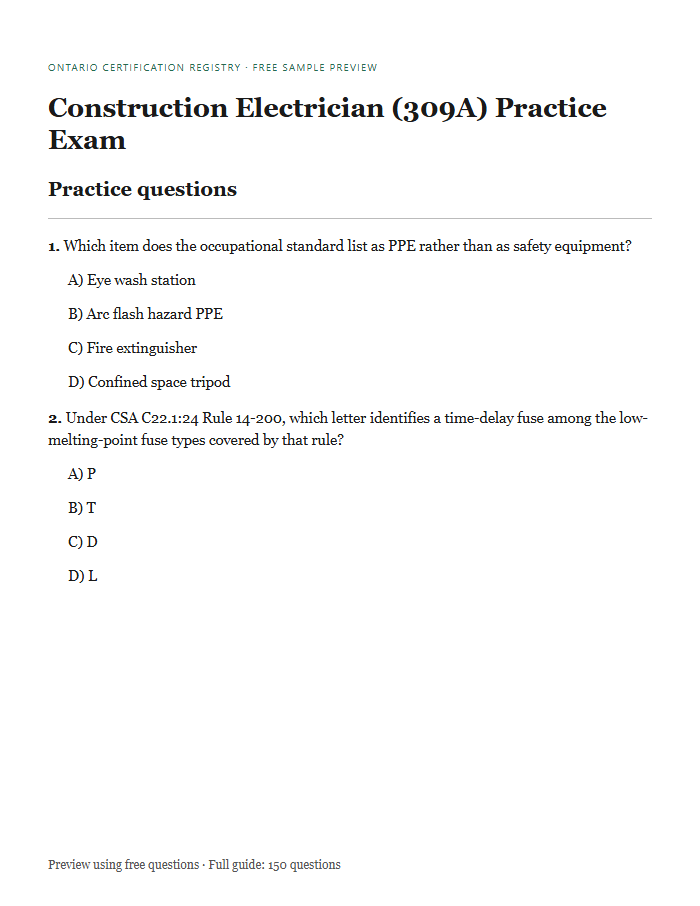
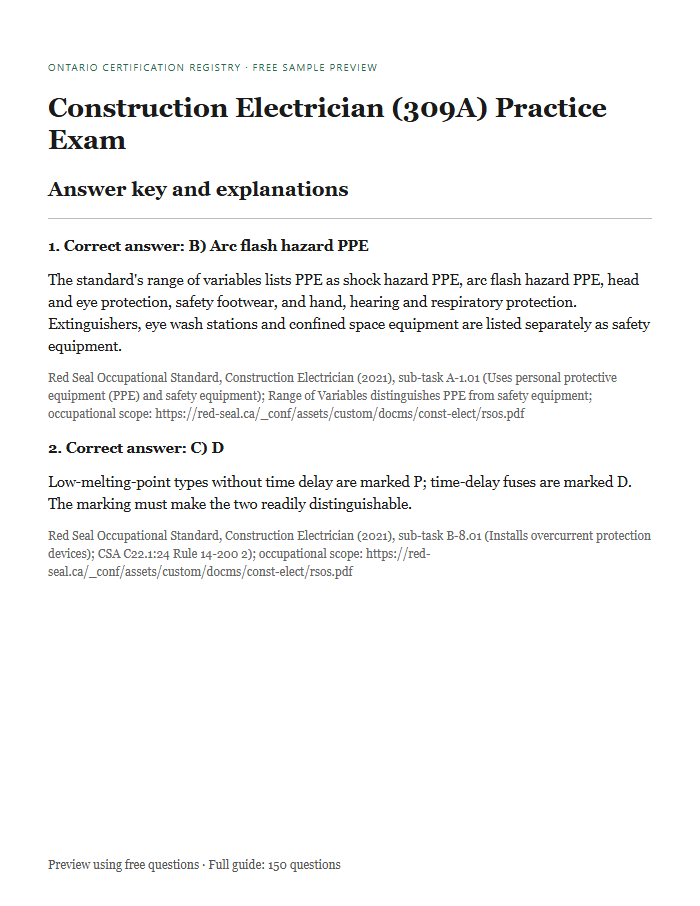
A preview of the question and answer-key layout, using questions from the free sample. The full guide contains all 150 questions.
What this guide covers
This guide scales the published Red Seal major-work-activity distribution to 150 questions, rounded to whole questions. The table shows the actual counts and shares in this guide.
| Major work activity | Questions here | Share of this guide |
|---|---|---|
| A. Performs common occupational skills | 16 | 10.7% |
| B. Installs, services and maintains generating, distribution and service systems | 42 | 28% |
| C. Installs, services and maintains wiring systems | 45 | 30% |
| D. Installs, services and maintains motors and control systems | 32 | 21.3% |
| E. Installs, services and maintains signalling and communication systems | 15 | 10% |
The published official exam has 100 questions. This guide contains 150 original study questions, with topic counts rounded to fit that length.
Coverage source: Published Red Seal exam breakdown
The mix of question types
The table compares this guide's mix with the published Red Seal ranges for this trade.
| Type | Questions here | Share | Published range |
|---|---|---|---|
| Knowledge and recall | 13 | 8.7% | 5 to 15% |
| Procedural and application | 92 | 61.3% | 60 to 70% |
| Critical thinking | 45 | 30% | 20 to 30% |
30 free sample questions from the Electrician - Construction and Maintenance bank
This fixed selection comes straight from the bank and covers every major work activity, with the answers and sources shown. Read them before you decide whether the rest is worth $67.49 to you.
Question 1: Which item does the occupational standard list as PPE rather than as safety equipment?
Sample 1 · Activity A
Which item does the occupational standard list as PPE rather than as safety equipment?
- Eye wash station
- Arc flash hazard PPE (correct)
- Fire extinguisher
- Confined space tripod
The standard's range of variables lists PPE as shock hazard PPE, arc flash hazard PPE, head and eye protection, safety footwear, and hand, hearing and respiratory protection. Extinguishers, eye wash stations and confined space equipment are listed separately as safety equipment.
Red Seal Occupational Standard, Construction Electrician (2021), sub-task A-1.01 (Uses personal protective equipment (PPE) and safety equipment); Range of Variables distinguishes PPE from safety equipment; occupational scope: https://red-seal.ca/_conf/assets/custom/docms/const-elect/rsos.pdf
Question 2: What is the correct sequence for locking out a motor circuit?
Sample 2 · Activity A
What is the correct sequence for locking out a motor circuit?
- Lock and tag, shut down, test for absence of voltage, open the disconnect
- Open the disconnect, test for absence of voltage, begin work, lock and tag
- Shut down, open the disconnect, lock and tag, then test for absence of voltage (correct)
- Shut down, test for absence of voltage, lock and tag, open the disconnect
The disconnect is opened and locked before testing, the test is made at the point of work with a proven instrument, and stored energy such as cable capacitance is discharged before hands go in.
Red Seal Occupational Standard, Construction Electrician (2021), sub-task A-1.03 (Performs lock-out and tag-out procedures); occupational scope: https://red-seal.ca/_conf/assets/custom/docms/const-elect/rsos.pdf
Question 3: What is the correct sequence for an insulation resistance test on a feeder?
Sample 3 · Activity A
What is the correct sequence for an insulation resistance test on a feeder?
- Apply test voltage while energized, record, then isolate and lock out
- Connect the instrument, energize briefly, record, then discharge
- Discharge the conductors, apply test voltage with the disconnect closed, record
- Isolate and lock out, verify dead, disconnect sensitive equipment, then test (correct)
The order protects the operator, the equipment and the reading. Electronics are removed because the test applies high DC voltage, and the conductors are discharged afterwards because the test charges the cable's capacitance.
Red Seal Occupational Standard, Construction Electrician (2021), sub-task A-2.01 (Uses common and specialty tools and equipment); occupational scope: https://red-seal.ca/_conf/assets/custom/docms/const-elect/rsos.pdf
Question 4: Under CSA C22.1:24 Rule 14-200, which letter identifies a time-delay fuse among the low-melting-point fuse types covered by that rule?
Sample 4 · Activity B
Under CSA C22.1:24 Rule 14-200, which letter identifies a time-delay fuse among the low-melting-point fuse types covered by that rule?
- P
- T
- D (correct)
- L
Low-melting-point types without time delay are marked P; time-delay fuses are marked D. The marking must make the two readily distinguishable.
Red Seal Occupational Standard, Construction Electrician (2021), sub-task B-8.01 (Installs overcurrent protection devices); CSA C22.1:24 Rule 14-200 2); occupational scope: https://red-seal.ca/_conf/assets/custom/docms/const-elect/rsos.pdf
Question 5: What is the minimum size of an aluminum grounding conductor under the general rule?
Sample 5 · Activity B
What is the minimum size of an aluminum grounding conductor under the general rule?
- No. 6 AWG
- No. 2 AWG
- No. 8 AWG
- No. 4 AWG (correct)
The general rule sets No. 6 AWG copper and No. 4 AWG aluminum as the floor. Smaller is permitted only where it is not smaller than the current-carrying conductors of the system being grounded.
Red Seal Occupational Standard, Construction Electrician (2021), sub-task B-11.01 (Installs grounding and bonding systems); CSA C22.1:24 Rule 10-114 1) b); occupational scope: https://red-seal.ca/_conf/assets/custom/docms/const-elect/rsos.pdf
Question 6: Which piping systems must be made equipotential with the electrical equipment's non-current-carrying parts?
Sample 6 · Activity B
Which piping systems must be made equipotential with the electrical equipment's non-current-carrying parts?
- Metal water, waste water and gas piping (correct)
- Metal water piping only
- Metal gas piping only
- Metal ventilation ductwork only
The rule names the continuous metal water piping, waste water piping and gas piping systems, among other non-electrical parts, so potential differences a person could bridge are removed.
Red Seal Occupational Standard, Construction Electrician (2021), sub-task B-11.01 (Installs grounding and bonding systems); CSA C22.1:24 Rule 10-700; occupational scope: https://red-seal.ca/_conf/assets/custom/docms/const-elect/rsos.pdf
Question 7: What must be installed in the primary circuit of each power and distribution transformer?
Sample 7 · Activity B
What must be installed in the primary circuit of each power and distribution transformer?
- A surge protective device
- A disconnecting means (correct)
- A ground fault interrupter
- A metering current transformer
The rule is direct: a disconnecting means shall be installed in the primary circuit of each power and distribution transformer.
Red Seal Occupational Standard, Construction Electrician (2021), sub-task B-15.02 (Installs low-voltage single-phase transformers); CSA C22.1:24 Rule 26-248; occupational scope: https://red-seal.ca/_conf/assets/custom/docms/const-elect/rsos.pdf
Question 8: A standby generator holds 600 V steadily but its output frequency sags from 60 Hz to 57 Hz as load is applied. Where is the fault?
Sample 8 · Activity B
A standby generator holds 600 V steadily but its output frequency sags from 60 Hz to 57 Hz as load is applied. Where is the fault?
- In the automatic voltage regulator
- In the generator's field windings
- In the engine or its governor (correct)
- In the load's power factor correction
Frequency follows shaft speed. Voltage holding steady while frequency drops means excitation is fine and the prime mover is the problem: the engine cannot hold speed as load is added.
Red Seal Occupational Standard, Construction Electrician (2021), sub-task B-12.01 (Installs alternating current (AC) generating systems); synchronous machine control; occupational scope: https://red-seal.ca/_conf/assets/custom/docms/const-elect/rsos.pdf
Question 9: What is the line-to-neutral voltage of a 600 V three-phase four-wire wye service?
Sample 9 · Activity B
What is the line-to-neutral voltage of a 600 V three-phase four-wire wye service?
- 600 V
- 300 V
- 208 V
- 347 V (correct)
Line-to-line voltage is the square root of 3 times line-to-neutral. 600 divided by 1.732 is about 347 V, giving the standard Canadian 347/600 V system.
Red Seal Occupational Standard, Construction Electrician (2021), sub-task B-7.02 (Installs three-phase consumer/supply services and metering equipment); wye relationship VL = 1.732 x VLN; occupational scope: https://red-seal.ca/_conf/assets/custom/docms/const-elect/rsos.pdf
Question 10: Which conductor of a 120/240 V single-phase three-wire system is intentionally grounded?
Sample 10 · Activity B
Which conductor of a 120/240 V single-phase three-wire system is intentionally grounded?
- The neutral (correct)
- The higher-voltage leg
- The bonding conductor
- Both ungrounded conductors
In a solidly grounded single-phase three-wire system the neutral is the conductor that is intentionally grounded. Bonding conductors connect non-current-carrying metal, which is a separate function.
Red Seal Occupational Standard, Construction Electrician (2021), sub-task B-7.01 (Installs single-phase consumer/supply services and metering equipment); CSA C22.1:24 Rules 10-206 and 10-208; occupational scope: https://red-seal.ca/_conf/assets/custom/docms/const-elect/rsos.pdf
Question 11: A metering CT primary remains energized. The meter reads normally, but the job requires secondary disconnection and no energized-service procedure is authorized. Which action resolves the unsafe work conditions?
Sample 11 · Activity B
A metering CT primary remains energized. The meter reads normally, but the job requires secondary disconnection and no energized-service procedure is authorized. Which action resolves the unsafe work conditions?
- Proceed after checking the normal meter reading
- Stop; isolate, lock out and verify safety (correct)
- Disconnect the secondary before isolating the primary
- Treat the normal meter reading as proof of isolation
A normal meter reading does not establish isolation. The primary remains energized, and the task has no authorized energized-service procedure. Stop and use the prescribed primary isolation, lockout, residual-energy control and verification procedure before disconnecting the secondary.
CCOHS, Lockout/Tag out, isolation of energy sources, residual-energy control and verification before service. https://www.ccohs.ca/oshanswers/hsprograms/lockout.html
Question 12: Given the following information: Available fault current is 22 kA Proposed breaker interrupting rating is 10 kA What does the Code require?
Sample 12 · Activity B
Given the following information: Available fault current is 22 kA Proposed breaker interrupting rating is 10 kA What does the Code require?
- Nothing further, the ampere rating governs
- A time delay added to the breaker
- A device rated for the available fault current (correct)
- Larger conductors to the panel
Equipment required to interrupt fault current must be rated for the fault current available at its terminals. Interrupting rating and ampere rating are different quantities, and oversizing conductors does not reduce available fault current.
Red Seal Occupational Standard, Construction Electrician (2021), sub-task B-8.01 (Installs overcurrent protection devices); CSA C22.1:24 Rule 14-012; occupational scope: https://red-seal.ca/_conf/assets/custom/docms/const-elect/rsos.pdf
Question 13: Under the general calculation method of Rule 8-102(1), excluding its permitted alternatives, what maximum voltage drop applies to a feeder or branch circuit?
Sample 13 · Activity C
Under the general calculation method of Rule 8-102(1), excluding its permitted alternatives, what maximum voltage drop applies to a feeder or branch circuit?
- 5%
- 2%
- 10%
- 3% (correct)
The limit is 3% in a feeder or branch circuit, and 5% from the supply side of the consumer's service to the point of utilization. The two are commonly confused.
Red Seal Occupational Standard, Construction Electrician (2021), sub-task C-16.01 (Installs conductors and cables); CSA C22.1:24 Rule 8-102 1) a) and b); occupational scope: https://red-seal.ca/_conf/assets/custom/docms/const-elect/rsos.pdf
Question 14: A non-metallic-jacketed cable lacks support near its device box and its conductors are strained. Under the general cable-support rule, what installation defect must be corrected?
Sample 14 · Activity C
A non-metallic-jacketed cable lacks support near its device box and its conductors are strained. Under the general cable-support rule, what installation defect must be corrected?
- The cable was not supported within 300 mm of the box (correct)
- The box was too small for the conductor count
- The connector was the wrong trade size
- The conductors were stripped too long
Rule 12-510(1) specifies support within 300 mm of every box or fitting and at intervals not exceeding 1.5 m, with stated alternatives and exceptions. Verify the connector's cable retention as well; a sound-looking connector alone does not prove proper clamping.
Red Seal Occupational Standard, Construction Electrician (2021), sub-task C-16.04 (Installs boxes and enclosures); CSA C22.1:24 Rule 12-510 1) a) and b); occupational scope: https://red-seal.ca/_conf/assets/custom/docms/const-elect/rsos.pdf
Question 15: Under the general rule, outside the inaccessible stationary-appliance exception, within what distance of a sink, bathtub or shower does a 5-15R receptacle require Class A GFCI protection?
Sample 15 · Activity C
Under the general rule, outside the inaccessible stationary-appliance exception, within what distance of a sink, bathtub or shower does a 5-15R receptacle require Class A GFCI protection?
- 1 m
- 1.5 m (correct)
- 3 m
- 300 mm
The rule sets 1.5 m from sinks that are wash basins complete with a drainpipe, bathtubs or shower stalls, subject to stated exceptions.
Red Seal Occupational Standard, Construction Electrician (2021), sub-task C-17.02 (Installs wiring devices); CSA C22.1:24 Rule 26-704 1); occupational scope: https://red-seal.ca/_conf/assets/custom/docms/const-elect/rsos.pdf
Question 16: A central standby battery must maintain the emergency load at not less than what share of full voltage?
Sample 16 · Activity C
A central standby battery must maintain the emergency load at not less than what share of full voltage?
- 80%
- 75%
- 91% (correct)
- 95%
The rule requires a rechargeable storage battery of sufficient capacity to supply and maintain the emergency circuits at not less than 91% of full voltage for the required time.
Red Seal Occupational Standard, Construction Electrician (2021), sub-task C-20.01 (Installs exit and emergency lighting); CSA C22.1:24 Rule 46-202 1) a); occupational scope: https://red-seal.ca/_conf/assets/custom/docms/const-elect/rsos.pdf
Question 17: What is required of the conductive sheaths and exposed metal of electric heating devices?
Sample 17 · Activity C
What is required of the conductive sheaths and exposed metal of electric heating devices?
- They must be isolated
- They must be insulated
- They must be grounded to a separate electrode
- They must be bonded (correct)
The rule requires the conductive shields, braids, sheaths, coverings and exposed metal surfaces of heating devices to be bonded.
Red Seal Occupational Standard, Construction Electrician (2021), sub-task C-19.01 (Installs electric heating systems); CSA C22.1:24 Rule 62-104 2); occupational scope: https://red-seal.ca/_conf/assets/custom/docms/const-elect/rsos.pdf
Question 18: Single-conductor aluminum-sheathed cables in a large feeder run hot enough to discolour the insulation, though each is loaded below its table ampacity. What is happening?
Sample 18 · Activity C
Single-conductor aluminum-sheathed cables in a large feeder run hot enough to discolour the insulation, though each is loaded below its table ampacity. What is happening?
- Induced sheath currents are adding heat (correct)
- The conductors need an ambient temperature correction
- The sheaths are bonded at one end only
- The feeder's voltage drop exceeds 3%
Single conductors carrying AC induce current in surrounding metal, and a continuous sheath carries it. Where those currents would push insulation past its rating, the Code's remedies include derating the cable to 70% of its rating.
Red Seal Occupational Standard, Construction Electrician (2021), sub-task C-16.03 (Installs raceways); CSA C22.1:24 Rule 4-008 1) a); occupational scope: https://red-seal.ca/_conf/assets/custom/docms/const-elect/rsos.pdf
Question 19: A 120 V branch circuit is assessed under Rule 8-102(1), with none of the permitted alternatives applicable. Its measured voltage drop is 6 V. Does it comply with that branch-circuit limit?
Sample 19 · Activity C
A 120 V branch circuit is assessed under Rule 8-102(1), with none of the permitted alternatives applicable. Its measured voltage drop is 6 V. Does it comply with that branch-circuit limit?
- Yes, 6 V is within the 5% allowance
- No, 6 V is 5% and the limit is 3% (correct)
- Yes, 6 V is exactly at the limit
- No, any measurable drop is a defect
6 V on 120 V is 5%. The 3% figure applies to the feeder or branch circuit, while 5% is the total from the service to the point of utilization, so using 5% in the branch alone is too much.
Red Seal Occupational Standard, Construction Electrician (2021), sub-task C-16.01 (Installs conductors and cables); CSA C22.1:24 Rule 8-102 1); occupational scope: https://red-seal.ca/_conf/assets/custom/docms/const-elect/rsos.pdf
Question 20: Above what input current must a heating fixture or trace heater set be on a branch circuit supplying no other equipment?
Sample 20 · Activity C
Above what input current must a heating fixture or trace heater set be on a branch circuit supplying no other equipment?
- 20 A
- 15 A
- 30 A (correct)
- 40 A
A heating fixture, trace heater set or heating panel set with an input of more than 30 A must be supplied by a branch circuit that supplies no other equipment.
Red Seal Occupational Standard, Construction Electrician (2021), sub-task C-19.01 (Installs electric heating systems); CSA C22.1:24 Rule 62-114 1); occupational scope: https://red-seal.ca/_conf/assets/custom/docms/const-elect/rsos.pdf
Question 21: Under the fallback method in Rule 8-102(1), a branch circuit has a 40 A protecting device and unknown connected load. What current is used to calculate voltage drop?
Sample 21 · Activity C
Under the fallback method in Rule 8-102(1), a branch circuit has a 40 A protecting device and unknown connected load. What current is used to calculate voltage drop?
- 40 A
- 50 A
- 20 A
- 32 A (correct)
The rule bases voltage drop on connected load where known, otherwise on 80% of the rating of the protecting device. 80% of 40 A is 32 A.
Red Seal Occupational Standard, Construction Electrician (2021), sub-task C-16.01 (Installs conductors and cables); CSA C22.1:24 Rule 8-102 1); occupational scope: https://red-seal.ca/_conf/assets/custom/docms/const-elect/rsos.pdf
Question 22: For a motor marked with service factor 1.15, what maximum percentage of full-load current is used for overload-device selection or trip setting under Rule 28-306(1)?
Sample 22 · Activity D
For a motor marked with service factor 1.15, what maximum percentage of full-load current is used for overload-device selection or trip setting under Rule 28-306(1)?
- 125% (correct)
- 115%
- 100%
- 140%
Rule 28-306(1)(a) gives 125% for a marked service factor of 1.15 or greater. The 115% provision applies where no service factor is marked or it is less than 1.15. This is a selection/setting limit; the device's time-current characteristic governs actual operation.
Red Seal Occupational Standard, Construction Electrician (2021), sub-task D-22.01 (Installs motor starters); CSA C22.1:24 Rule 28-306 1) a); occupational scope: https://red-seal.ca/_conf/assets/custom/docms/const-elect/rsos.pdf
Question 23: What minimum percentage of a continuous-duty motor's full load current must its branch circuit conductors carry?
Sample 23 · Activity D
What minimum percentage of a continuous-duty motor's full load current must its branch circuit conductors carry?
- 100%
- 125% (correct)
- 115%
- 150%
Conductors of a branch circuit supplying a continuous-duty motor must have an ampacity of not less than 125% of full load current.
Red Seal Occupational Standard, Construction Electrician (2021), sub-task D-22.01 (Installs motor starters); CSA C22.1:24 Rule 28-106 1); occupational scope: https://red-seal.ca/_conf/assets/custom/docms/const-elect/rsos.pdf
Question 24: A drive is switched off, locked out and verified dead at its supply terminals. A technician opening it minutes later still receives a shock inside. Why?
Sample 24 · Activity D
A drive is switched off, locked out and verified dead at its supply terminals. A technician opening it minutes later still receives a shock inside. Why?
- The motor was back-feeding through its windings
- The lock-out was applied to the wrong disconnect
- The DC bus capacitors were still holding charge (correct)
- The instrument was not rated for DC
A drive rectifies incoming AC onto a DC bus with substantial capacitance, and that bus holds charge after the supply is removed. Manufacturers specify a wait time and a bus voltage check before the enclosure is opened; testing at the supply terminals proves nothing about the bus.
Red Seal Occupational Standard, Construction Electrician (2021), sub-task D-23.01 (Installs AC drives); occupational scope: https://red-seal.ca/_conf/assets/custom/docms/const-elect/rsos.pdf
Question 25: Given the following information: Continuous-duty motor Full load current 28 A What minimum conductor ampacity is required?
Sample 25 · Activity D
Given the following information: Continuous-duty motor Full load current 28 A What minimum conductor ampacity is required?
- 28 A
- 45 A
- 31 A
- 35 A (correct)
125% of 28 A is 35 A. The conductor is then selected from the ampacity tables for that value and the installation conditions.
Red Seal Occupational Standard, Construction Electrician (2021), sub-task D-22.01 (Installs motor starters); CSA C22.1:24 Rule 28-106 1); occupational scope: https://red-seal.ca/_conf/assets/custom/docms/const-elect/rsos.pdf
Question 26: Given the following information: Motor full load current 20 A Marked service factor 1.15 What maximum current setting applies under Rule 28-306(1)?
Sample 26 · Activity D
Given the following information: Motor full load current 20 A Marked service factor 1.15 What maximum current setting applies under Rule 28-306(1)?
- 25 A (correct)
- 23 A
- 20 A
- 28 A
Apply the stated Rule 28-306(1) selection/setting limit of 125% to the supplied 20 A full-load current. This gives 25 A. Actual trip time follows the overload device's specified characteristic.
Red Seal Occupational Standard, Construction Electrician (2021), sub-task D-22.01 (Installs motor starters); CSA C22.1:24 Rule 28-306 1) a); occupational scope: https://red-seal.ca/_conf/assets/custom/docms/const-elect/rsos.pdf
Question 27: Given the following information: Motor full load current 20 A No service factor marked What maximum current setting applies under Rule 28-306(1)?
Sample 27 · Activity D
Given the following information: Motor full load current 20 A No service factor marked What maximum current setting applies under Rule 28-306(1)?
- 25 A
- 23 A (correct)
- 20 A
- 30 A
Apply the stated Rule 28-306(1) selection/setting limit of 115% to the supplied 20 A full-load current. This gives 23 A. Actual trip time follows the overload device's specified characteristic.
Red Seal Occupational Standard, Construction Electrician (2021), sub-task D-22.01 (Installs motor starters); CSA C22.1:24 Rule 28-306 1) b); occupational scope: https://red-seal.ca/_conf/assets/custom/docms/const-elect/rsos.pdf
Question 28: How must a fire alarm system's power supply be provided?
Sample 28 · Activity E
How must a fire alarm system's power supply be provided?
- From the nearest lighting circuit
- By a separate circuit (correct)
- Through a ground fault interrupter
- From the emergency lighting circuit
A separate circuit means the fire alarm supply cannot be lost because an unrelated load tripped. Where a system has more than one control unit or transponder, the Code addresses how each is supplied.
Red Seal Occupational Standard, Construction Electrician (2021), sub-task E-26.01 (Installs fire alarm systems); CSA C22.1:24 Rule 32-108 1); occupational scope: https://red-seal.ca/_conf/assets/custom/docms/const-elect/rsos.pdf
Question 29: Electrical non-metallic tubing may carry fire alarm conductors only where embedded in at least what depth of masonry or concrete?
Sample 29 · Activity E
Electrical non-metallic tubing may carry fire alarm conductors only where embedded in at least what depth of masonry or concrete?
- 25 mm
- 75 mm
- 50 mm (correct)
- 100 mm
The rule permits electrical non-metallic tubing where embedded in at least 50 mm of masonry or poured concrete, which gives it the protection the other permitted methods provide on their own.
Red Seal Occupational Standard, Construction Electrician (2021), sub-task E-26.01 (Installs fire alarm systems); CSA C22.1:24 Rule 32-102 1) d); occupational scope: https://red-seal.ca/_conf/assets/custom/docms/const-elect/rsos.pdf
Question 30: How are the incoming and outgoing conductors connected at a fire alarm device's dual terminals?
Sample 30 · Activity E
How are the incoming and outgoing conductors connected at a fire alarm device's dual terminals?
- Twisted together under one terminal
- Spliced ahead of the device
- One terminal used, one left spare
- Independently, each to its own terminal (correct)
Independent termination is what makes the circuit supervised. Joined under one screw, removing the device would not break continuity and the panel could not detect the fault.
Red Seal Occupational Standard, Construction Electrician (2021), sub-task E-26.01 (Installs fire alarm systems); CSA C22.1:24 Rule 32-106; occupational scope: https://red-seal.ca/_conf/assets/custom/docms/const-elect/rsos.pdf
Before you buy
- These questions use the cited occupational standards, curriculum and technical references. Nothing here is reproduced from a real exam.
- Passing this does not guarantee passing the certifying exam, and nothing here is a substitute for the training standard or your in-school hours.
- It is a PDF. There is no login, no expiry and no subscription, and you can print it.
- Automated structure and distribution checks are complete. Technical accuracy review by a licensed tradesperson remains outstanding.
Questions about your purchase or a missing PDF? Contact Blue Crane Works with the email used at checkout. The download link lasts 30 days; your saved PDF does not expire.
When you are ready for the real exam
You book the 309A certifying exam yourself in the Skilled Trades Ontario Portal ($150 plus HST) and write it at one of 24 exam centres, or at your college in your final level of school. How to book it and find the nearest centre.
Writing in Alberta, BC or Manitoba? Same Red Seal exam
The Construction Electrician exam is the national Red Seal exam, so this practice exam fits writers in other provinces too, wherever the trade carries the Red Seal. Trade names differ by province.
Where the exam facts on this page come from
The study distribution follows the cited occupational or curriculum reference. The regulation and issuing authority explain the actual credential and examination requirements.
The free reference material for this trade
Everything about the certification itself, the classification, the hours, the ratio and the official sources, stays free on this site and always will. The practice exam is the only thing here that costs anything.